Romanian Communists in the French Resistance
The generation who fought against Fascism strongly believed in the ideals of socialism and communism.
Steliu Lambru, 23.06.2014, 10:03
The generation of people who fought against Fascism strongly believed in the lofty ideals of socialism and communism. Some of those ideals even had the support of decent people, who found racism outrageous. Fascist aggression throughout Europe was a strong enough reason for young left-of-center militants to mobilize against the worst evil history had ever imagined. According to internationalist Marxist-Leninist doctrine, Fascism was nothing else but the embodiment of capitalism’s most evil spirit, namely nationalism.
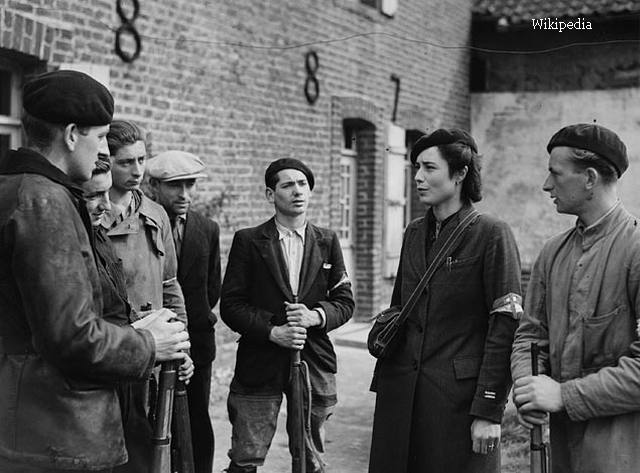
For Romanian communists, the occupation of France was the sign it was high time they did something about it. Renowned Romanian-born historian Vladimir Tismaneanu, a University of Maryland professor in the United States, was born into a family with strong Marxist roots. Both parents had fought in the Spanish Civil War, where his father lost an arm in action. Vladimir Tismaneanu’s aunt used to be active in the French Resistance, and even received the highest decoration. Vladimir Tismaneanu recalled an episode of the journey his mother made to Spain in 1936, when she joined the International Brigades as a volunteer. It was the birth of the Romanian anti-Fascist resistance in the Second World War.
Vladimir Tismaneanu: “Via France, mother headed for Spain. It was the policy of non-intervention that practically banned people from straight out joining the International Brigades in Spain. Those people’s route took them through Italy, and that’s how my father got there, or through France. Mother arrived in France, in Paris, which was the hub where the French Communist Party’s Foreign Bureau had its headquarters. At that time mother was rather naive, and let me just recall a telling episode. She set foot in Paris, where she stayed for a month, she was given a room, and she got her training. The most important man in the movement in Paris was Palmiro Togliatti, who was a representative of the Spain — Moscow — Paris axis. My mother took the train to Perpignan, and in her naiveté she saw no problem in buying a newspaper to read on the train. Imagine what newspaper she bought? Officially she was traveling as an art history student to visit monasteries. And she bought L’Humanite. It was her first big mistake, since she was traveling to Spain, speaking with a foreign accent and besides, she bought L’Humanite. There was only one person in the compartment with her, and at the end of their journey, as they were getting off, the man told her, ‘You’re going to Spain to join the International Brigades.’ She denied it, but the man told her, ‘Girl, if you do that again, make sure you don’t buy L’Humanite the next time. You just don’t strut around reading the French Communist Party’s official newspaper.’ The man was the communist elected official of the region.”
Internationalism was the issue that caused most of the Romanian resistance fighters from France choose a side. Here is Vladimir Tismaneanu again:
Vladimir Tismaneanu: “Worth mentioning here is the definition Stalin gave to proletarian internationalism. By definition, Marxism was an internationalist doctrine. Nationalism and Marxism are not complementary. If you’re an honest nationalist, you cannot be a Marxist, and if you are a Marxist, you cannot be a nationalist. Things are very clear in this respect. There were all sorts of alloys and alliances, that’s another kettle of fish, it’s precisely that which needs explaining. Stalin gave the definition of proletarian internationalism, the famous litmus test. The litmus test for proletarian internationalism, Stalin used to say in 1927, and that was still valid until the Soviet-Chinese conflict, was the attitude towards the Soviet Union. No one was a genuine internationalist if they questioned the validity of the Soviet Bolshevik party.“
Olga Bancic, Cristina Luca, Mihail Florescu, Gheorghe Gaston Marin and Alexandru Jar were among some of the most active personalities of Romanian communist diaspora in France. However, there were other anti-Fascist intellectuals who took up that line. One such important person was pilot and inventor Traian Vuia. We also wanted to find out from Vladimir Tismaneanu if Traian Vuia had any ties with the French Resistance and the Romanian communists in France.
Vladimir Tismaneanu: ”I know those ties were very strong, I know that from my aunt, I also know they met several times. Also, there was a strong connection with Elena Vacarescu, she was responsible for that connection, through writer Ilarie Voronca. The same thing happened with Elvira Popescu. We cannot deny that prominent Romanian intellectuals were leftists, and there’s another name that comes to mind, that of ballerina Lisette Codreanu, Brancusi’s friend. That was a discrepancy: intellectuals in Romania did not have any leftist leanings, yet when they arrived in Paris, they all became leftists. All of them were either leaning towards the socialist left or the communist left. Vuia had never been a communist in any way, as far as I know, but he had ties with them, he gave them money, shelter and connections in villages, he had a holiday house which was used by the Resistance. It was that kind of connections which in northern France could lead to many complications. When De Gaulle removed the communists from the government in 1946, when Thorez was a minister, the Cold War began. In 1948 and 1949, communists faced large-scale expulsion from France, and that’s when Mihai Sora returned, for instance. Some of them hadn’t managed to become French citizens.”
Once Fascism was destroyed, those who had believed in a better world heaved a sigh of relief. They got the feeling socialism would bring salvation to mankind, and would also put an end to all suffering. But the course history took was quite different.