The Soviet Bloc’s Stalin Cities in the post-war era
Shortly after 1945, the Soviet Union occupied had half of Europe, it imposed its own political economic and social model
Steliu Lambru, 14.10.2019, 11:25
The Soviet Union
was the winning side against Nazi Germany in World War Two. Immediately after
1945, the Soviet Union occupied half of Europe and imposed its own political
economic and social model. An inherent part of such a model was the cult of the
supreme commander, Iosif Vissarionovici Djugaşvili or Stalin.
According to the
communist propaganda, the love for Stalin had to be boundless: from commoners
to grandiose projects or even cities, the name of Stalin was everywhere.
Communist leaderships in Albania, Bulgaria, former Czechoslovakia, the then
German Democratic Republic, Poland, Romania and Hungary named some of their
major cities after Stalin, the great leader according to the Soviet
propaganda. With such an honor were received other communist leaders as well.
In 1953, in the
former German Democratic Republic, the city of Chemnitz became Karl Marx Stadt.
In former Yugoslavia, where there was no Stalin City, Montenegro’s capital
Podgorica, became Titograd, from 1946 to 1992, after the name of communist
leader Iosip Broz Tito. In Romania, the town of Onesti became Gheorghe
Gheorghiu-Dej, while the town of Stei became Dr Petru Groza. We recall Gheorghe
Gheorghiu-Dej and Petru Groza were two prominent Romanian communist leaders.
Nicolae Pepene
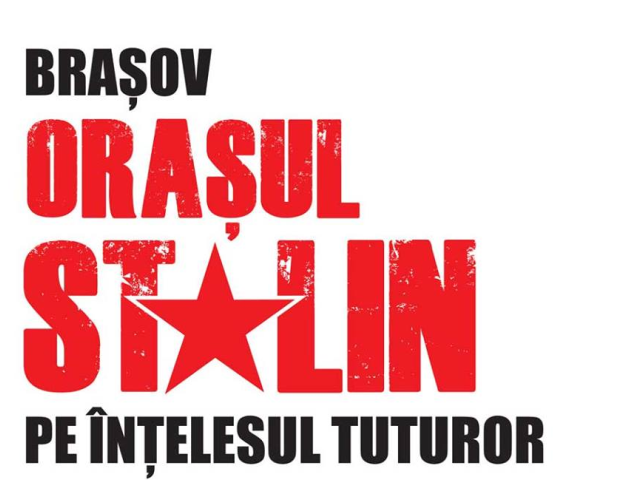
is the director of Brasov County History Museum. In 2017, the year when the
centennial of the Bolshevik Revolution was marked, he initiated the Stalin
Cities, a project for which he received financing from the European Union. We
asked him why Brasov became Stalin City.
Nicolae Pepene: There is a formal explanation we find in the publications of that
time namely that the rail workers decided to honour their friendship with the
great leader, his concern for the Romanian people, for the workers, by changing
the name of the city. Why rail workers? Somehow it was the connection with the
great national leader Gheorghiu-Dej, who used to be a rail worker. Everything
was part of the propaganda machine of the time. The name was changed around
August 23rd 1950, a symbolical date for the communist regime.
Unfortunately, there were no unofficial records about the event. We can imagine
it was a gesture of servitude towards the local authorities as the ties with
the Soviet Union were quite strong. A monument of the Soviet soldier was built
in the city’s central park in 1949 and there was also a house of the
Romanian-Soviet friendship in Brasov, central Romania. Writers from the Soviet
Union used to come to Romania, and there were exchanges of workers and teachers
as well. The city of Brasov was the spearhead of the propaganda machine because
it had a strong community of workers. Although affected by the allied
bombardments, most of the factories in Brasov remained operational and upon
their coming to power, the communists pumped massive investment into the region.
Some local historians believe there was also a move to humiliate the
Transylvanian Saxons living in the region, as the city used to have a
significant Saxon minority back then.
The propaganda
agents were so hell-bent on making the city’s new name known to everyone that
they ordered a large number of fir-trees on Tampa mountain cut down, so that
the name could become visible from any angle. The map of Stalin cities was
stretching from the Soviet Union to Central Europe and no country from behind
the Iron Curtain could escape the trend. Here is Nicolae Pepene again at the
microphone.
Nicolae Pepene: Of course things started off in the Soviet Union, because they created
the pattern. Volgograd became Stalingrad. The city of Donetsk became Stalino
and after the Soviet occupation of Central and Eastern Europe, they exported
this propaganda pattern. The Bulgarian city of Varna became a Stalin city
in 1949, at a time when Varna was Bulgaria’s second largest city. Next came
Poland, which renamed Katowice in 1953, shortly after the dictator’s death.
However, the Poles came back to the city’s real name three years later. Another
city which was named after Stalin’s name was Stalinvaros, a workers’ city built
from scratch in Hungary, which is now called Dunajvaros and is presently
Hungary’s most important metallurgic center. The Albanians didn’t choose a big
city, but a small one previously called Kutzova, south of capital Tirana. The
Democratic Republic of Germany also had a Stalin city, formerly known as Eisenhuttenstadt,
which was also a steel city. Interestingly, Czechoslovakia didn’t have an
entire city named after the Soviet dictator, but only major districts in
various cities. A major district in Prague was named after Stalin and so was a
district in Ostrava.
Stalin cities
returned to their first names according to the political situation in their
countries. Katowice and Varna got back their original names in 1956 and Brasov
in 1960. They were followed by Eisenhuttenstadt and Dunaujvaros in 1961 and so
did Volgograd and Donetsk. Kutzova, in Albania, was the last to scrap its
Soviet name back in 1991.