Radio Bessarabia
Radio Romania has been a national project right from the start
Steliu Lambru, 21.10.2019, 14:20
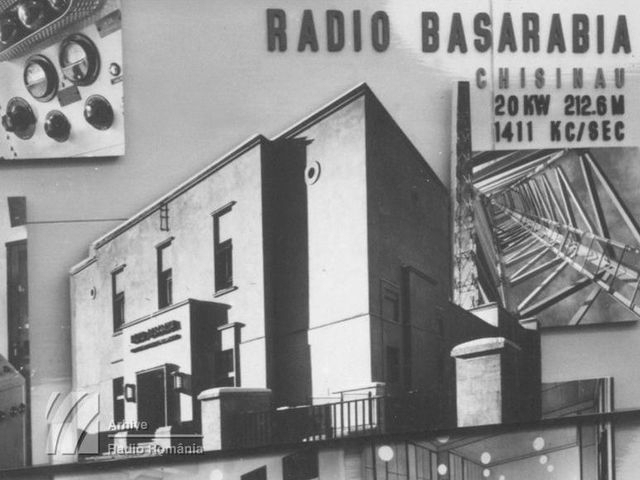
Radio Romania has been a national project right from the start. It was part of the effort to educate and inform people that were to be part of the new Romanian society. Coverage of the entire territory was an integral part of the strategy to consolidate the Romanian state after territories with predominant Romanian population emerged from multinational empires and united with the Kingdom of Romania in 1918. In addition to the central station in Bucharest, which was inaugurated on November 1, 1928, regional, or territorial, stations were created in Cluj, Iasi, and Chisinau, which was then part of Romania. The territorial station in Chisinau, the regional seat of Bessarabia, was meant to combat anti-Romanian propaganda carried out the Soviet station of Radio Tiraspol, over the Dnestr, which started broadcasting in 1930. Chisinau was the first territorial station for the Romanian Broadcasting Corporation, because reception was quite poor over there. Its schedule was similar to that of the central station, plus a few hours of local interest programming over the week. The Board of Administrators of the corporation, in its meeting on October 29, 1937, approved the creation of the Chisinau branch, dubbed Radio Bessarabia, which would broadcast in the 291.2 meter band, with a nominal power of 20 kW.
In the 1930s, Gheorghe Crisbasanu was a technician with Radio Romania, and was working on assembling the broadcast equipment in Chisinau. In a 1997 interview with the Radio Romania Oral History Center, he recalled the work they were doing back then:
“The 20 kW station was taken apart and carried to Chisinau. It was two days on the road for us. The first day we went to Bacau, then the second day we went to Iasi, where we stopped to get the equipment onto the trucks and wait for refueling. There were four ton trucks, International, Ford, Plymouth, and Dodge, because the RBC only had American vehicles. Then we went to Chisinau, we unloaded the equipment, and the lads got to assembling, the building was ready to have the antenna set on top. We were two to a truck, plus two sedans. In one of them we had General Director Lulu Ionescu and Technical Director Lohan. After we finished the assembly, they went to Bucharest and we, the technical crew, stayed behind to run things.”
As work was going on, the October 1, 1938 issue of Radio Universe magazine announced: “Starting on January 1, 1939, radio listeners from Bessarabia will be able to hear Romanian language and song without needing bulky equipment, but easily affordable, small sized units. The Chisinau broadcast tower is ready, and it is a point of pride for the locals. Technical installation is almost done, as well as the studio in the center of Chisinau, on Pushkin Street.”
Radio Bessarabia started broadcasting on October 8, 1939, and Radio Universe announced with pride on November 2, 1939: “Since the station went on the air in Chisinau, we have seen a sizable increase in the number of subscriptions in Bessarabia and Moldova. They are, of course, the portable size or the one or two lamp receiver owners that can now get Romanian broadcasts loud and clear on their minuscule receivers.”
Unfortunately, Radio Bessarabia would be suddenly silenced right the following year. After the ultimatum given to Romania in June 1940, the USSR occupied Bessarabia, the Romanian territory between the Prut and the Dnestr. The losses that Romania incurred then were the radio station and its crew. 90,000 subscribers were lost, and 150 million lei of the total budget of 300 million lei, a 50% loss. In June 1941, Romania took Bessarabia back. The NKVDs so-called destruction battalions had the mission to raze to the ground several major buildings, which could not be evacuated. On 25 June 1941, Radio Bessarabias building became one of them. To top it all off, the Soviets shot the crew there without a trial, deeming them traitors and agents of Romanian imperialism. Their bodies were later found in an abandoned well. Gheorghe Crisbasanu recalls what he found when he went back to Radio Bessarabia after the 1941 liberation:
“When the war broke out, I was in the 1st Armored Division, A company, and we occupied Chisinau. After we finished that, the next day I took two riflemen with me and went to the radio station. We could see one of the pylons, the other one had been blown up, and a single pylon was left, which we could see from the hill where we were. I left on foot to get there, and we found the station had been blown up, but not entirely. I sent word to the director general of RBC by a motorcycle courier who was going to Bucharest, to General Quarters, to come with cars and get back whatever was left. About four days later we went to see what was going on. The Director General, Ionescu, had come with four trucks and two cars with all the people he needed. I went back to my barracks and after that left in pursuit of the Russians, to Odessa.”
After 1941, Radio Bessarabia could not be restored, and its mission was taken over by Radio Iasi. After December 2011, RBC is represented in Bessarabia by Radio Chisinau.