Medieval Romanian rulers and their age
A fresh perspective on Stephen the Great's reign of Moldavia
Steliu Lambru, 20.06.2022, 14:00
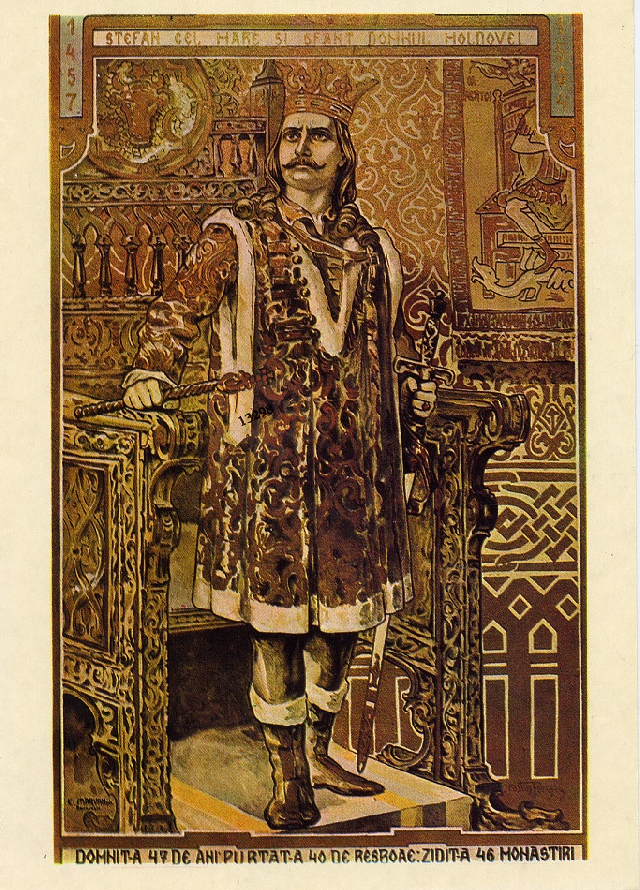
Stephen
the Great was the most important ruling prince in the history of Moldavia. Stephen
the Great ruled Moldavia for 47 years, between the second half of the 15th
century and the early 16th century, actually between 1457 and 1504. It
was a most remarkable feat in itself, not only because of its duration, at a
time when instability was rampant, but also because of the management of power.
Stephen the Great knew how to play an intelligent game between Hungary and
Poland, then the regional powers, and the Ottoman Empire, in turn being their
ally and their opponent.
The Romanian historians of the Romantic period in the 19th
century created a heroic image of Stephen the Great, as well as an image of a
powerful and thriving Moldavia. However, even during such an auspicious reign as
that of Stephen the Great, the principality of Moldavia still lay at the periphery
of European civilization. If we look into the external and internal documents
of that time, we can see Moldavia was a marginal territory, with people living
on limited means and with a high degree of insecurity. Historian and archeologist
Adrian Andrei Rusu is the author of the most recent work on Stephen the Great’s
ruling period. Rusu focuses on the material civilization of Moldavia in the
second half of the 15th century. The historian is set to bust the exaggerations of
historians of the Romantic period as well as the archaeological errors. Historian
Ovidiu Cristea is affiliated to the Nicolae Iorga Institute of History. Dr
Cristea told us the discrepancy between what the authors of the documents say
and the historians is caused by the difficulty to tailor the language and the
content of the past to suit the demands of the present.
Ovidiu Cristea:
I am quoting one of
professor Rusu’s tenets: the medieval reality could not have been covered by
the dictionaries of the chancellery language. And at this point, a very good
example was provided by Umberto Eco. Examining Marco Polo’s text,
Eco used to say Marco Polo mentioned some sort of unicorn because, to the best
of his knowledge at that time, what he had seen, and which was in fact a
rhinoceros, could not possibly have been expressed through an appropriate word.
Using his knowledge of the medieval bestiary, Polo spoke about a unicorn
instead of of mentioning a rhinoceros. And that can also happen when we run
into apparently unusual objects, whose usefulness is unbeknownst to us.
Historian Adrian Rusu said that in his most recent research nhe focused,
among other things, on as detailed as possible descriptions of daily life, in a
bid to make the Moldavian world at the time of Stephen the Great accessible to contemporary
readership. A case in point was the recast of the residence where Stephen the Great
used to live, which was something that had never been done before.
Dr Adrian Adrei Rusu:
I had to go over
the entire archaeological and architectural information for a second time
around and prove that in his Suceava castle, Stephen had princely suites. He
had an assembly hall with a gothic vault, with very beautiful keys and, come to
think of it, the Moldavian rulers even had a bathroom, a cold-water bathroom
and a hot-water bathroom. There also was a garden, which was absolutely normal
for all neighboring princely and royal courts. It was hard to imagine for those ruling princes, especially for
Stephen the Great, who had a long-lasting and unswerving reign, which was
strongly built into all sectors of civilization, to be deprived of something which,
in his time, simply went with the territory.
As for the dynamism of the economic activity in Moldavia, historian
Adrian Rusu expressed his skepticism.
We’re speaking about the great trade route,
crossing Moldavia from north to south, but shipment was only made of
pepper and silks, and that could not be a driving force for civilization. Very
few people got rich doing that kind of trade. Other people got rich, the Saxons
in Transylvania, Brasov and Bistritsa got rich, in Moldavia they were selling
nails, hammers, hacksaws, timber, textile, all that the ordinary people of that
time needed. All those products, in fact, pushed society forward. There also
was a come-and-go movement of craftsmen, they did not settle in Moldavia.
They came and worked seasonally, yet they worked constantly because Stephen the
Great offered them an inflow of construction yards, he guaranteed their payment
and that is how that string or architectural foundations came into being and
which also began to perform stylistically.
Under the circumstances, how was it possible for Stephen the Great’s
reign to be that long? Here is historian Adrian Rusu once again, attempting an
explanation.
Clearly it is all about his personal qualities. The man understood
his time, and understood his competitors. It was all clear that one year after
the next during his reign, he was threatened by the rivals who could turn up in
droves from everywhere. He was capable of knowing his country, his was a
governance solution he inherited from John Hunyadi. If you want to know your
country, you need to go places all the time so that people can see you. It wasn’t
written anywhere, but everyone could tell it was a princely suite coming. There were
signs of display of the princely authority we were not that much aware of: how exactly
the ruling prince showed up before his country ? .
In 2006,
as part of the Great Romanians contest, Stephen the Great was voted the greatest
Romanian ever to have existed. Yet about the voivode and his age, we need to
know all about that using a language
which remains a language of the past but which always needs to be adapted to
the present.
(EN)