The Paradoxes of Diminishing Poverty in Romania
10 years after Romania joined the EU, the country made significant progress in addressing poverty.
Christine Leșcu, 08.08.2017, 12:49
10 years after Romania joined the EU, the country made significant progress in addressing poverty. In 2007, 47% of Romanians lived under the poverty threshold, but in 2015, that figure went down to 37%. These figures are calculated based on a statistical index called AROPE, measuring both annual income and assets. This means that, in the last few years, more Romanians could afford appliances, mobile phones, as well as eating meat every other day, or go on vacation once a year. The Romanian branch of the Friedrich Stiftung Foundation, with its Social Monitor project, analysed the data gathered since the EU accession, and drew conclusions regarding poverty. Victoria Stoicioiu shared them with us:
Victoria Stoicioiu: “You can see with the naked eye that more people today own mobile phones and colour TVs than in 2007. These goods went down in price, and contracting a loan is much easier. So, if we look at this index, we can see that poverty went down significantly between 2007 and 2015. Romanians are doing better.”
However, the Social Monitor revealed a paradox as well: while Romanians overall are faring better, for some it has been getting worse. If we look at income alone, the money that people have on hand, we can see that poverty has actually been on the rise. More to the point, there was a rise in people with incomes below 60% of the national average. In 2015, the figure reached 25% of the population, from 18% in 2007. Victoria Stoicioiu goes into detail:
Victoria Stoicioiu: “The poorest 10% of Romanians live in rural communities, and they are generally people who make a living practicing subsistence agriculture. No progress has been registered in this respect. In 2007, the poorest 10% of Romanians were making 556 Euro annually. I am talking about income, not salary, income that can be obtained by selling homemade products, such as eggs and cheese, etc. In 2015, the incomes of the poorest reached 714 Euro per year, which is insignificant. Approximately 2 million Romanians live on 714 Euro annual incomes.”
Iulian Angheluta is the head of Free Miorita Foundation, and he talked to us about poverty in mountain areas. The foundation took on a difficult issue: to bring electricity to Romanian villages that have none. There are many such areas in Romania still, and the most affected in this respect are the most isolated areas, villages and homesteads in the mountains. He described for us the living conditions there:
Iulian Angheluta: “They have unpaved roads, and water sources are mostly mountain springs. There is no electricity. In most areas of the Apuseni Mountains, in the mountain parts of the counties of Hunedoara, Maramures and Bistrita Nasaud, there is no wiring for electricity. There are plans, and the so-called feasibility studies. In addition, in many of those places they dont have the minimum necessary elements for a civilized life, such as a school or a clinic. They practice subsistence farming. Most people have a few animals in their yard, mostly cows and sheep. The forest is a source of firewood, as well as mushrooms and berries.”
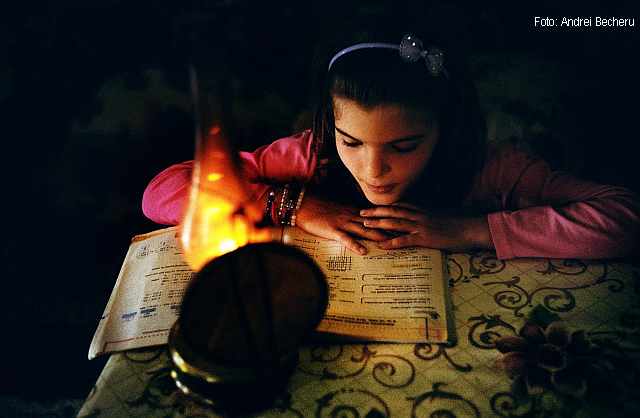
For these people, electricity would provide a minimum of comfortable living, but would also bring them out of isolation. Iulian Angheluta and his Free Miorita colleagues have provided a few isolated communities with solar panels, thinking first and foremost of the children in those communities:
Iulian Angheluta: “Any household needs people who can work. Whether we like it or not, children are workhands. They take the sheep to pasture up in the mountains, or help their parents in various other ways. Their life is hard. Education is relegated to the background. Which is why I think electricity is very important. It is very important for children when they want to do homework, but also when they want to get informed and educated. They would have access to radio and telephone services, including for accessing emergency services, such as ambulances.”
The situation of children and young people compared to that of older people is one of the paradoxes that emerge out of the analysis of poverty, according to Victoria Stoicioiu, representing the Friedrich Stiftung Foundation:
Victoria Stoicioiu: “While Romania has made progress when it comes to reducing poverty and social exclusion among the elderly, progress has been more modest among young people. Poverty went down by only 6% between 2007 and 2015 for the people below 16 years of age. The pace has accelerated a lot. A possible explanation is that in 2009, the government passed a measure that contributed decisively to reducing poverty among the elderly: introducing the minimum social pension. At this point it is a mere 415 lei. And although 400 lei cannot provide a decent living, it is much better than it was before.”
Civil society is trying to fill the gap left open by the lack of social protection policies. For instance, Free Miorita has provided 78 households in 15 counties with solar panels. In the last year, they also provided electricity to four schools and two churches.
(translated by: Calin Cotoiu)