How can we support rural education?
Putting an end to school dropout, though an emergency for Romanian education, has not seen any progress in the past years
Christine Leșcu, 01.11.2017, 10:35
Putting an end
to school dropout, though an emergency for Romanian education, has not seen any
progress in the past years. Quite the opposite, EU statistics show a growing
number of students are leaving the system, at a rate which in 2016 stood at
18.5%, higher than in the previous years. The worst situation is in the
countryside, where children abandon school in larger numbers than in cities.
The gaps between the rural and the urban areas have also been highlighted in a
study titled Investing in rural education, launched this autumn by World
Vision Romania.
Gabriela Onofrei, one of the foundation’s managers told us more
about this situation:
Data
provided by the Education Ministry show that there is a 24% gap between the
rates of participation in the education process in rural and urban areas
respectively. One out of ten schools in the rural environment does not manage
to see all its pupils graduating to the fifth grade, and half of them lose most
of their students after 8 grades. The highest school dropout rate is registered
in high schools, with only less than a quarter of them not being faced with
this problem. Some 40% of the pupils who drop school after graduating from the
eighth grade remain in their communities and work for their families.
Unfortunately,
rural education is faced with other, equally big problems. For instance, a
comparison between the results of the 2017 national evaluation, an examination
that all 8-grade graduates must take before joining high-school, show that the
average performance level in rural areas is lower than in the urban areas. In
fact, this is exactly when problems get worse, right before high-school. The
drop-out rate grows dramatically because high-schools in rural areas, which are
significantly less, are also located far from student’s homes.
Here is Gabriela
Onofrei again:
It’s
quite difficult for a child who lives in a rural area to get to high-school,
and the study also covers the situation in which children must take a very long
and difficult road in order to get to school. More than 18% of the respondents
have said that school is too far, and the average duration of a trip is 90
minutes. There are also significant differences between the children’s school
performance, and the number of those who get grades before 5 is three times
bigger in rural areas than in the urban ones. Also, the number of average
grades above 8 is 20% higher in urban areas.
In order to
encourage children to keep going to school, World Vision is running a project
called I want to be in the 9th grade, which has been implemented
for ten years now. Over this period, some 1,300 children benefited from
financial support, granted by sponsors, in order to stay in school. Another
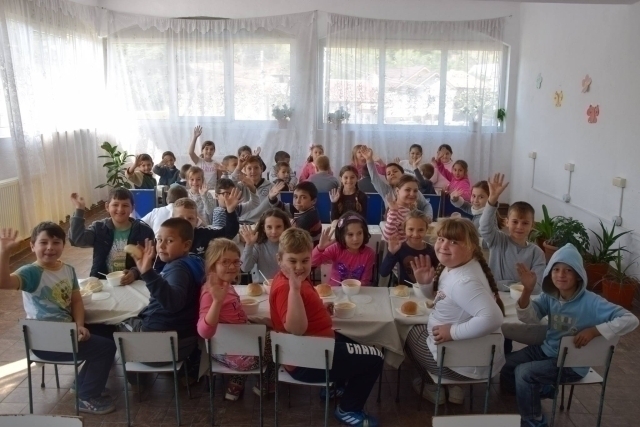
programme is Bread and Tomorrow, which ensures a warm meal and homework
support for children in primary school.
Another problem in
rural education is the scarcity of staff. Many teachers have to travel long
distances in order to get to their schools. Also, the gaps in terms of
qualification are big as well, as most teachers that have a PhD degree or the
first level of qualification are based in towns and cities. Ema Barba, a
communication officer with the Teach for Romania programme told us more:
Statistically speaking, 96% of the children born in the rural areas will never
get to college. Also, if we speak of the Roma population, the percentage is
even higher, 99%. Also, human resources are limited as teachers hardly choose
to go and work in rural schools. That is why we see that there are many gaps
that need to be bridged. It’s important for this teaching posts in rural areas
to be occupied, for children to benefit from the right education.
In order to
improve the situation, the Teach for Romania programme, part of the
international network Teach for All, runs projects aimed at attracting and
integrating teachers into the rural education system. And it appears that there
would be enough teachers willing to do that, given the big number of applicants
and trainees that have completed the programme.
Ema Barba: Currently, there are 66 teachers in our programme. We already have two
generations of graduates, people who took part in the programme for two years
and are now active in various civic engagement activities. We are currently
present in 70 schools in 12 counties. Last year we had 1,000 candidates who
wanted to be trained by the Teach for Romanian programme. We were happy to see
that so many people, who could literally do anything they wanted in various
other fields, chose to become teachers in the public education system,
especially in disadvantaged areas.
The program has
four stages, of which the first two are preparation and training, and the third
teaching proper, for two years. The last stage starts at the end of this two
year period of teaching, when the Teach for Romania educators and teachers can
carry on their work in the education system or can choose related fields, in
which they can also support the reform of the Romanian education system.