Overcrowded Homes
Of the 27 EU member states, Romania ranks first in terms of overcrowded homes
Luiza Moldovan, 01.09.2021, 14:00
Of the 27 EU member states, Romania ranks first in terms of overcrowded homes. 45.8% of the Romanian population lives in such homes, meaning that there is an insufficient number of rooms for people living there, including in terms of age. Other record numbers are seen in other countries too, such as Bulgaria, 41.1%, Croatia, 38.5%, Latvia, 42.2%, and Poland, 37.6%. These are statistics provided by Eurostat, which also provides data on the countries at the other end, with the lowest rates. These are Cyprus, 2.2%, Ireland, 3.2%, Malta, 3.7%, and The Netherlands, 4.8%.
Overcrowded homes are considered those in which children play in the same room as parents, some who try to work from home under the COVID-19 quarantine. In addition, overcrowding increases the risk of spreading the virus, according to Eurosta. It also has a special kind of mental impact, due to the lack of personal space and intimacy. Psychologist Daniela Ionescu tells us how this impact on people looks:
“People have around them a space in which they feel comfortable when alone. It is like and extension of our bodies. Our home, our car, the pen we write with, or the desk chair we sit in, are perceived as part of us, a place where others are not allowed. Allowed are only the people with which we have a good relationship (parents, partners, close friends). The clear delimitation of the piece of atmosphere that we feel we own has to do with the need to be in touch with ourselves, with our essence. Here we analyze our state of being, we ask ourselves questions, we make plans, we design projects. In case of communal living, since we cannot completely control the space, to feel safe and comfortable, we tend to feel depersonalized, which makes us feel vulnerable. In a way, your life is not your own. You blend with the others, you live through the others, for the others. This alienates people. Romanians even have an expression for this: Don’t shove yourself into my soul! If you understand the principle of personal space, you can avoid misunderstandings, you learn to be aware of yourself and others. You learn to impose limits, and say no. In this way, you gain self-confidence and self-respect, in relation to yourself and others. Not to mention that this provides one with better health, you will avoid transmitting viruses and bacteria by keeping this distance.
Children need personal space too. Adults have to understand this in order to raise a balanced child, according to Daniela Ionescu:
“Violating personal space feels as if an uninvited stranger gets into your house. This triggers a fight or flight response. Adrenaline shoots up, and you have a state of discomfort, you get grumpy and agitated. This increases aggression. If the violation of personal space persists, as happens in overcrowded homes, there is nothing you can do to remove the danger, to take distance, negative emotions get pent up within ourselves. This causes bouts of fury, conflicts, and general stress. It is the beginning of self-destruction, because this helplessness affects us both physically and mentally. In the end you can fall ill. It is worst, however, in the case of children. Adults don’t understand that children past 3 or 4 years of age need personal space, so they step into their room without knocking, they hug them without permission, they force them to do things. Even if the parents are well intended, this behavior turns children into abuse victims, be they physical, emotional, or sexual. Which is why, in case living space is limited, one should draw a space one or two square meters around the child. Respecting this space means raising a balanced adult.
Personal space is different depending on culture, civilization, or gender. Men are more aggressive in delineating their territory, women tolerate better having their personal barriers violated. Daniela Ionescu explains:
“Personal space has to be seen through the prism of culture, civilization, or gender, and personal habits. Yes, the demographic explosion and overcrowding have increased our tolerance for intrusion. For instance, if you grew up in a small apartment in a building, full of furniture, surrounded by siblings, parents, grandparents, maybe some pets too, of course you will be OK with crowding on a bus or at standing in a line. However, you should not be surprised if I, born and raised in the countryside, in wide open spaces, will react immediately and maybe aggressively to forced closeness. Men delineate right away a wider territory. They react to any attempt for this to be violated. Women, by their nature, need closeness and affection, so they tolerate better intrusion into their personal space. In America, and mostly Anglo-Saxon countries, personal distance is greater, if you stretch out your arm, you barely touch the other person. In Europe it is smaller, and in Asia the 40 to 50 cm that are intimate to us, to them amounts to social distancing. Scientists say that, by violating personal space we transform the others, turning them into objects, avoiding physical and visual contact with them.
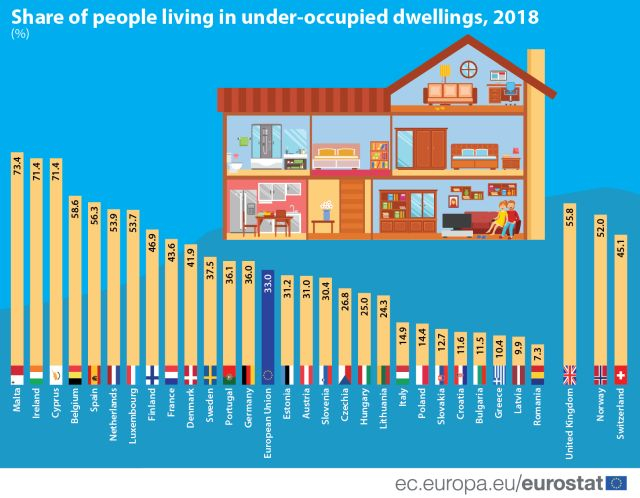
Also last year, 70 to 75% of the population lived in undercrowded homes, meaning homes considered too large for the needs of inhabitants, in Malta, Cyprus, and Ireland. Other member states where more than half the population lives in undercrowded homes are Spain, Luxembourg, Belgium, and The Netherlands. The countries where less than 15% of the population lives in undercrowded homes are Romania, 7,7%, Latvia (9,6%), Greece (10,7%), Bulgaria (11,5%), Croatia (12%), Slovakia (14%) and Italy (14,2%).