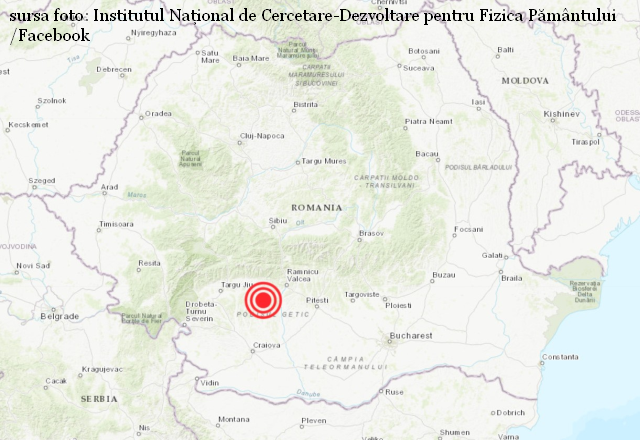
The Vrancea Earthquake Area
Turkey is facing a disaster with the major 7.8 Richter scale earthquake of February 6
Corina Cristea, 16.02.2023, 17:55
Turkey is facing a disaster with the major 7.8 Richter scale earthquake of February 6, followed by hundreds of aftershocks, some of great intensity, which left dozens of thousands dead. The Turkish authorities appealed to international aid, and the EU responded by activating its civilian protection mechanism. Many countries, Romania among them. have sent in rescue teams. The quakes in Turkey were felt in Israel, Lebanon, Cyprus, and northern Syria, and they had dramatic consequences — countless dead and major material damage. Seismologist Mihail Diaconescu, with the Institute for Research and Development in Earth Sciences, speaking for Radio Romania, explained what can cause such a chain of powerful earthquakes:
“The first earthquake, the initial one, 7.8, occurred close to the conjunction of three tectonic plates, the Arab, the African, and the Anatolian. It probably was an impulse from the Mediterranean submersion area in the Mediterranean, in the Cypriot arc, which upset the balance in the area, and generated this 7.8 earthquake. The later earthquake, 7.5, is not part of the seism sequence of 7.8, since it had a rupture direction of east to west, while the 7.8 had a north-east-south-west rupture. In Turkey we have superficial quakes, caused by the East Anatolia fault, the North Anatolia fault, where we were used to have quakes above 7 on the Richter scale. This faultline is in the north of Turkey, and is parallel with the Turkish coast of the Black Sea. In Romania, according to official records, we had a 7.9 scale earthquake in the 19th century, representing the peak of magnitude that the fault line in Vrancea may produce. But, this being a historically described quake, it may have been slightly overestimated.”
These comments are related to a parallel between what happened in Turkey and the most seismic area in Romania, the Vrancea area. The strongest Vrancea quake, 7.9, allegedly came in 1802, and was felt from Moscow to Istanbul, and chronicles write that the steeples of all the churches in Bucharest collapsed. 138 years later, in 1940, a 7.4 quake occurred 133 km down the crust, and lasted for 3 minutes. The effects were devastating, with 1,000 estimated deaths, and 4,000 estimated injured. It struck Bucharest, where it left about 3000 dead, with most of them in the rubble of a very modern high rise at the time, 12 stories of reinforced building. After the 1940 earthquake, the General Association of Engineers in Romania put together a study of the effect of quakes on reinforced concrete buildings, and as a result new norms were applied to all post-war buildings. In March 1977, a new earthquake, 7.2 on the scale, left about 1,570 people dead, most of them in Bucharest, where 33 or more high rise buildings collapsed. The epicenter was estimated at 100 km, and the shock wave traveled the entire Balkan Peninsula. Nine years later, 150 people died in another earthquake, 7.1 on the Richter scale, and in 1990 Romania had three more quakes, 6.9, 6.4, and 6.1, which killed 13 people. Speaking to Radio Romania, engineer Matei Sumasacu, expert in construction and earthquake risk assessment, talked about the possible causes of the size of the disaster in Turkey, and Romanias vulnerabilities at the same time:
“We are obviously talking about a tragedy, and, as the saying goes, earthquakes dont kill people, buildings kill people in earthquakes. The Turkey earthquake met a seismic vulnerability of the buildings there, which is for several reasons. First of all, the inadequate building codes before 2000 started being revised with a more adequate system, but really, it was only after 2018 that they improved. However, they were left with a wide swath of buildings erected before 2000, considered very unsafe, buildings with a flexible ground floor, which are very fragile in an earthquake, and we have seen how the ground floors of many buildings caused a serial collapse, a so-called sandwiching of the whole building. We thought of our buildings here, in Bucharest, Romania, because we have a whole host of aging buildings, designed without quakes in mind, before 1940, or before 1977, when the seismic design was not exactly applied correctly.”
However, among the collapsed buildings in Turkey there were newly built structures. Matei Sumpasacu told us that this is another layer of vulnerability, the area of quality assurance in buildings, which makes the difference between reality and how a project lays on paper. This is the area, he says, that entails corruption, and apparently the most corrupt domain in the world is construction, by making shortcuts through the system.