Romanian tractors
Tractors were the sign of a developed, industrialized economy, mechanization being its main feature, resulting from the industrial revolution of the 1820s.
Steliu Lambru, 06.06.2015, 14:32
Tractors were the sign of a developed, industrialized economy, mechanization being its main feature, resulting from the industrial revolution of the 1820s. The introduction of mechanization in agriculture started in the US, then Germany starting building the first such farming machines. The first tractors were built in 1900 and their serial production and extensive use started in the 1920s. In Romania the land was ploughed with animal-drawn ploughs, either horses or oxen. The history of the Romanian tractor is rather short-lived because the very mechanized agriculture has a short history in Romania too. By the end of WWII Romania had not produced tractors and neither had it imported such vehicles. With the Soviet occupation and the installation of the Communist regime, “The Romanian Aeronautics Industry aircraft factory in Brasov was deprived of its equipment and assembly lines and was turned into a tractor factory. By producing tractors, the Communist regime bombastically announced that IAR Brasov started to produce machines for times of peace. Actually the name of the factory in Brasov remained the same, reminding of the tradition of aircraft production.
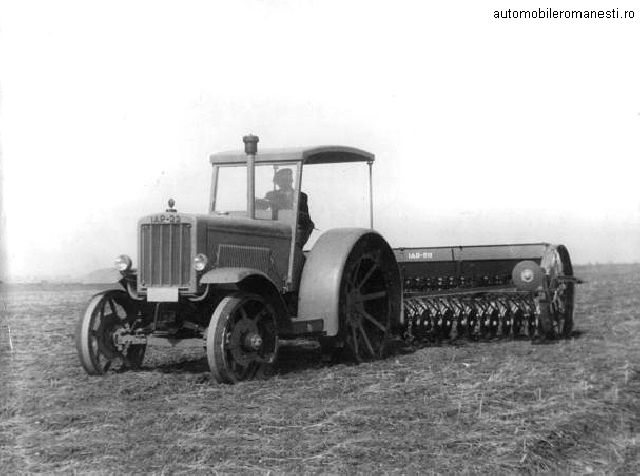
n 1946 the first tractor produced by IAR was called IAR 22, a name that had to show that nothing had changed and that there was continuity. IAR 22 was the first Romanian tractor built after the model of a German tractor “Hanomag. Thus Communist Romania was aligning itself to the Soviet practice of copying products of the western industry and making them their own brands. The machine weighed 3.4 tons and was equipped with a Diesel, 38-horse power engine and had a drag force of 1,225 kilograms. The state commissioned the factory to produce 5,000 IAR 22 tractors.
In 1949 they gave up the name IAR and the factory was named “Tractorul Brasov Factory. In the 1950s and the first half of the 1960s, “Tactorul Brasov increased its production, diversified its products and even managed to export. There emerged the caterpillar-track-type tractor and in 1955 its wheel-type version called “Universal 2 (U2), the latter being the tractor based on which the most successful Romanian tractor “Universal 650 (U 650) was built. Despite all these the production capacity of the “Tractorul Factory was limited and the factory also faced ideological restrictions.
After 1965 the Romanian industry received an important impetus for its development. A first explanation would be the gradual reduction of the Soviet presence in the economy and the gradual increase of the Romanian Communist Partys independence in making decisions. The new political leader of Romania, Nicolae Ceausescu, gave a different direction to the economy and imposed the speedy development of the machine-building industry. Development had particular support in agriculture, the main branch of the Romanian economy.
“Tractorul Brasov factory developed at a fast pace, more people were hired and investments were made in introducing new technologies. Also more production units for other types of tractors were opened in the cities of Miercurea Ciuc and Craiova. The party strategy was aimed at rapidly increasing the production capacity in order to penetrate both the European and emerging markets. In 1963 “Tractorul Brasov purchased the production license for a Fiat model and, given the previous experience, they started producing the U 650 model, the most popular model of tractors in the Romanian industry. In 1989, the last year of the Communist regime, the Brasov factory was producing 50,000 U 650 tractors and its variants, of which 40% were exported to Iran. U 650 was equipped with a direct injection Diesel engine with an electric starter. The engine had a power output of 65 hp at 1,800 rpm and also had a 10-speed gearbox.
The development of the “Tractorul Brasov factory also entailed social transformations. A residential area was built for the factorys 26,000 employees and it was named after the factory. Despite the increase in production and exports, the living conditions of “Tractorul employees deteriorated just like the living conditions of all Romanians. The workers from “Tractorul together with those from the “Steagul Rosu Truck Factory took part in the anti-Communist uprising on November 1987 and then suffered the regimes persecutions after the protest movements were repressed.
After the fall of the Communist regime and following the implementation of economic reforms, the “Tractorul factory underwent deep transformations. From 26,000 employees in 1989 it was left with only 1,700 in 2007. And to top it all, in 2007 the “Tractorul platform was sold to a real estate developer to make way for a residential compound. However in the past years the tractor output in Brasov has increased and the factory is still trying to recover.