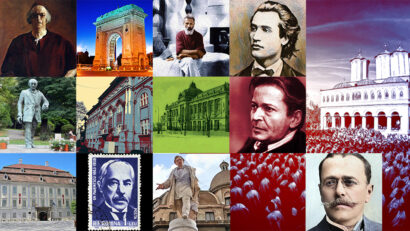
The Romanian Academy’s 150th anniversary
The consolidation of the modern Romanian state began in 1866. On April 1st the same year, the future Romanian Academy was established.

Steliu Lambru, 09.04.2016, 12:38
The consolidation of the modern Romanian state began in 1866. On April 1st the same year, the future Romanian Academy was established. It was meant to rally Romania’s outstanding intellectuals and scientists. Its initial name was The Romanian Literary Society. A year later, on August 1st, 1867, its name was changed into The Romanian Academic Society. It was named The Romanian Academy in 1879, a year after Romania had become an independent and sovereign state, in the wake of the 1877-1878 war.
In 1948, when the People’s Republic of Romania was proclaimed and the communist regime forcefully turned the Society into a state-run institution, the name of The Romanian Academy was changed into The Academy of the People’s Republic of Romania. As soon as the official name of the country was changed into The Socialist Republic of Romania in 1965, the Academy would become The Academy of the Socialist Republic of Romania. In 1990, the institution resumed its historically justified name, that of The Romanian Academy, which the institution had in 1879.
The first pre-modern academies in the Romanian space were established in Wallachia’s capital city, Bucharest, in 1689, during the rule of prince Constantin Brancoveanu, as well as in Moldavia’s capital city Iasi, in 1707, during the rule of prince Antioh Cantemir, the father of the future ruling prince and outstanding scholar Dimitrie Cantemir. The two academies provided the foundation for the future University of Iasi in 1860 and the University of Bucharest in 1864, respectively.
The Romanian space had been undergoing a modernization process in the second half of the 19th century. For the advancement of knowledge, modernization entailed the setting up of an authoritative body, meant to certify the researchers’ level of knowledge and specialized competence. At this point, we might as well add that the cultural project of the Romanian Academy went hand in hand with the political one. Romantic intellectuals came up with the idea of an academic society capable of steering the activity of Romanian scholars for the political and cultural unity of all Romanians.
The Romantic cultural and political effervescence laid the foundation of the Academy, thanks to the efforts of the 21 founding members from all Romanian-inhabited provinces. Three of them came from Moldavia, Bessarabia, Wallachia and Transylvania each and two of them from Banat, Maramures, Bukovina and Macedonia each.
Initially, the Academic Society did systematic research on the language, since the Society itself was founded by philologists. The Academic Society standardized the orthography of the Romanian language, compiled a Grammar of Romanian and edited a Dictionary of the Romanian language. Actually, the Academy awarded its first prize ever in 1867 to Timotei Cipariu, a philologist of scintillating intellectual capacity, who wrote the first part of the aforementioned Grammar of Romanian. After 1879, when the Academic Society became the Romanian Academy, its research gained scope, including history, fine arts and sciences. The Academy started off with three sections and their number grew to seven at present.
The first president of the future Romanian Academy was writer Ion Heliade Radulescu. He was one of the foremost Romantic writers, an encyclopaedist, political activist and advocate of the national idea, of the union of Wallachia and Moldavia. Ever since its foundation, the number of the Academy members has been growing, also including foreign intellectuals whose research focused on Romanian studies. The author of “The Dictionary of Romanian Academicians 1866-1999, biographer Dorina Rusu listed 1,494 Academy members, 980 of whom were Romanian and 514 foreign. Countries with the largest number of members of the Romanian Academy were France, with 163 members, Germany, with 60 members, Italy, with 48 members, the USA with 39 members, England with 22 members, the USSR and Russia, with 20 members. Tenure members of the Romanian Academy, as well as corresponding and honorary members have been granted a lifetime membership. Members can also be elected post-mortem.
The Romanian Academy’s heyday was between the two world wars, when the institution enjoyed the support of the new Romanian state, which was formed after 1918, while benefiting from the effervescence triggered by the new political and cultural order. However, after 1945, the communist regime put an end to the Romanian Academy’s upward trend and in 1948 reorganized the Romanian Academy on Soviet principles. Gaining membership of the Academy was solely based on political criteria. Also, the freedom of expression was suppressed; no less than ninety-eight members of the old Academy were expelled from the institution, since they allegedly failed to meet the political criteria of the time. One of them was the outstanding historian Gheorghe Bratianu, who died in the Sighet prison in 1953. It was not until 1962 that the Academy saw a certain opening to Western culture and science.
The Romanian Academy regained its freedom in 1990. New members were accepted, including the winner of the 1975 Nobel Prize for Medicine, George Emil Palade, human rights activist Elie Wiesel and Pope John Paul the second, the first Pope to have visited Romania, a country with a predominantly Orthodox population, in 1999.