Gheorghe Lazar
The Romanian principalities of Wallachia and Moldavia began a modernisation process in the early 19th century.

Christine Leșcu, 24.06.2017, 14:51
The Romanian principalities of Wallachia and Moldavia began a modernisation process in the early 19th century and a key component of that process was education. There were few schools at that time, while teaching was mostly done in Greek and Slavonic, the languages used in the administration and the church. In fact, the first higher education school teaching in Romanian to appear in Bucharest was founded by a scholar from Transylvania.
His name was Gheorghe Lazar. Literary historian and critic Mircea Popa tells us more about him: “Gheorghe Lazar was educated in Transylvania with the help from of governor Baron Samuel von Brukenthal from Sibiu. Lazar was born near Sibiu, in Avrig, on June 5th 1779. He studied in Sibiu and Cluj, and furthered his higher education at the Faculty of Theology in Vienna, preparing himself for a career in the clergy. However, he did not get along with the Romanian Orthodox bishop in Sibiu, where Gheorghe Lazar was teaching at the Theological Seminary, so the only solution was to leave for the principalities. The situation had become even more complicated as he had publicly expressed support for Napoleon and had been investigated for rebellion against the Austrian Empire.”
In Bucharest, he found support for his pedagogical projects among the more open-minded boyars advocating the modernisation of Wallachia. The literary historian Mircea Popa explains: “As soon as he arrived in Bucharest and its strongly Hellenised environment, he was surprised at how little interest there was in systematic education of the kind seen elsewhere in Europe and worked out a plan of measures to bridge this gap. He proposed the creation of a Romanian-teaching school where the nation’s young could benefit from teaching in their mother tongue. He achieved this with the help of the boyar Constantin Balaceanu, first by introducing parallel classes in Romanian in 1817 and later by creating a higher education school where he himself taught, together with two other teachers, Eufrosin Poteca and Ioan Erdely, and where they obtained remarkable results.“
With the help of the enlightened boyars and through a decree signed by the Phanariot ruler Caragea, Gheorghe Lazar eventually established the school of Saint Sava in 1818, thus continuing the tradition of the Princely Academy that had existed at the Saint Sava Monastery since the end of the 17th century. The new school was accessible not only to the boyars’ sons, but also to young people from less affluent families. The school used to teach a lot of science courses, such as land engineering, as well as humanities course, such as philosophy and grammar. Beyond that, however, Lazar and his teachers taught their young students innovating ideas about political and social systems in Western Europe and about national identity.
The literary historian Mircea Popa once again: “Gheorghe Lazar introduced a topography course at his school and taught young people about the generation and dissemination of national ideas. So little wonder then that later on, around 1821, we find him in on the side of Tudor Vladimirescu, with whom he shared the national ideal. He became the latter’s advisor and advocated in favour of a national movement born from among the local small boyars. Apart from teaching, Gheorghe Lazar also drafted a series of manuals and translated pedagogical, mathematical and philosophical works among other things. He is also the author of a very diverse body of work, and his preoccupations were extremely varied. Most of these works were published posthumously.”
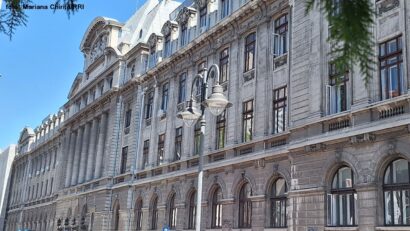
Unfortunately, Gheorghe Lazar died an untimely death in 1823, when he was only 44. His groundbreaking ideas, passed on to his students, were implemented by the younger generation of boyars and intellectuals who had enough time to assimilate them before they initiated the 1848 revolution in the Romanian principalities. Today, Gheorghe Lazar is considered the founding father of education in the Romanian language. His statue lies opposite the University of Bucharest, and one of the city’s best high schools bears his name.