The Centennial Of The Theory of Sonics
In the annals of science and invention, the name of engineer Gogu Constantinescu ranks high in the area of sonics
Steliu Lambru, 02.11.2019, 14:14
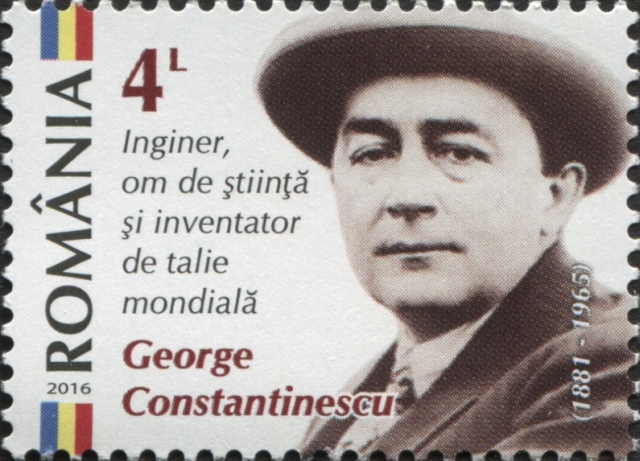
In the annals of science and invention, the name of engineer Gogu Constantinescu ranks high in the area of sonics, in which he applied himself the most. He is a major figure in the beginnings of sonics, which is the transmission of energy by vibration in fluids or solids, and 2019 is the centennial of this discipline. Constantinescu started coming up with sonics by listening to his mother play music. Over his lifetime, engineer-inventor Constantinescu patented around 130 inventions, earning worldwide fame.
Gogu Constantinescu was born in the city of Craiova on 4 October 1881 to a maths teacher and an Alsacian music teacher. He graduated the National School of Roads and Bridges at the head of his class. He started off as a construction engineer, and his first passion was using reinforced concrete in construction. Constantinescu was one of the people who established the distribution of load in concrete and rebar structures, changing the general attitude towards these construction materials.
At the event called The White Night of Galleries, the exhibition called Gogu Constantinescu 100, organized by Sorin Mihailescu, stood next to important names in Romanian fine arts, which was not by chance, according to the organizer:
“The juxtaposition of art and science is not by chance, because the theory of sonics itself was born out of the deep study of musical harmony that Gogu Constantinescu went into. He studied thoroughly the piano and the trumpet. Based on the energy that develops in that thin tube, Constantinescu discovered that liquids are compressible, and that energy can be transmitted through vibrations. On November 4, 1919, he held a famous talk in Bucharest at the National School of Roads and Bridges, which he had graduated in 1900 at the head of his class.”
In WWI, Constantinescu became famous by inventing a device that allowed airplane mounted machine guns to synchronize with propellers, allowing them to shoot between the blades as they were spinning. Early in the conflict, air power was starting to gain importance. Supremacy was held by the Germans, who had equipped their fighters with very effective machine guns, causing immense damage to the British air corps. At that point, the British Admiralty launched a competition to improve their fighter planes. Gogu Constantinescu signed up, and came up with a device he called the Constantinescu Fire Control Gear, allowing guns to shoot through spinning propeller blades. The rate of fire for the guns went up to 1200 per minute for each of the guns mounted on either side of the propeller. Constantinescus success with this invention was enormous, and the British and the American air forces ordered about 50,000 such synchronization gears. He also got very rich, even though his invention was immediately classified. After this success, the British Admiralty agreed to continue to finance Constantinescus research, building for him a lab at West Drayton, near London. There he started applying some of the ideas that he had been throwing around since 1901 in terms of the propagation of energy by vibration, coming up with the theory of sonics.
Such a creative spirit could not limit itself to a single area of study. Among other things, we can mention his contributions to the automatic gear automobile, which had impact worldwide. In a film shot in 1926 at the Paris Auto Salon, you can see the inventor himself pushing the gas pedal of a car with a cane, then releasing the pedal, causing the car to stop. In 1936, the Monte Carlo Rally was won by the Romanian team made up of Petre Cristea and Ionel Zamfirescu, who piloted a car designed by the Romanian engineer. Sorin Mihailescu told us that the inventor also diverted his energy towards large scale construction:
“A lot of buildings in Bucharest which are now considered jewels of Romanian architecture were built out of reinforced concrete based on Constantinescus theory. In 1905 he issued that theory of reinforced concrete, and he subsequently built in 1906 the famous bridge in Carol Park. Other buildings, such as Bucharest City Hall, have their structures studied and approved by Gogu Constantinescu and his old professor Elie Radu, a great teacher in construction, who was responsible for the first sewage system in Bucharest. The Athenee Palace Hotel and the Stock Exchange Palace are also emblematic buildings.”
Sorin Mihailescu celebrates Gogu Constantinescus memory on-line too. His website gogu-constantinescu.ro contains a lot of information, period documents, photos, and events dedicated to the scientist.
On December 12, 1965, Gogu Constantinescu was granted an honorary doctoral degree from the Bucharest Polytechnic University, and was made a member of the Romanian Academy. That same year, he passed away in his home near London.