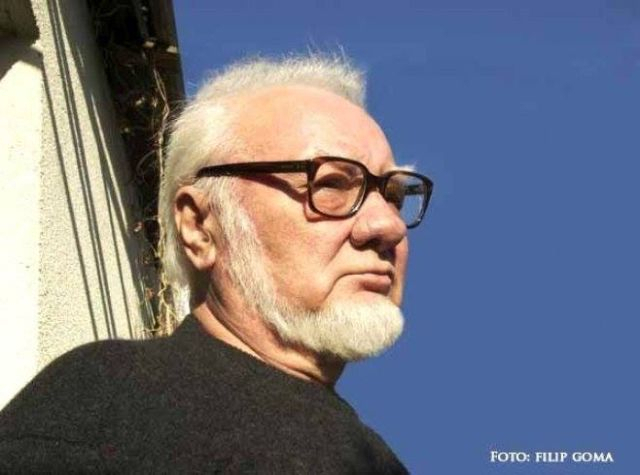
Writer Paul Goma
Writer Paul Goma, a major figure in the anti-communist resistance, succumbed to COVID-19
Steliu Lambru, 11.04.2020, 14:25
On 25 March, 2020, as the coronavirus pandemic struck, news agencies announced a sad event: writer Paul Goma, a major figure in the anti-communist resistance, died in the Pitié-Salpêtrière university hospital, succumbing to COVID-19. An atypical and non-conformist figure, Goma was the uncomfortable kind that no regime could have subdued short of physically removing him. In spite of that, he survived the most brutal regime in history, and left behind the memory of a man ready to go to any length to stand up for his convictions.
Writer Paul Goma always criticized unreservedly all that bothered him, things that went against a decent life. He was born on October 2, 1935, in Orhei County in the northeast of what is now the Republic of Moldova, part of which was formerly known as Bessarabia. After the USSR took it over in 1940, the Goma family took refuge in Romania. One can say a lot about Paul Goma, but not that he was fearful.
His conflictual relationship with the communist regime started in 1955, when he was a student, and fell into disagreement with his scientific socialism teachers. This was the beginning of the so-called Goma Case, which went on to become the Goma Movement, which ended up involving a total of 430 people. The writer handed in his Communist Youth membership card in solidarity with the Hungarian revolution of 1956. It was the first time he was arrested and sent to prison for two years. Upon release he was sent into house arrest in Baragan, where he stayed until 1964. In 1971, his novel Ostinato, heavily censured in Romania, was published in West Germany, and as a result he was kicked out of the Communist Party, which he had joined in support of Ceausescus anti-Soviet policies. When another one of his novels, The Door, was published in West Germany, he became an utter enemy of the regime. Starting in 1970, he started sending letters to Radio Free Europe. Historian Cristina Petrescu summarized Paul Gomas personality:
It is a known fact that Goma was the initiator of the human rights movement which was modeled on the 77 Charter from Czechoslovakia, and then the regime tried to co-opt Goma, which partially worked out, if we look at the articles he published before he was arrested. While in prison, he retracted many of the positions he was expressing, and is finally set free due to international pressure. Then he was exiled, and became one of the major figures of the democratic exile up until 1989. He remained a controversial figure after 1989 too, especially because of his opinions on the Sovietization of Bessarabia. i will conclude by saying that, to a large extent, Paul Goma is a forgotten hero of our recent history, precisely because he couldnt find his proper place in it.”
Even if Goma supported the Ceausescu regime in August 1968, when he opposed the invasion of Czechoslovakia, he remained an open opponent of it. Cristina Petrescu told us that the leader of the Romanian human rights movement continued to be a thorn in the side of the regime:
“Goma stood out when in the 1970s he was a spearhead of non-conformism among Romanian writers, because he was the first one who managed to publish abroad two books that had been blocked by censorship. One of them is openly against the regime, it is a book about an inmate obsessed by freedom. It enjoyed great success because it came at the time that Solzhenitzyns Gulag Archipelago was translated into international languages, and is the reason for which Goma is referred to as the Romanian Solzhenitzyn.”
Goma came into conflict once again with the Communist authorities in 1977, when he co-signed a collective protest letter addressed to the OSCE from Belgrade, which was broadcast on Radio Free Europe. The letter denounced the human rights violations in Romania, and was the beginning of the Goma movement. Here is Cristina Petrescu once again:
“We have this phrase that appears in many historical writings, that of the Goma Movement, and which is the way this collective protest became part of the canon. In fact, this unfortunate phrase was how the Securitate defined this group. In this case, the outlines of the group are more complicated than that, precisely because it was a larger group than the Ellenpontok samizdat, or the Aktionsgruppe Banat one. I will try to draw a slightly different interpretation of this movement. First of all, I draw a difference between who Goma was, as a cultural opponent of the Communist regime, and who became part of the canon in this way, and the Goma movement, which became part of the canon in a completely different way.”
Paul Goma was arrested on April 1, 1977, and that same year, on November 20, he, his wife, and his child were exiled, and their citizenship was revoked. They went to Paris, where they filed for political asylum, but the writer did not apply for French citizenship. After 1989, the Romanian regime restored Gomas citizenship.