The Bucharest Painting Collection
Dacia-Romania Palace will be housing the Bucharest Municipal Museum
Christine Leșcu, 13.06.2020, 14:00
In the historic area of Bucharest, on Lipscani Street, which has always been the trading and banking center of the capital, right across from the National Bank of Romania, you can find the Dacia-Romania Palace. An elegant and sumptuous building, it had many functions across history, and recently came under the administration of the Bucharest Municipal Museum, and turned into the The Bucharest Painting Collection. The history of the place is interwoven with the history of the city, because the terrain on which the Dacia-Romania Palace lies was bought in mid-17th century by a boyar called Ghiorma, of Greek origin, erected a church. In time, the church went through all kinds of tribulations, and became a local landmark known as the Church of the Greeks, especially after an inn was built around in the 18th century. In 1882, the Dacia Romania insurance agency bought the land in order to build its headquarters there. Construction work started in 1882 and finished in 1889, though the building was practically finished by 1886.
The building is in eclectic style, with Art Nouveau influences, and we still dont know who came up with the design, as we found out from Elena Olariu, deputy director of the Bucharest Municipal Museum, the Fine Art section: “We still dont know who the architect who designed the building was, we are still researching that. It seems he was an Austrian architect, because the facade seems to be in Viennese style. Some say it was Adolf Lang. I am quite sure that after the research is conducted we will find out who he was. In 1931, because the insurance companies that were in the building were not profitable enough, the palace was taken over by the National Bank of Romania. In fact, the National Bank was the last owner before City Hall took over and turned it into the museum. In the 1950s, an interesting thing happened, it was turned into the headquarters of the Music and Dramatic Arts Conservatory. Those were the murky years after the war, when many institutions lost their buildings, and were moved in temporary locations. Then between 1979 and 1983, the building was renovated, because it was badly damaged by the 1977 earthquake. Then it was turned into a luxury store — to the extent that you could call it that during communism — and many Bucharesters probably still remember it being there when they pass through the area. In 2013, City Hall bought the building to set up there the Bucharest Painting Collection. In 2019, our museum got this building, and we hope to turn it into a very modern and very dynamic art gallery. It will be interactive, and, we believe, perfectly placed in the Historic Center, where we have most foreign tourists, where we may present Romanian art and culture of a manner that will be enjoyed by all Bucharesters, not just the lovers of the avant-garde.”
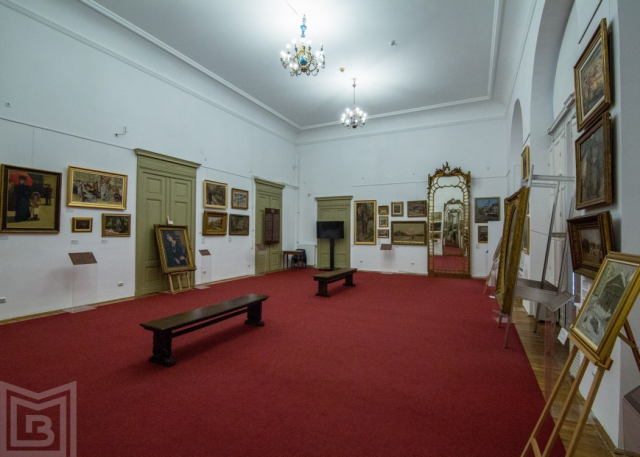
It is in itself a work of art, which should be taken advantage of. The Dacia-Romania palace, which housed even a few banks after 1990, gained a new role, much better suited to its aspect, after they open there the The Bucharest Painting Collection. Here is Elena Olariu: “We have in our custody over 5,000 items, of which over 2,500 are paintings we have a lot of spectacular and interesting graphic art, which we will exhibit in special areas. We also have a significant number of sculptures, but also decorative art, about 700 items. Our patrimony is very rich, because in 1933, when the collection was housed by the Astronomical Observatory, it was supposed to be the representative gallery for Bucharest. Back then there was no National Art Museum of Romania, and people of culture conceived the collection to be representative for Romanian art and culture. Which is why, between the wars, they had a coherent strategy of acquisition and attracting donations, precisely in order to cover the whole history of Romanian art, and acquire valuable works.”
After moving the collection in the Dacia-Romania Palace, the Bucharest Municipal Museum has an innovative project to set up the permanent exhibition and to structure the interior, as we were told by Elena Olariu, deputy director of the Bucharest Municipal Museum, the Fine Art section: “The art section I manage implemented a very interesting project. The ground floor, which is very low, and where we can break the barrier between the visitors and tourists that pass by in the street, we plan to turn into a contemporary art gallery, because the patrimony of the collection allows us to do so. It can be even a section dedicated to communist art in combination with contemporary art, in a contemporary exhibition. We will have the possibility of bringing together two museum: a contemporary art museum and a historical museum. The other two levels of the building will be dedicated to the Bucharest Painting Collection. Here we will be exhibiting works by the greatest Romanian artists: Constanin Lecca, Gh. Tattarescu, Theodor Aman, Nicolae Grigorescu, Ion Andreescu, Gh. Petrascu, Stefan Popescu, Th. Pallady, Nicolae Tonitza. In addition, we have many female artists represented, such as Olga Greceanu, whom we would like to better showcase. It would be interesting for a Romanian art exhibition to popularize more these artists, who deserve their own grand gallery. We also have works by avant-garde artists such as Marcel Iancu, Maxy, Sabin Popp, Corneliu Baba, all of them great artists. We have already started restoration, and the acquisition of frames for the first and second level, because this project is at an advanced stage.”
Until the museum opens, however, the palace on Lipscani Street has to have minor exterior work, while the interior has to be set up for the permanent exhibition. The ground floor can be opened faster as conference and temporary exhibition space. In fact, starting with the lockdown period, up until now, the masterworks by Romanian masters in the museum patrimony can be admired in a virtual exhibition on-line.