Royal residences at the Black Sea and the modernization of Dobruja
Dobruja had a multi-ethnic population, that included Romanians, Turks, Tatars, Bulgarians, Germans, Roma and Jews.
Steliu Lambru, 25.12.2022, 14:00
Dobruja is the territory between the Lower Danube in the west, the Danube Delta in the north and the Black Sea in the east, which became part of the Romanian independent state in 1878. Thus, the province between the Danube and the Black Sea, which had a multi-ethnic population, made up of Romanians, Turks, Tatars, Bulgarians, Germans, Roma and Jews, united with Romania. After 35 years, in 1913, through the Treaty of Bucharest signed after the Second Balkan War, the territory of Dobruja expanded with the Cadrilater, or Southern Dobrogea.
Starting 1878, Dobruja developed at a fast pace. The construction of the Sulina navigable channel, the exit to the Black Sea, the construction of the Constanța Port and the Cernavodă Bridge turned Dobruja from a backward province into a prosperous, developed one. Also, the presence of the Romanian Royal House in this area was very important and would contribute a great deal to what the province became in the following decades.
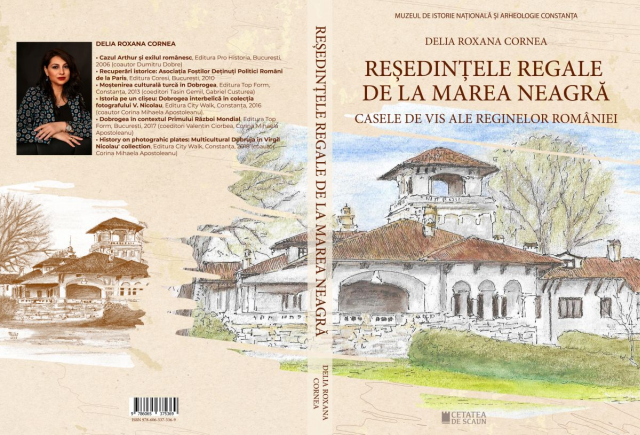
Historian Delia Roxana Cornea is the author of the volume Royal Residences at the Black Sea. The Dream Homes of Romanias Queens. She tells the story of the province s development, but also a societal history related to the presence of Romanian sovereigns on the Black Sea shore, through their residences: The building of the old Royal Palace was administered by the Ministry of the Interior and the Prefecture since it was built. The first royal apartments were arranged there. Later, the building became the headquarters of the Court of Appeal, with King Ferdinand s approval, during a meeting he had at Palas Hotel in Constanta with the local leaders. As for the Royal Pavilion on the pier, it was administered by the Port of Constanta and the Maritime Service. In theory, it was in the possession of the royal family until the communists took over power. As for the royal residence in Mamaia, the donation document of December 1924 proves that that land was donated to the Royal Family. All the documents that I have researched prove that this residence was part of the royal property. The donation document of 1927, to Princess Mother Elena, clearly established the ownership rights, based on which the subsequent sale of the palace was possible.
The Romanian Royal House moved in tune with the Romanian society, so in keeping with the rules of the market economy and the law – it received donations, sold, purchased and invested. Delia Roxana Cornea: The fact that Princess-Mother Elena was no longer allowed to own properties in Romania was well known. In 1932, she sold the palace and the Crevedia farm and used the money to purchase a villa in Florence, where she spent a big part of her life. So, all these residences, whether they were built by local authorities, or with the contribution of local authorities and the funds of the royal family, as it was the case with Balchik Castle, where Queen Maria also invested money of her own, belonged to the Royal House. They have become places of memory, places that speak about the role that the royal family had in the development and modernization of Dobruja as a whole.
For Delia Roxana Cornea, choosing a favourite royal residence out of the four wass difficult. She told us about Balchik Castle, visited every year by around 200,000 Romanians: Balchik is spectacular mainly due to the natural setting where it was built, its proximity to the rocky area of the sea. There is also the special style that Queen Maria imprinted to all the constructions in this area of Balchik, especially to the terraces and parks shaped under her close supervision. Queen Maria loved Mamaia as well, proof of that being her very own words, the notes she made in 1935, when she visited Mamaia for the last time. It is the moment when the Royal Footbridge in Mamaia was inaugurated. She was invited by the prefect of Constanta to attend the ceremony. On that occasion, she visited the new establishments on Mamaia beach, and also her former residence. Late that night, back in Balcic, she wrote in her diary that that she was deeply saddened by the poor state of the garden and park that she had built there, a beautiful garden of pink petunias, flowers that grow in sandy soils. The prefect of Constanta promised her that he would do everything to save her park and garden in Mamaia.
The presence of royal residences is an example of how a territory can develop economically and transform socially. The Romanian sovereigns castles at the Black Sea acted as catalysts for the development trend that Romanian society followed in the second half of the 19th century and the first quarter of the 20th century. (EE)