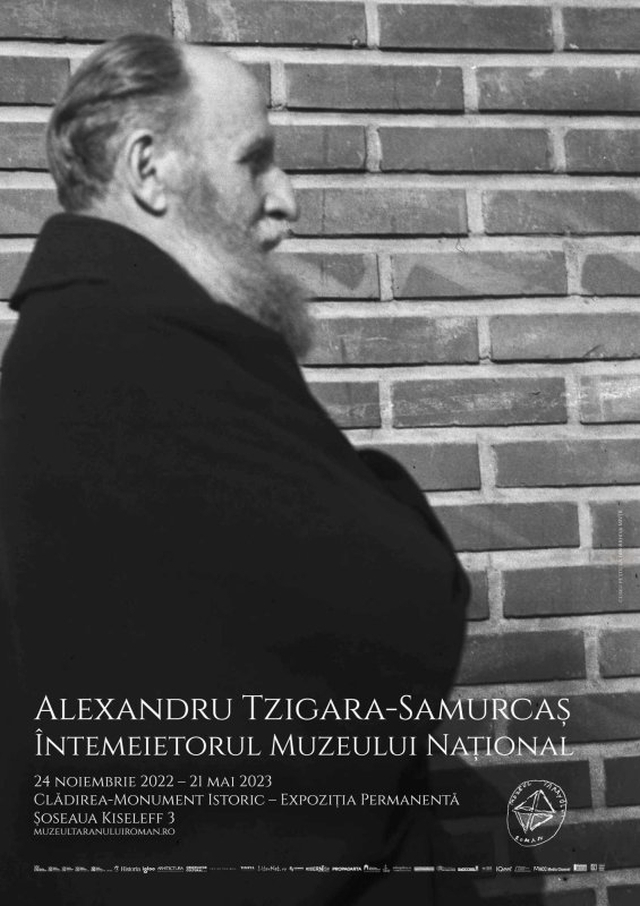
Photographer Alexandru Tzigara-Samurcaș
The beginnings of the study of the Romanian rural world are linked to the name of Alexandru Tzigara-Samurcaș
România Internațional, 30.04.2023, 14:00
The beginnings of the study of the Romanian rural world are linked to the name of Alexandru Tzigara-Samurcaș, a folklorist, ethnologist, art historian, professor of art history at the universities of Bucharest and Cernăuți and father of Romanian museography. But he is also a name that entered the history of Romanian photography, a passion he used to immortalize the world of the village, which was given less attention compared to urban life. In order to present the public with his photographic work, the Library of the Romanian Academy organized an exhibition titled Oltenia a century ago in the photographs of Alexandru Tzigara-Samurcaș. The collection of the mentioned institution today holds approximately 4,000 photographs and 1,000 films authored by the famous ethnologist.
Alexandru Tzigara-Samurcaș was born in Bucharest in 1872 and, according to rumors, he was the illegitimate son of King Carol I. A Germanophile, he studied philosophy at the University of Munich where he specialized in art history. Genealogical research showed that he had Greek and Italian descent, but also blood ties with Romanian noble families, being related to Kretzulescu and Crețeanu. Tzigara-Samurcaș married a member of the Cantacuzino family, which allowed him to rise in the aristocratic world even higher.
He was part of the Junimea literary society of liberal-conservative orientation and started being active in the cultural press. In the First World War he was in favor of keeping Romania’s alliance with Germany and against the alliance with France and Great Britain. After the First World War there were voices that demanded the punishment of Alexandru Tzigara-Samrucaș for collaborating with the German occupier between 1916 and 1918. He survived the criticism and continued to teach at the university. Among other things, his name is also associated with the first radio show in Romania, being the one who inaugurated the show with a text written especially for the event, on November 1, 1928. Alexandru Tzigara-Samurcaș died in 1952, in Bucharest, three days before reaching the age of 80.
Alina Popescu from the Library of the Romanian Academy was the one who designed the Tzigara-Samurcaș exhibition and she gave us the details:
The exhibition includes photographs representing churches and monasteries from Oltenia, as well as frescoes and furniture from these places, practically representing a visual benchmark of how these monuments and objects looked approximately 100 years ago. The photos date from 1900-1930 and are interesting to compare to how these things look today. There were photographers before him, especially photographic artists, who stopped and photographed here and there for artistic reasons or at the request of a client, one church at a time. There were also tourist travelers who also had cameras with them. Perhaps he is the first who really dedicated himself to photographing place by place and object by object, thinking of his own subsequent projects, like giving an art history course or writing a book or, why not, he was already thinking, since the turn of the century, of founding the National Museum, named today the National Museum of the Romanian Peasant.
We asked Alina Popescu what Alexandru Tzigara-Samurcaș saw when immortalizing the world of the Romanian village.
He saw a lot of buildings, churches in ruin, objects in an advanced stage of degradation, oblivion and disinterest. So even the churches that were once the chapels of the local boyar courts, courts of small and medium nobility, which survived and in which there were votive portraits of those families, even those edifices were quite unkempt, poorly lit, damaged. In fact, his photographs are somehow just a bit ahead of the Monuments Commission’s restoration projects, which were quite numerous from the 1880s to the 1940s. There really was a large number of restoration sites.
What differences are there between what the eye of a viewer sees today and what the photographic eye of Alexandru Tzigara-Samurcaș saw more than 100 years ago? Alina Popescu says that time has created differences that require additional explanations.
I made sure that the labels of both the catalog and the exhibition for the churches and objects that look completely different today contain notes that say exactly what the differences are. For example: at the church in the village of Vladimir, with the patron saints Constantine and Elena, Saint Paraschiva and Saint John the Baptist, richly decorating the western façade, have completely disappeared. It is a whitewashed facade compared to the circa 1920 facade which features the original 1800 fresco.
Alexandru Tzigara-Samurcaș’s photographs from more than a century ago illustrate a rather undeveloped world, but which had started transforming, a world that today’s people understand better with the advantage of the time that has passed. It is the world that has reached us thanks to the technology of that time, today’s technology having the mission to carry to the world of tomorrow what it sees today. (MI)