RRI Live!

Listen to Radio Romania International Live

The poet Tudor Arghezi (1880-1967)

The history of Romanian literature has a special place for Tudor Arghezi.
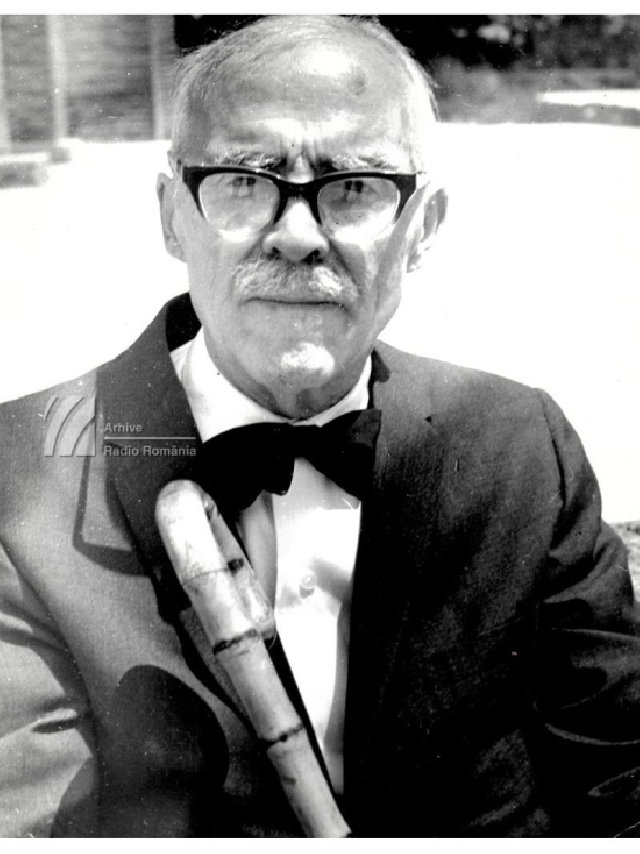
The poet Tudor Arghezi (1880-1967)

, 21.01.2024, 14:00


Born Ion Nae Theodorescu and using the pen name Tudor Arghezi, the 20th Century writer approached all literary genres, from poetry to short stories, novels, theatre and journalism, although he excelled in poetry. He was also passionate about painting and drawing.


Arghezi was born in 1880 in Bucharest and died in 1967 in the Romanian capital city. He made his debut in 1896, and in his early years he was close to Symbolism and the Vienna Secession movement. As a young artist, he became friends with the journalist and priest Gala Galaction and the left-wing writer Vasile Demetrius. During the 1907 uprising, he stood up for the oppressed peasantry, and became close to the Socialist-leaning writer and journalist N. D. Cocea. But during the same period he also wrote art criticism articles and he became close to Liberal-leaning personalities like Eugen Lovinescu and Ion Minulescu, as well as to art collectors like Krikor Zambaccian and Alexandru Bogdan-Pitești.


During the Great War, he expressed pro-German views in the “Gazeta Bucureștilor” (Bucharest Gazette), put out by the German occupation authorities between 1916 and 1918. At the end of the war, he was sentenced to 5 years in prison for collaborationism, but was pardoned by the king after only serving one year.


After the war, he worked extensively as a journalist and a writer. In 1928 he became the director of a literary publication called “Bilete de papagal”, which ran in 4 series, in 1928-1929, June-October 1930, 1937-1938 and 1944-1945, with well-known Romanian poets like Otilia Cazimir, George Topârceanu, Felix Aderca and Urmuz seeing their works published in it.


In the inter-war period, he wrote childrens literature, and during WWII, in 1943, because of a parody targeting the German ambassador to Bucharest, he was arrested for a year. The Radio Romania archive preserves an audio recording of Tudor Arghezi reading the 1931 poem “Flori de mucigai” (“Flowers of Mildew”), which dwells on his prison time.


After the war, Arghezis work was banned during 1948-1952 by the communist censorship. But thanks to Mihai Ralea, a cultural personality who had joined the ranks of the communist nomenklatura, his name was cleared and he took full advantage of his new position. He wrote poetry acceptable to the regime, and saw his 80th anniversary celebrated by the Academy of the Peoples Republic of Romania in 1960. On that occasion, Arghezi gave a speech exuding false modesty, duplicity and self-victimisation, in which he made a point of slandering pre-war democratic Romania:


Tudor Arghezi: “Although in the Socialist era my writing enjoys almost undeserved appreciation, a recital for me is overwhelming. It was my fate to experience the great chasm between two ages, both for literature and for my insignificant self. What was, in the old times, a writer, a composer, a painter or an actor? A lesser or a bigger shame, depending on the family in which they had been born. Personally, over the years I had to fight, during my creative years, against all the related cultural authorities: the academia, the Academy, poetry, prose, print media, the police, the judiciary, the censorship, the gendarmes and even my fellow writers. I was isolated, with my pen and my notebooks, on an ice bloc as large as the country, I was ridiculed, spit at, insulted. The only right and the only duty of a writer were to die on a mat in hospital or in a mental institution. Save for some patriotic poems, sung in the army and in primary school and written by Alecsandri, and for the works of Carmen Sylva, with their royal atmosphere, anyone else was irrelevant, almost loathsome.”


Tudor Arghezis home on Mărțișor street in Bucharest is now a museum, preserving the poets legacy. (AMP)
Lo scultore Frederic Storck
RRI Encyclopaedia Saturday, 21 February 2026

A Scholar of international repute – Traian Săvulescu

Traian Săvulescu used to be one of the leading figures of the Romanian science in the 20th century, a biologist, botanist, professor and president...

A Scholar of international repute – Traian Săvulescu
RRI Encyclopedia
RRI Encyclopaedia Sunday, 15 February 2026

General Henri Cihoski (1871-1950)

The history of the Romanians was also written by foreigners, just as Romanians are present in the history of other nations. Although a numerically...

General Henri Cihoski (1871-1950)
RRI Encyclopedia
RRI Encyclopaedia Saturday, 07 February 2026

The ancient city of Callatis

Callatis was an active commercial, cultural and spiritual center for over a millennium, spanning the Greek, Roman and Roman-Byzantine periods....

The ancient city of Callatis
RRI Encyclopedia
RRI Encyclopaedia Saturday, 31 January 2026

Romania’s Strongest Trade Bank before WWII

Marmorosh-Blank used to be one of Romania’s strongest banking institutions before 1945. It functioned under two generations of bankers, the first...

Romania’s Strongest Trade Bank before WWII
RRI Encyclopaedia Saturday, 24 January 2026

Archaeology in Glina, near Bucharest

Under the visible layer of today’s Bucharest and the capital’s surroundings lie much older traces of human habitation, which predate the...

Archaeology in Glina, near Bucharest
RRI Encyclopaedia Sunday, 18 January 2026

Monuments from Soviet-occupied Bucharest

On pedestals, in imposing poses, they have to convey inspiring messages across generations. War heroes and heroines, kings and queens, politicians,...

Monuments from Soviet-occupied Bucharest
RRI Encyclopaedia Sunday, 11 January 2026

The Corneşti Iarcuri Citadel

Just a few kilometers from Timișoara (western Romania), in the town of Cornești in the Banat Area, there are traces of one of the most spectacular...

The Corneşti Iarcuri Citadel
RRI Encyclopaedia Sunday, 04 January 2026

Ion Monoran

The Romanian Revolution of December 1989 created modern heroes—the heroes of the anti-communist civic movements whose goal was for human beings to...

Ion Monoran

Partners

Muzeul Național al Țăranului Român Muzeul Național al Țăranului Român
Liga Studentilor Romani din Strainatate - LSRS Liga Studentilor Romani din Strainatate - LSRS
Modernism | The Leading Romanian Art Magazine Online Modernism | The Leading Romanian Art Magazine Online
Institului European din România Institului European din România
Institutul Francez din România – Bucureşti Institutul Francez din România – Bucureşti
Muzeul Național de Artă al României Muzeul Național de Artă al României
Le petit Journal Le petit Journal
Radio Prague International Radio Prague International
Muzeul Național de Istorie a României Muzeul Național de Istorie a României
ARCUB ARCUB
Radio Canada International Radio Canada International
Muzeul Național al Satului „Dimitrie Gusti” Muzeul Național al Satului „Dimitrie Gusti”
SWI swissinfo.ch SWI swissinfo.ch
UBB Radio ONLINE UBB Radio ONLINE
Strona główna - English Section - polskieradio.pl Strona główna - English Section - polskieradio.pl
creart - Centrul de Creație Artă și Tradiție al Municipiului Bucuresti creart - Centrul de Creație Artă și Tradiție al Municipiului Bucuresti
italradio italradio
Institutul Confucius Institutul Confucius
BUCPRESS - știri din Cernăuți BUCPRESS - știri din Cernăuți

Affiliates

Euranet Plus Euranet Plus
AIB | the trade association for international broadcasters AIB | the trade association for international broadcasters
Digital Radio Mondiale Digital Radio Mondiale
News and current affairs from Germany and around the world News and current affairs from Germany and around the world
Comunità radiotelevisiva italofona Comunità radiotelevisiva italofona

Providers

RADIOCOM RADIOCOM
Zeno Media - The Everything Audio Company Zeno Media - The Everything Audio Company