Old Romanian books
The printing press emerged in mid-15th century. It was arguably the most important revolution in the history of the book and the circulation of texts. However, until then, books were little known objects. Books could be found in monasteries, at the nobles’ courts and the prices and kings’ chancelleries. In the Romanian space as well, the printing press fulfilled the function of promoting the written word for the use of the education system, worship, princely chancelleries. It was the printing press that made the book increasingly popular.
Radio România Internațional, 27.07.2024, 14:10
The printing press emerged in mid-15th century. It was arguably the most important revolution in the history of the book and the circulation of texts. However, until then, books were little known objects. Books could be found in monasteries, at the nobles’ courts and the prices and kings’ chancelleries. In the Romanian space as well, the printing press fulfilled the function of promoting the written word for the use of the education system, worship, princely chancelleries. It was the printing press that made the book increasingly popular.
However, in the past, books were nowhere near the objects we see today, simple, user-friendly, accessible to everybody. In the past, books were the outcome of a remarkable intellectual and physical amount of work. Books had sumptuous covers, with engravings and decorations, while, in turn, their pages were decorated with suggestive drawings, the calligraphic text being a manual work of art in its own right.
A key element of the old books, that including the books of the Romanian Principalities, was the hallmark of the one who had paid for their being brought out: a prince, a bishop, a nobleman, a merchant. And by that, we mean the emblem of the family, but also the dedications in verse that went with the volume, created by those who curated the edition.
The Bucharest Municipality Museum has mounted an exhibition of Old Romanian books from the 17th to the early 19th century. The theme of the exhibition were the princely emblems and the rhyming lines that went with them. Bucharest Metropolitan Library holds a collection of Old Romanian books. The Library’s Ramona Mezei told us that the exhibition themed “Old princely books with emblems and poetical rhyming lines” was of great value, were it only to for the fact that it had items that were hundreds of years old.
” Most of the old books that are exhibited are worship books. And that somehow comes as something natural, given the timeframe when they were created. It was of utmost importance, in the old days, that those printed items were brought out under the patronage of the ruling princes of that time. Somehow in a bid to come up with a token of gratitude towards the ruling princes, in the printing process, the emblems were also printed. Moreover, those who curated the edition, editors and even printing workers, they created some sort of rhyming lines. That is, there were verses, some of them serious, others, funnier, yet it was important for that to be done. The very moment an image was imprinted, the book also became a source of beauty, apart from the fact that, broadly speaking, a book was a source of wisdom. In the long run, books have been, are and will be of a priceless value, all the more so as the seal of time put its hallmark on them. “
Museographer Daniela Lupu is the one who coordinated the exhibition. Ms Lupu was keen on highlighting the central place of the emblem of the prince, the one who was the patron, as well as the value of the literary compositions dedicated to him.
”The emblems are points of interest for those who are into heraldry. The rhyming lines were studied by the literary historians. Some of them detected, in those rhyming lines, the beginning of the deferential poetry in Romanian language, even though, in the beginning they were just little rhyming lines. Their authors are great scholars of the past centuries: Udriște Năsturel, Antim Ivireanul, chancellor Radu Greceanu. Dating from the 17th century, these verse, poetic rhyming lines or political rhyming lines, just as they appear on the books, are still of great interest, even to this day. “
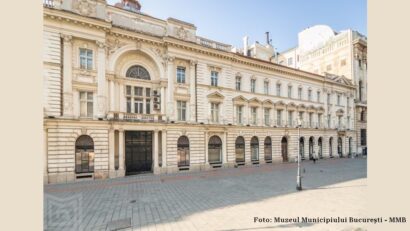
The books that are on display in the glassed cases of the Sutu Palace in Bucharest city center inspire us to take a journey in the past. Here is Daniela Lupu once again, this time telling us the exhibition is also a look back at how emblems and dedication vary, in the course of three centuries.
“If, broadly speaking, it is accepted that the princely emblems on the printed books, beginning with the first books printed in Wallachia and Moldavia, appear as early as the 16th century, we can see that beginning with the first printed books, such as Macarie’s Service Book of 1580. The Wallachian emblem is printed on the frontispiece. Then this emblem has its place on the books’ back page, just as we usually find it later. That happened in the time of Matei Basarab, in the 17th century. We have made an attempt to depict the evolution of how the princely emblems are being presented and we noticed the themes did not comply with the writing rules or the classical composing rules of the rhyming heraldry.”
The books with princely emblems and poetic rhyming lines are more than the aesthetic flavor they have. The beauty of the language in which the rhyming lines were written goes ties in with the beauty of the images. The Cyrillic alphabet the Romanian language used for a couple of centuries when knowledge was conveyed, as well as the calligraphy, they are attractive because they cannot be understood at a single and cursory glance alone.
From what can be noticed of the old books with princely emblems and their dedications, we get info about the people who lived back then, about the universe they were brought up in and the social position they held. We find out about ruling princes and the representation of power, about economic, political and cultural elites that professed the ideas of their times, we find out about moral principles and values that stood the test of time and are still valid, as we speak. And, not the least, we find out we resemble those who lived before us more than we can imagine.