Physics. Magic. Progress.
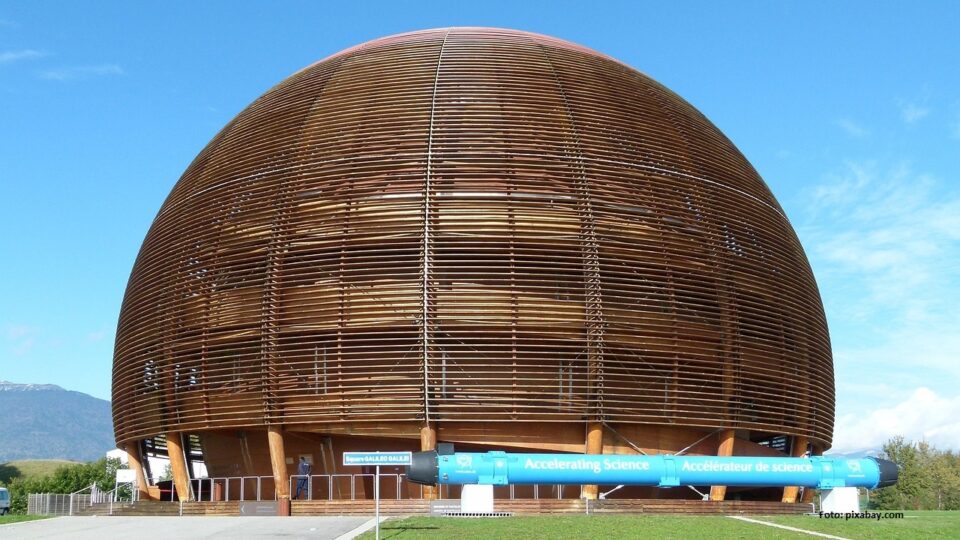
The European Organization for Nuclear Research in Switzerland, CERN, as it is known, benefits from the presence of a community of over 100 Romanians working in research.
Ana-Maria Cononovici, 07.07.2026, 14:00
The European Organization for Nuclear Research in Switzerland, CERN, as it is known, benefits from the presence of a community of over 100 Romanians working in research. Cristina Andreea Alexe is one of the employees, being a PhD student at the CMS experiment (The Compact Muon Solenoid), a general-purpose detector at the particle accelerator.
Cristina Andreea Alexe told Radio Romania about the practical applications of the research here: “CERN actually comes from French, Conseil européen de la recherche nucléaire, the European Organization for Nuclear Research. It is a European association, it has mainly European members, and also associates from non-European countries. It is an international laboratory for fundamental physics research, which ultimately finds applications in society. It has already happened. For example, we use the internet, the worldwide web platform was invented at CERN and it was worth it! And other applications that are under development include proton-based cancer therapies, which are less invasive, in the sense that they can attack the tumor and do not affect the surrounding healthy tissue, which would be a revolution in therapies like this. So the best place where you can study how to manipulate protons the way you want is the largest proton accelerator. Even though we start the stories from the fundamental part of science, they end with smiles on people’s faces.”
We learned from our interlocutor that initially she wanted to be a physician and save lives, so she attended a high school specializing in natural sciences, but over time she realized that she wanted to do something bigger, to bring a change to society, so after thinking about social sciences, she considered IT, she returned to a passion from her secondary school classes, more precisely, physics. Cristina Andreea Alexe is at the microphone with details: “In 2018 when I started the faculty, it was still affordable to study in the UK and I studied there, I did a bachelor’s and master’s degree, meaning that in 4 years I wrote only one thesis, the Master’s degree thesis and I graduated with a Master’s degree from the University of Manchester. And then to continue and stay in research, I looked for a PhD student position, and eventually I ended up where I am now, at the best university in Italy. I found out after I was admitted that it was the best, it is the Scuola Normale Superiore di Pisa. I’m doing my PhD research there, working on a data analysis project, data taken from the CMS experiment, from CERN. I ended up doing data analysis-programming. That’s what I do every day. And statistics. Surprisingly a lot of statistics.”
How does this change the world? Cristina Andreea Alexe states that the idea of change brought to the world has remained: “I feel this best when I come home, to Buzău, and talk to my students about what I do and think about what skills I have managed to gain and I hope to convince them too. I consider my contribution to be the fact that I am part of an experiment with a unique mission, the idea of continuing fundamental research. And I am one of the people who have the motivation to get to know what we do not know now. We push humanity’s knowledge as far as possible!”
Cristina Andreea Alexe assured us that physics is not magic: “In the scientific world, there is more and more talk about communicating. Communicating with the non-scientific community, normal people, children in school, about what we do. And it is always said that you should not talk as if physics was a magical thing and you were some sort of wizard. I mean, people need to understand what we do, it is the healthiest thing in a society.”
Next she explained what CMS is: “It’s a tunnel with a 27-kilometer circumference, which is located 100 meters underground, between Switzerland and France, near the city of Geneva. For it to work, we need a huge team of people. In my experiment alone, we have around 4,000 collaborators, and we need engineers who operate this experiment, we need IT people who operate the servers, who make sure that our data stays there, and in the end it comes to people like me, the physicists. I am among those who analyze this data and extract the actual information from it.”
Cristina Andreea Alexe’s PhD thesis, on the CMS experiment, refers to elementary particles that could indicate a new force of nature. For such researchers, limits are not insurmountable, they are merely pretexts for a new discovery. (LS)