On the International Roma Day: about the danger of exceptionalism and the importance of learning contexts
The International Roma Day was established on April 8, 1971.
Iulia Hau, 23.04.2025, 14:00
The International Roma Day was established on April 8, 1971. Although the Roma represent the second largest ethnic minority in Romania, sociologists unanimously agree that the official figures do not even approximately reflect the total number of Roma citizens in Romania.
Most media materials about the Roma document either the levels of discrimination and segregation to which the members of this community continue to be subjected, or the increasingly numerous prominent Roma personalities. Meanwhile, in Vizurești, a village in Dâmbovița County, southern Romania, Ionela Pădure, together with her husband, are creating learning and development contexts for Roma and non-Roma children in the village, right in the courtyard of their house. Ionela Pădure says that, until recently, most studies on the Roma community had been carried out by people outside the community. In recent years, however, more and more people from the community have joined the ranks of the intellectual elite, as sociologists, historians, or artists, and are sitting at the table of discussions. They bring that personal perspective without which political changes cannot have a practical impact on everyday life.
Before returning permanently to Romania and founding the Vizurești People’s Research and Documentation Center, Ionela Pădure completed her studies abroad and taught French at a college in France. However, she believes that the discourse about certain Roma that they are “exceptional” does as much disservice to the community as the discriminatory discourse: “From my point of view, when we talk about the Roma, we should not talk in terms of ‘they have risen above their background’, ‘he or she is an exception in the Roma community’… Because I think that causes us more harm than good. These intellectuals that I was talking about earlier, who rose from those vulnerable communities, had a context. I always talk about myself as the result of my interactions with Roma and non-Roma people. I mean, Ionela Pădure had the chance to study at the Sorbonne because she came across teachers who believed in her more than she believed in herself sometimes. Look at (Nicolae) Furtună, our sociologist, at Rowena Marin, at Cristi (Pădure), at the level 1 certified Romani language teachers, with PhD degrees. Look at Professor Negoi… These people had a context, they had other people around them who helped them grow. What happens in communities is that, besides socioeconomic problems, there is this whole range of racist attitudes which materialize in discrimination. And, to overcome these things, an additional effort is needed, which some make, others don’t. But if they don’t make it, that is, if you don’t get to study at the Sorbonne, it doesn’t mean that you are less okay, less good, less valuable. Success is relative. And it seems to me that when we talk about Roma communities, we need to emphasize this idea of diversity. We don’t need to reach a certain level of performance to talk about ourselves.”
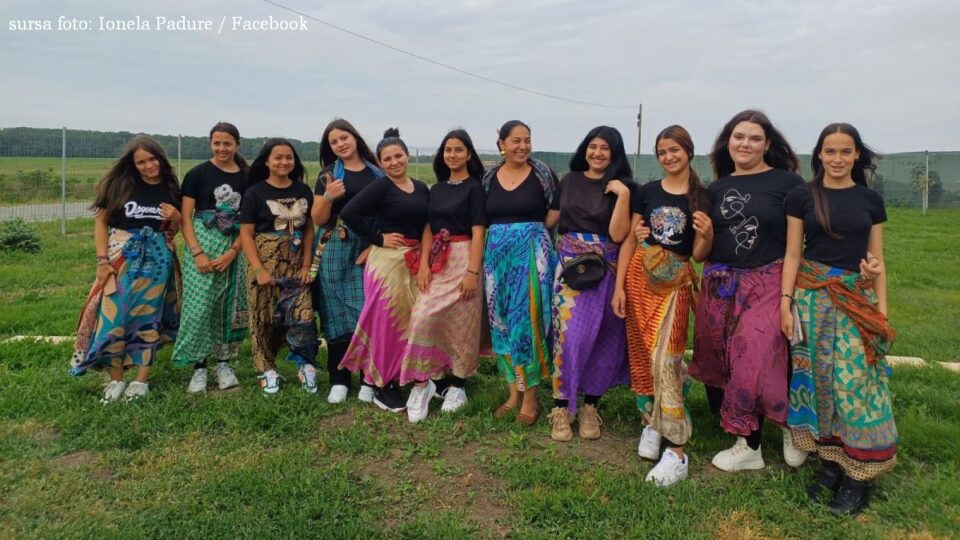
Ionela Pădure says that she finds it equally valuable to bring to light stories about ordinary Roma — like her mother who, without academic achievements, was a very organized woman, raising six children in much less favorable conditions than she has now. Ionela celebrated April 8 this year with the Roma feminist organization E-romnja and other Roma women, of different ages, from several communities around the country, discussing their daily lives. She believes that the life experiences of those women deserve to be told and known. She also says that, after returning from France, she spent two years observing and getting to know the children in the village of Vizurești to figure out what they like to do and what they need: “Vizurești is not my village. We chose to live here after we returned from France. And then I sat and observed the children… what do the children of Vizurești do? And I tried to observe what skills they have, which, as you said, are not necessarily validated by society. Simply, what do they know, what can they do? Girls dance and boys fight. Ok, we need to build and develop soft skills. Okay, let’s connect with what they know. So, we developed dance classes and boxing classes, with this idea in mind: to develop the relationships between them, the way they manage their emotions, their identity, and so on. We have been doing this for five years and every course we add to our activity comes from them, from the children. I have been working with children for five years and so far I have never told them “as tomorrow we will play chess”, for example. No. I ask them. What do you want us to do? Do theater? Good. Let’s do theater. Why? Because they need to express a lot of things. Let’s build on the skills you already have, because we don’t ‘build’ children for contexts, we build contexts for children. And this is happening in Vizurești, and my medium and long-term goal is to train new generations of facilitators and trainers. Maybe in five years I’ll go to Paris again and things have to continue after I leave.”
Ionela Pădure insists that the trainers at Vizurești are exclusively people that the children know. She also tells how, nowadays, older children with more experience often prepare and organize the younger ones. For her, when a child feels valued for the competence he or she has, their self-esteem solidifies, their relationship with themselves grows healthily, and this gives them the courage to expand their field of action and interest. (LS)