Optimism over the future of the Republic of Moldova
In late August, Moldova marked 30 years since the proclamation of its independence from the former USSR
Corina Cristea, 17.09.2021, 14:00
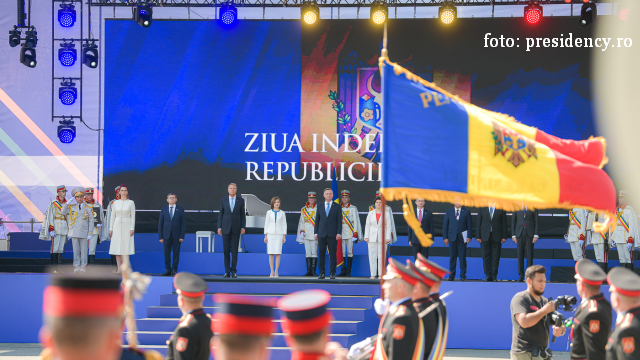
The end of August, when the Republic of Moldova marked 30 years since the proclamation of its independence from the former USSR, found Moldova in a good moment, when relations with the western partners are improving in the context of Maia Sandu’s victory in the presidential election held in November 2020 and of the departure from power of the Socialist Party and its allies, following the parliamentary elections held in July this year. Forcefully engulfed within the former USSR in 1940, the Republic of Moldova, located across the Prut River and having a majority Romanian-speaking population, proclaimed its independence 51 years later, in a political context characterized by similar moves in its neighboring countries.
A guest in Radio Romania’s studios, the historian Adrian Cioroianu, a former foreign minister of Romania, analyzed those events in an attempt to explain how the idea of separation emerged: “The context was created by that favorable period in the history of Eastern Europe marked by Mikhail Gorbachev’s reforms in the Soviet Union. This was actually the trigger, and also the decision of other states such as Ukraine and Belarus and Boris Yeltsin’s Russia to break with the Soviet Union, which actually turned Mikhail Gorbachev into an apprentice sorcerer. His own reform turned against himself, and he could no longer control things, he came to rule a Soviet Union that practically did not exist anymore. That was the moment when the Republic of Moldova, back in 1990, and before the dissolution of the Soviet Union, started regaining its identity. Everything started as a cultural movement. Let’s not forget that the first claims of recovery were related to culture and identity, and I’m referring to the Romanian language, the Latin alphabet, and the rediscovery of the identity of a culture of European origin. This cultural claim became the foundation on which, in August 1991, independence was proclaimed. Unfortunately, independence was proclaimed in parallel with the start of a conflict, as the conflict on the Dniester had just started.”
Besides the situation in Transdniester, a Russian-speaking region which continues to consider itself independent from the Republic of Moldova, and which is supported by Moscow, Moldova, the former Soviet republic with a majority Romanian-speaking population, has faced serious economic crises over the past 30 years, especially in 1998, and had to cope with domestic political turmoil and large-scale protests. After, in 2009, it stated that its main foreign policy target was the rapprochement to the European Union, the Republic of Moldova obtained, among others, a visa waiver agreement and signed a free trade agreement with the EU states. Nevertheless, several years later, relations with Brussels soured after one billion dollars disappeared from Moldova’s banking system in 2014, after several important reforms, among which the reform of the judiciary, reached a deadlock and after, in 2016, a pro-Russian president Igor Dodon was elected. Now, with the victory of pro-western Maia Sandu in the November 2020 presidential election and the departure from power of the Socialist Party and their allies following the parliamentary elections held this year in July, relations with western partners seem to get revived.
According to political analyst Vlad Turcanu, the current political situation in Moldova is a chance for it to go back on the European path: “The Republic of Moldova has a huge chance to reiterate, once again, and maybe, to strengthen its European aspirations after a difficult enough period which it has experienced over the past years. After these 30 years, and after the latest developments in Moldova, namely two consecutive victories in the presidential and parliamentary elections by the pro-western politicians, the Moldovan citizens have reason to hope that Moldova will return on the path assumed in 1991.”
In her speech on the anniversary of 30 years of independence, President Maia Sandu underscored that the top priorities of the new power remained building the rule of law in the Republic of Moldova and ensuring a decent life for the Moldovan citizens. What projects does the Republic of Moldova need?
Political analyst Anatol Țăranu from Chisinau explains: “I believe that the main project which the Republic of Moldova needs today is the consolidation of state institutions, which are able to give a correct orientation to the development of the state of the Republic of Moldova. And what Maia Sandu and the team that has now come to power do – their fight against corruption, the attempt to strengthen state institutions in terms of policy coherence that are promoted in the Republic of Moldova in various fields – is in line with the idea of consolidation. On the other hand, the Republic of Moldova will not be able alone to achieve this major goal of becoming a prosperous society, which guarantees the fulfillment of democratic rights and the well-being of its citizens, if it does not embrace the goal of European integration, of becoming a European state. And this, again, is unlikely to happen if the Republic of Moldova does not strengthen its relations with Romania, because Romania is, in fact, the country that most sincerely supports the Republic of Moldova on its way towards European integration.”
Romania was the first state to recognise the independence of the Republic of Moldova 30 years ago and now, the Romanian President Klaus Iohannis has reiterated Bucharest’s commitment to supporting the reform and European integration processes assumed by the Moldovan authorities.(LS)