Romanian castles
A look at some of Romania’s most imposing castles and princely residences.
Daniel Onea, 11.12.2025, 14:00
Today we will introduce you to some of Romania’s most imposing castles and princely residences, which are not simple stone structures, but genuine testimonies to long-gone eras. We will begin our journey in Prahova Valley, in the south of the country, for a visit to the Peleș Royal Estate, an ensemble of great architectural value. Built in the style of the German Renaissance, it used to serve as the summer residence of King Carol I (10 May 1866 – 10 May 1881, 10 May 1881 – 10 October 1914). A guided tour of the castle also includes rooms that were closed to visitors for a long time. Paul Popa, the director of the National Centre for Tourist Information and Promotion in Sinaia, tells us more:
“Visitors who wish to find out the entire history of the castle can see the castle from the ground floor all the way to the loft. The loft was closed for 47 years for various reasons. Visitors will now be able to see very important and unique things, it’s a space that is a bit different from the rest of the castle, it’s more intimate and where the queen’s ladies in waiting used to spend their time. King Michael used to have an apartment there when he was a child. The loft also houses the drawing room, where drawing lessons were held for the king, the queen and their close friends.”
The royal estate is also home to Pelișor Castle, a smaller structure but very beautiful, which used to be the residence of heir to the throne Ferdinand and his wife Marie. Pelișor represents a surprising stylistic transition, being the clear expression of Queen Marie’s artistic taste for the Art Nouveau.
“Pelișor Castle has stayed just the way it used to be. Queen Marie embraced the Art Nouveau style and left her mark on the castle, which, although it closely resembles Peleș Castle on the outside, it is a whole different thing inside. It’s the only completely Art Nouveau castle in Romania. It is also home to the queen’s heart, which was brought here, as was her wish, so that she would be close to the people she loved so much even in death. Queen Marie’s heart is placed in the room that the queen liked the most, which was designed entirely by her, in the Golden Salon of Pelișor Castle. It is covered with the flags of Romania and Great Britain, reminding of the British origin of the Romanian queen. Pelișor Castle will add to the whole picture, with visitors having travelled through many different, yet delightful styles and epochs, from the German Renaissance to Art Nouveau.”
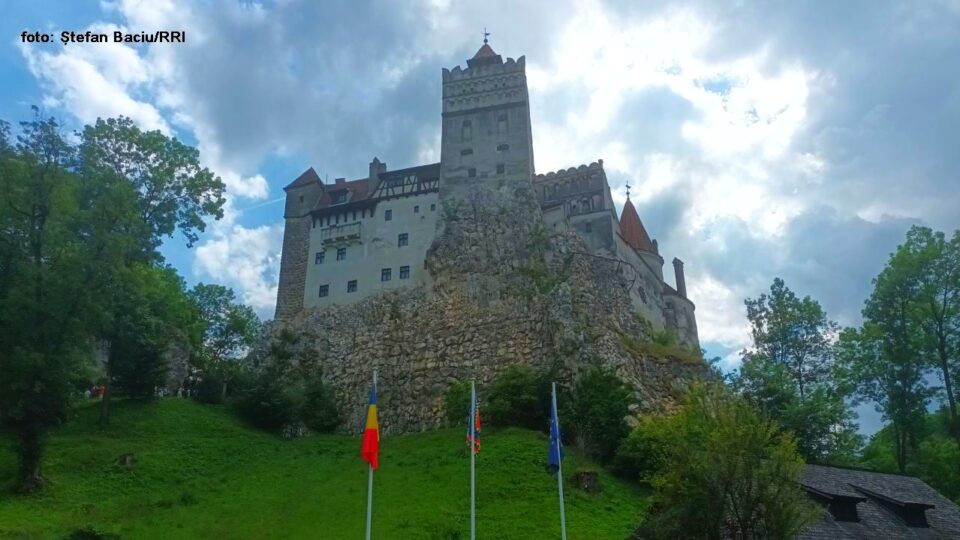
Our journey continues to central Romania. Here, Bran Castle remains one of the most popular tourist attractions. Although it is most often associated with the myth of Dracula, its real history is much richer, being also liked to the Teutonic Knights, the voivodes and, later, Queen Marie of Romania (b. October 29, 1875, Eastwell Park, Ashford, Kent, England – d. July 18, 1938, Pelișor Castle, Sinaia, Kingdom of Romania). The Bran Caste has benefited from major investments over time to improve the visitor experience. Alexandru Priscu, marketing director, tells us more about the constant efforts to develop the whole complex:
“There hasn’t been a single year, since 2009, that we haven’t had discussions and projects for the development of the property, the Bran estate. Some of these projects are less visible to the public, such as the restoration of the rooftop. On the other hand, the work on the southern facade was quite visible. Another project was the Time Tunnel, which consisted in the introduction into the tourist circuit of an elevator that goes down from the inner courtyard of the castle, on the ground floor, to the Royal Park. It is a 34-meter ride, through the rock. We also restored the Tea House and opened it for visitors, and we restored the Administrator’s House. Also worth noting is the exhibition “A History of Fear in Transylvania”, an exhibition that was launched in 2020 during the Covid lockdown and which transformed the fourth floor of the castle into a large exhibition space showcasing characters from Romanian mythology. For many years, Bran Castle was the only museum to be open 7 days a week, with no exceptions. It’s also open on Christmas Day and on the first day of the year.”
Finally, we’re heading to western Transylvania, to Hunedoara, to admire the Corvin Castle, considered one of the most beautiful medieval castles in the world. It is an imposing building, with bastions, towers and an impressive courtyard. It is also a true foray into medieval life. Tourists can explore defensive structures and valuable decorative elements, as well as areas that preserve the memory of stories passed down through the centuries, as we learn from Sorin Tincu, director of the Corvin Castle Museum:
“Visitors to the castle will first arrive at the fountain, around which there exists a very well-known legend. It has it that the foundation was built by three Turkish prisoners who worked for 15 years digging in dolomitic limestone to reach the groundwater. However, upon completion of the work, they were not granted their last wish, that of being freed, and they were executed. According to the legend, one of the prisoners scribbled on the walls of the castle the following sentence: ‘You may have water, but you have no heart.’ Next, visitors can visit the Gothic lapidarium, displaying a series of Gothic elements removed from the walls of the castle during the 19th and 20th century restorations, followed by so-called Artillery Terrace or Ammunition Bastion, another 17th century construction, and then the Bears’ Pit. This is a courtyard on the edge of the castle where legend has it that bears used to be kept and which were fed the prisoners taken.”
These fortifications are not just unforgettable tourist attractions, but genuine history lessons and witnesses to fascinating eras that invite visitors to exploration and discovery.