Sighisoara
The citadel was first mentioned in documents in 1280 but there is evidence that the area has been inhabited for 4 thousand years. Located in central Romania, Sighisoara is visited by thousands of tourists every year.

Daniel Onea, 28.06.2018, 14:42
The citadel was first mentioned in documents in 1280 but there is evidence that the area has been inhabited for 4 thousand years. Located in central Romania, Sighisoara is visited by thousands of tourists every year.
Romania boasts as many as 250 citadels and fortified churches. Sighisoara citadel or Schasburg was included on the UNESCO heritage list in 1999, being one of the few still inhabited citadels in Europe, and a hotspot with foreign tourists who come to visit Romania.
Adrian Burlacu, a former local councilor and currently a tourism entrepreneur, will tell us next why Sighisoara is a must in one’s tourist itinerary: “Sighisoara is among the world’s top 12 tourist destinations, so it’s worth a visit. Actually any important international travel fair will tell you this. Sighisoara has great accommodation facilities and the offer for tourist routes is quite rich. The medieval citadel also boasts an area called Dracula, which is very attractive for tourists.”
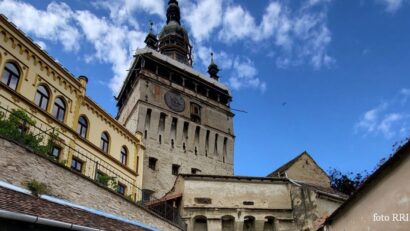
The main monument of the Sighisoara citadel is the Clock Tower which is 64 meters high. Inside it you will find the town’s History Museum set up in 1899. The tower has 6 levels, and on each level there is a different exhibition: archeology, medieval pharmacy, medieval furniture, tools that belonged to the guilds of Sighisoara and an impressive collection of clocks. The mechanism of the big tower clock dates back to 1906. This Swiss mechanism also sets in motion the clock’s figurines which are unique in Romania. Some of the figurines represent the days of the week while others represent various deities such as the Goddess of Justice, the Goddess of Fairness and the Goddess of Peace. The last level of the clock tower is an open balcony which offers a wonderful panoramic view of the citadel.
The clock tower is actually the entrance gate to the town, says Adrian Burlacu: “When you enter the citadel, you first pass under the clock tower, where you can visit the weaponry area. The History Museum is right inside the tower. Then you can visit the other towers: the blacksmiths’ tower and the tailor’s tower. One of them hosts various cultural events. You will also discover a covered staircase in Sighisoara, which is very beautiful. Sighisoara is first of all a cultural destination, we do have beer gardens too, but they have a medieval look. They usually close at 10 p.m. Tourists can sit at the beer garden in the Citadel’s Square. We also have night clubs but they are not a destination for a cultural location like Sighisoara.”
The citadel is an open-air museum. It also boasts many coffee shops and tea houses, places where tourists can relax and exchange opinions. There are certain periods every year when the citadel’s streets are more animated than usual and the medieval times are being brought back to life. In the upcoming period events such as the Craftsmen’s Fair, “Sighisoara Medievala” Festival, “Academia Muzicala” Festival, The “ProEtnica” Intercultural Festival and the Brass Band Music Festival will be held.
The citadel’s cultural agenda is full, says Dorin Stanciu, the drummer who welcomes tourists to Sighisoara: “Sighisoara is the city in the area with most activities for tourists. As many as 60 events are organized here every year. Many of the festivals in Sighisoara are famous all over the world. The most important one, which is also one of Romania’s brands, is the Medieval Art Festival. The ProEtnica Festival is the most beautiful festival in the country. It brings together all 20 minorities, who wear traditional costumes and sing songs in their own language. The citadel promotes itself via cultural tourism, through the Christmas Fair and the Sighisoara Days. For a year, a medieval train has been running in the Citadel Square. As of this year, tourists can listen in the headsets to a presentation of these places’ history. They get on the train, visit the citadel and listen to the history of the Saxons in Transylvania and Sighisoara.”
Also in Sighisoara tourists can visit the Monastery Church and the Hill Church. These are churches built in the Gothic style, more than 800 years ago. They belong to the German community here, but, due to the ever smaller number of ethnic Germans, during the summer season these churches are turned into museums. They are open to visitors Monday to Saturday while Sundays the religious service is held. On their way to the two churches, tourists come across the Covered Staircase, or the Students’ Staircase, as it is also called. The stone stairs in the upper part of the citadel are covered by a wooden structure, which gives them the aspect of a tunnel.
No wonder that the number of people visiting Sighisoara grows by the year, according to Dorin Stanciu, the citadel’s drummer: “This is the only place in Romania where we greet tourists in 60 languages, on behalf of the Sighisoara Town Hall. From Israel alone we have 34 thousand tourists every year. They appreciate the fact that I welcome them in their own language and the fact that I sing their songs. We also have tourists from Japan, around 10 thousand a year. We also greet them in their own language. We do something unique here in Sighisoara. (…) Sighisoara looks very good. It has preserved its Middle Age look and its 930 meters of fortified walls. Works on the infrastructure are under way. A number of projects are unfolding in Sighisoara. We are trying to get funds from the Culture Ministry and repair the wall, the nine towers and the 160 houses rebuilt after the big fire of April 30, 1676.” (Translated by L. Simion and E. Enache)