Andrei Epure’s Debut: “Don’t Let me Die”
Today we bring you a short interview with director Andrei Epure, co-writer alongside Ana Gheorghe of the film "Nu mă lăsa să mor" (Don't Let Me Die)
Corina Sabău, 24.01.2026, 12:02
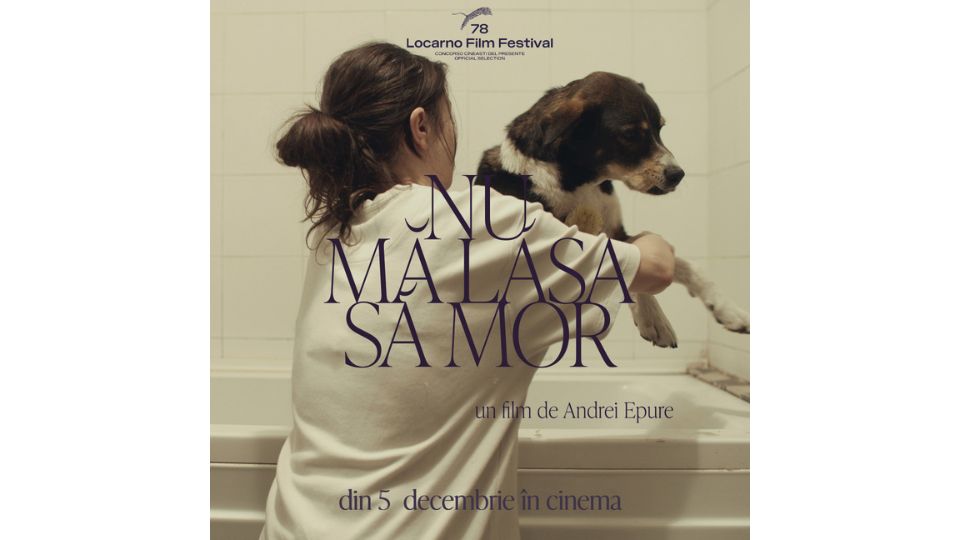
Today we bring you a short interview with director Andrei Epure, co-writer alongside Ana Gheorghe of the film “Nu mă lăsa să mor” (Don’t Let Me Die). Premiered at Locarno, in the section dedicated to new voices in cinema, the film deliberately explores an area of ambiguity, oscillating between arthouse horror and an absurd comedy about death, a combination that defines the irreverent humor present in other screenplays by Andrei Epure. In “Don’t Let Me Die,” director Andrei Epure expands on the story from “Interfon 15,” presented in 2021 at “La Semaine de la Critique,” a section of the Cannes Film Festival, exploring in his feature film debut a world where the line between absurdity and human fragility is becoming increasingly blurred. Filmed over 26 days in Eforie, Mangalia, Neptun, Olimp, and Bucharest, “Don’t Let Me Die” follows the efforts of Maria (played by Cosmina Stratan), who tries to organize the funeral of her enigmatic neighbor, Isabela (played by Elina Löwensohn). A humane gesture throws her into a maze of bureaucracy, strange encounters, and oppressive silences. The story in “Don’t Let Me Die” was born from a memory of co-writer Ana Gheorghe about a lonely neighbor who died near her home. “Essentially, the film is a cry against oblivion,” says Ana Gheorghe, who is also the film’s producer.
We talked with Andrei Epure about how he constructed the portrait of the main character in “Don’t Let Me Die” and about his sources of inspiration:
“I was interested in how I could portray someone in their absence, that is, a person who becomes more present after death than they were in life. In a somewhat simplistic way, post-mortem is the only way you can build a portrait of someone, because death offers finality, and this finality allows us to draw conclusions, even if they are still based on fragmentary observations. For example, the portrait of the character Isabela is made up of just a few elements: she talked to trees, she had two dogs, she was a teacher of Latin, and she had a child. I was also interested in what the mysterious life of an enigmatic character might leave behind. In this case, what remains after this woman’s death are two dogs. What can the two dogs convey to the woman in her absence? I tried to explore this, what remains after someone’s death. I was also attracted to this subject because it is related to my childhood. I grew up in Gorj, in Alimpești, and I can say that I had a very special relationship with my grandmother and great-grandmother. Among other things, it was a film made out of a desire to communicate with animals, but also with my childhood memories.”
Andrei Epure also told us how the story in “Don’t Let Me Die” oscillates between several registers and how this stylistic ambiguity reflects his artistic intentions:
“Now I see it as a film set on the edge, and I think that’s the best way to describe it. I’m referring to a liminal zone, somewhere between realism and fantasy, between comedy and horror — a combination that, I suspect, can be disturbing. Even the comical moments are somewhat uncomfortable; it’s not always clear if or when you should laugh, sometimes you can’t tell what the director or screenwriter’s intention was. In short, you don’t know if those sequences were directed to provoke laughter or to create a different sensation. I didn’t go to the screening in Bucharest, at Les Films de Cannes a Bucarest, because it’s hard for me to go to screenings, but I heard from those who did go that there was laughter at moments when I wouldn’t have expected it. I think the audience felt the need for a form of liberation, of relaxation. It was as if people were asking themselves: What does this film want from me? And I really like that. There was also this intention to make a film that starts out realistic and then opens up to other areas—I would call them transcendental or surreal. I applied this false dichotomy throughout the film, both in terms of style and tone, including the sound design. In other words, the story somehow always remains in an intermediate stage.
Produced by Saga Film, the movie “Don’t Let Me Die” brings up a pretty alarming issue: people who live alone. According to the study “Dimensions of Loneliness” conducted by the Never Alone – Friends of the Elderly Association, in partnership with Kantar Romania, more than half of the elderly in urban areas in Romania face loneliness, and nearly 310,000 of them feel it very strongly. Beyond the fictional story, the film brings to light an ignored reality in Romania: lives that fade away in silence, neighbors we only discover when they are gone, people who only become visible at the moment of death. In this context, the partnership with the association supports a common mission: to bring the issue of elderly isolation back into the spotlight and encourage the public to get actively involved. The organization urges viewers of the film to become volunteers, to offer support, time, and companionship to those who live alone—small gestures that can change lives. (MI)