Exhibition ‘Why We Should All Be Feminists’
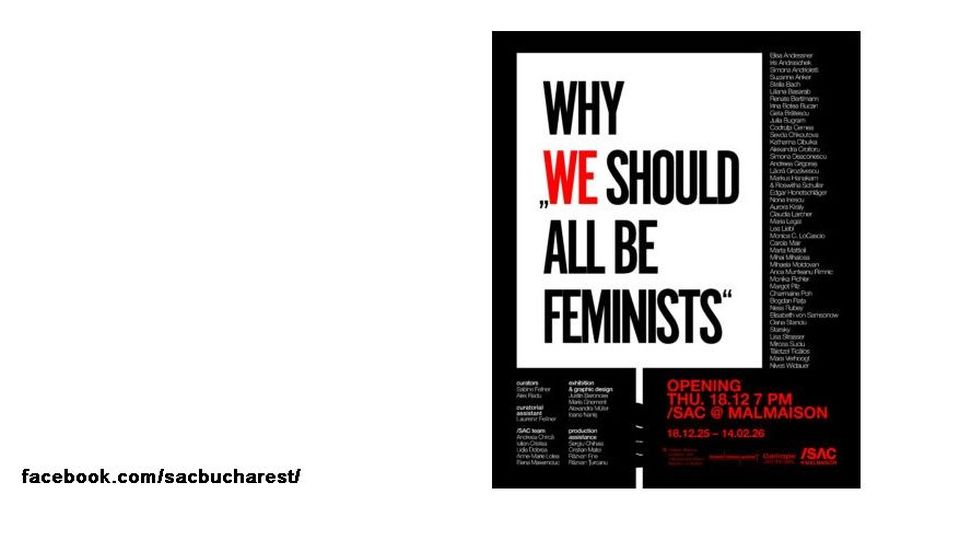
Following the success of the 2024 exhibition “Touch Nature”, curators Sabine Fellner and Alex Ion Radu bring together the works of 45 leading artists from Romania and Austria in a new, far-reaching project that dismantles taboos.
Corina Sabău, 14.02.2026, 14:00
Following the success of the 2024 exhibition “Touch Nature”, curators Sabine Fellner and Alex Ion Radu bring together the works of 45 leading artists from Romania and Austria in a new, far-reaching project that dismantles taboos. The exhibition “Why We Should All Be Feminists” is a plea for a change in the way we have become accustomed to responding to old social dynamics and for the construction of new ones. The exhibition opened at the end of December and is organized by /SAC – Contemporary Art Space and the Austrian Cultural Forum, with the support of the Austrian Ministry for European and International Affairs. Artists from the two countries try to propose solutions and ideas for fairer and more sustainable communities that accept diversity and differences, and show more care for their members. The works, all of great impact, are extremely diverse: from drawing and painting to video art and installation, contemporary art projects from the 20th and 21st centuries. The exhibition is part of the international project “Why We Should All Be Feminists”, conceived by Sabine Fellner and developed in numerous countries around the world, in collaboration with the network of Austrian Cultural Forums.
We spoke with Andrei Popov, deputy director of the Austrian Cultural Forum, about some relevant moments in the history of the feminist movement that are illustrated in the exhibition Why We Should All Be Feminists: “Basically, this exhibition goes back to several moments that feminist art in Austria has gone through since 1968. In the early 1970s, a group of artists called Impact was formed in Vienna. In a completely different form, this group still exists today. The artists in question brought extremely current themes into the context of society at that time. However, the evolution of feminism in Austria and Romania is very different in every way. What interested us, as organizers and curators, was to mirror these two developments. In Romania, the communist regime gave a completely different meaning to the idea of feminism. It is very interesting to see how feminist art in Austria has evolved compared to that in Romania. Because this exhibition – and here is the most interesting thing – brings together artists from all these waves of feminist art since 1968, mirrors them, and the comparisons are extremely interesting.”
In 2012, Chimamanda Ngozi Adichie, a Nigerian-born writer and activist, gave a speech at TEDxEuston in London entitled “We Should All Be Feminists”. This feminist manifesto advocated for a more just world, in which people are truly equal, regardless of gender and cultural identity. Although, at the legislative level, there has been much progress in terms of legal equality for women, everyday life shows that the concrete situation is often much more nuanced and complex, if not different from legal texts. Gender continues to influence social position, access to resources, rights, economic interests and perspectives. Starting from the theme of the exhibition Why We Should All Be Feminists, which proposes a dialogue about the way gender and equality are addressed today, the question inevitably arises whether art has greater freedom than public discourse in dealing with these topics.
Andrei Popov: “Definitely, because art can propose things that, in public discourse, cannot be said or are quite difficult to express. The idea of art, in general, is to shake up social edifices, community edifices, preconceived ideas, clichés, stereotypes and so on. I firmly believe that it is essential that, at the moment, there are discourses and positions taken by artists that can provide a cold shower to public discourse and the mainstream. And this is what happens in the exhibition Why We Should All Be. Currently, public discourse is very inflamed on various political and social topics and often gets lost in pointless polemics. Many times we no longer know very clearly what we are defending and what we are contesting. I believe that art has this power and even this duty to pull us by the sleeve and put us back on track. That is why people really enjoyed the idea of this project, because it allows us to say things and touch on essential topics.”
The exhibition Why We Should All Be Feminists can be visited until February 14, at /SAC – Contemporary Art Space, @ Malmaison.