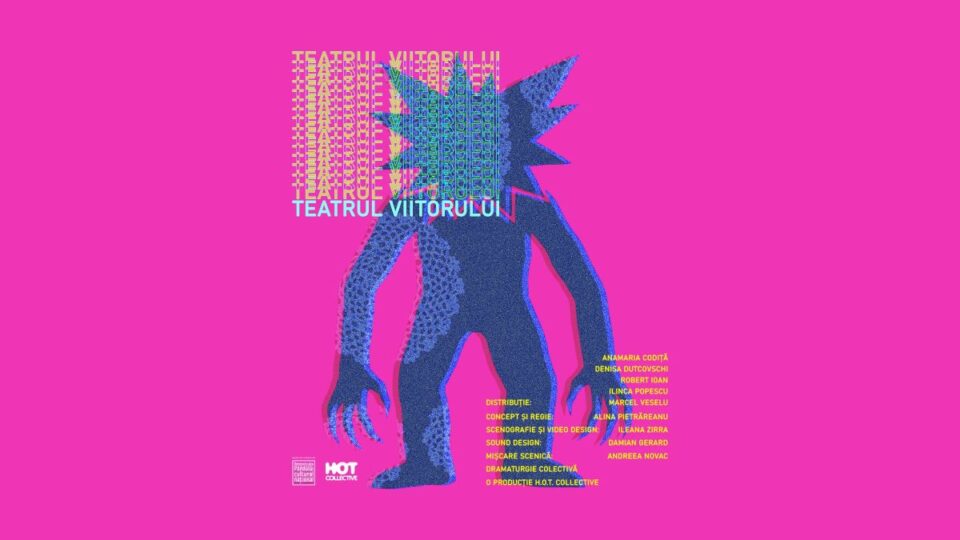
“Theatre of the Future”, a reaserch laboratory
Earlier in December, H.O.T. Collective had the premiere of its show "Theatre of the Future".
Ion Puican, 27.12.2025, 14:00
The premiere of of the show “Theatre of the Future”, held in December, was part of a theater research project that explores new forms of interdisciplinary and collaborative creation in contemporary theater. The project was intended as an artistic laboratory dedicated to emerging artists. It aims to answer the question “What will the theater of the future look like?”.
We talked about the theme of the project and its artistic, psychological and emotional components with actress Denisa Dutcovschi: “I would like this show to have a positive impact and encourage artists to create their own shows, their own work environments in which to form teams and build things together. From my point of view, collective work makes the journey much easier, and the meeting of multiple visions can generate much cooler and much stronger artistic forms. And I think it is necessary to make shows relevant to the times we live in, shows that reflect reality and question it… First of all, they helped us get to know each other and to be able to talk about what we would be interested in discussing in the show, what problems we would like to talk about in this show. And somehow, being a devised theater process, we were no longer just simple actors, but actors who generate material. We were doing improvisations that lasted up to two hours and had different issues to be solved during this time. All kinds of scenes were born that remained in the show.”
The central theme of the show is the anxiety related to the future, acutely felt by the younger generation. The show was born in an interdisciplinary laboratory. How did this influence the creative process and what was the dramatic thread that connected the fragmented narrative of the show? Denisa Dutcovschi: “I think I will answer with a line from the show. It appears at the very beginning, namely, “in order to imagine a theater of the future, we should imagine a future”. We realized that it is very difficult to imagine a future and I think you can do this exercise too. When we did it, we came up with a lot of options, but somehow none of them seemed possible and somehow this was interesting. That is what we wanted to explore in the show, this search for a possible or even impossible future, somehow, questioning the future itself. And I think that’s why it’s a relevant theme for the audience too. Because the theater of the future somehow offers the chance not to be passive in the face of the future, but to think about it, to question it. And maybe, why not, to change it… We generated a lot of material, and at some point, lines started to appear that were related to the future imagined by Chekhov, this being a Russian playwright from the late 19th century. And we found it extremely interesting that that future imagined by him then is practically the present that we live in. Lines like “How do I imagine my life in 200… 300 years”. And we found that really cool, because, paradoxically, in the process of working it was apparently easier for us to relate to Chekhov’s lines than to imagine a future ourselves. And so we ended up turning to the past in order to build a perspective on the future… The show does not propose a classic structure, that is, it does not follow a single narrative thread. On the contrary, it brings to the fore a multitude of themes and problems, precisely to leave the audience the freedom to build their own connections, ask their own questions and find their own answers. And that seems very beautiful to me, because these answers can never be identical, because each spectator comes with their own inner universe. … including the fact that the action often unfolds on several levels at the same time, sometimes even three simultaneously. All of this somehow makes the show alive, dynamic and somehow keeps you hooked and doesn’t let you get bored.”
The “Theatre of the Future” works like a “living laboratory”, where interdisciplinary working methods are tested and documented, to be disseminated through public presentations, university workshops and educational materials. For the theatre world, for professionals, the project aims to build a replicable model of independent artistic creation, contributing to the development of a new generation of creators in Romanian experimental theatre.
For the general public, what is the message you want the audience to take home after the show? Denisa Dutcovschi: “I don’t think the show proposes an explicit message. Rather, it opens a space in which each spectator is invited to build their own meaning. And this freedom of interpretation is in itself, a message. That the future, being an abstract concept, I believe begins in the present. And that is why it becomes essential, in my opinion, to relate to our actions now as gestures that can have real consequences on what will come. Even in this context in which, I quote from the show – Happiness is not for us and maybe it will never be. This idea of continuing remains necessary. I quote again – We must live and work. And when I say this, I do not say it as a resignation, but as a form of responsibility towards the future that we are building, consciously or not.” (EE)