The Wall (Hotarul) – Between Realism and Humor
A village in the Republic of Moldova, two neighboring families, and a piece of land that ends up sparking a full-blown war.
Corina Sabău, 25.07.2026, 14:00
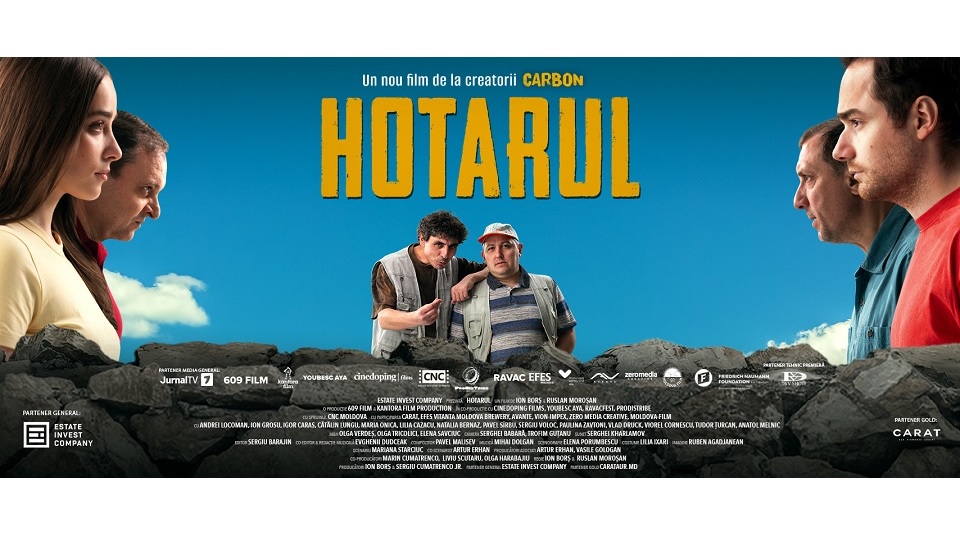
A village in the Republic of Moldova, two neighboring families, and a piece of land that ends up sparking a full-blown war. From this seemingly simple premise emerges THE WALL (HOTARUL), the new film by Ion Borș and Ruslan Moroșan, a comedy brimming with verve, humor, and subtext, built on the small tensions of everyday life that end up speaking about much larger issues. Following the success of the film Carbon, which was acclaimed by both audiences and critics, Ion Borș returns with a story that retains realism and an eye for local detail, presenting them in an accessible format intended for the widest possible audience. The film begins with a conflict between neighbors, but beyond the witty dialogue and situations that border on the absurd, THE WALL speaks about pride, the limits we impose on one another, and the boundaries, visible or invisible, that separate us.
We spoke with Ion Borș about his collaboration with screenwriter Mariana Starciuc, with whom he also worked on Carbon, and about how a story comes to be transformed into a film: “I’ll always enjoy working with Mariana; we’ve collaborated on other projects as well. To me, Mariana is the kind of playwright and screenwriter who has a special sensitivity toward the Moldovan people, she understands them so well and can capture that in the pages of a screenplay. And that’s why I specifically collaborate with her on the screenplay. There are many stories, and many people recommend scripts to me, but Mariana and I have a specific way of working. First, we sketch out a few ideas together, which we then turn into scripts. There’s no set formula for getting a story onto the big screen. First of all, we have to be sincere with that story; we have to believe in it as a narrative. Second, in the case of this film, we wanted to create a comedy, but not a gratuitous one. We want it to be a comedy that contains a deeper message. And we’re crafting the script in such a way so that audiences who aren’t looking for a deep message, but just want to have fun, may still enjoy the story; and that the people who want more than that may discover a subtext and a deeper message.”
While Ion Borș says the film is “about us, about our people and communities, about the small conflicts that hide truths which we all recognize,” Sergiu Cumatrenco Jr., one of the film’s producers, states that THE WALL continues the direction set by ‘Carbon’, bringing to the screen an authentic comedy inspired by everyday life.
Ion Borș speaks openly about the difficulty of bringing Moldovan audiences back to movie theaters after decades in which Moldovan cinema was virtually absent from this circuit, as well as about how a film made with limited resources manages to say big things: “We have this mission to bring audiences in the Republic of Moldova back to the cinema, which is very difficult. After more than thirty years during which people simply stopped going to the movies to see Moldovan films, we have to convince them. And so the story we tell has to appeal to different kinds of audiences, both those looking for a light-hearted story and those seeking a deeper meaning. Only after we win over both types of audiences and convince people to come to the movies can we propose other genres of films. It’s a longer process that takes time. As artists and filmmakers in the Republic of Moldova, we want to write scripts that captivate and move people. But we’re aware that we don’t have access to helicopters, ammunition, drones, or special effects. So all we have left is ingenuity and creativity. How can we convey the same messages, but with limited resources? This is where the metaphor comes in, helping us transform a local story into a universal truth. In this film, we set out to explore visible, invisible, large-scale, and global boundaries through a fence in a small village in the Republic of Moldova. And that’s how the story was born.”
This is also one of the film’s greatest strengths: its ability to transform a fence, a patch of land, and a conflict between neighbors into a metaphor about boundaries, pride, and the distances people put between themselves. The mix of experienced actors and newer faces contributes to the story’s authenticity and its connection with the audience, a deliberate choice, essential in rebuilding the relationship between the viewer and local cinema. The cast, which brings together Ion Grosu, Andrei Locoman, and Sergiu Voloc, contributes to the success of a film that has already crossed borders, drawing sold-out crowds in Dublin and Brussels. (LS)