
RRI Live!

Listen to Radio Romania International Live

Baron Samuel von Brukenthal

The founder of the first public museum in what is now Romania, and one of the first in Europe
Baron Samuel von Brukenthal

, 06.08.2016, 14:15

The founder of the first public museum in what is now the Romanian space, and one of the first in Europe, was also the first ethnic Saxon governor of Transylvania – Baron Samuel von Brukenthal. He was born in 1721, 295 years ago, in the village of Nocrich, in Sibiu county. As the son of a prestigious family in the Saxon community he studied law, philosophy, political science and public administration at the universities in Halle and Jena.


In 1745 he returned to Sibiu, where he held important positions in administration until 1753. In 1753 he went to Vienna, where he was granted an audience with Empress Maria Theresa. It is said that she was so impressed by him that she appointed him a member of the public servant corps of the Hapsburg Empire, which at the time included Transylvania, an autonomous principality within that empire. In 1762, the Empress dubbed him a baron of the realm. In 1765 he was appointed head of the imperial chancery, in 1772 head of the provincial chancery, and in 1777 he was granted the position of governor of the Grand Principality of Transylvania, which he held until 1787.


As he was climbing the social ladder in the empire, he started dabbling in sciences and the arts. He started collecting art objects, but also artifacts reflecting his interest in the biological and botanical sciences, as well as his interest in numismatics. He gradually became recognized as an encyclopedic personality, in the spirit of the times. Sabin Luca, curator of the Brukenthal Museum in Sibiu, spoke to us about the diversity of interests that the baron held:


Sabin Luca: “As governor of Transylvania, but also before and after holding that position, he was very open towards everything that was novel. Which is why he sought to bring to Transylvania many things that were all the rage in Europe at the time, from the study of plants and animals to architecture and the organization of space. He was an extremely complex person, and that is reflected in the structure of the collections he gathered in a lifetime. These are diverse and extremely valuable collections, covering geology, numismatics, the fine arts and books. He was very fond of books.


Baron Brukenthal’s first collections (wine, prints, books, and coins) were put together between 1759 and 1774.


Sabin Luca: “The baron hired people educated in Vienna who were purchasing items and paintings in a fairly helter-skelter manner. Which is why the value of his collections is uneven, but at the same time, during that time, the valuation of certain Flemish, German or Italian paintings was different. Today we find out that we hold items that are less valuable, but whose real value is very high. For instance, Portrait of a Man with a Blue Chaperon, which was long believed to be by Durer, is in fact a van Eyck. It is such an important item that it is always at the top of the list for all exhibition imports. Right now it is on display in a temporary exhibition in Holland, dedicated to Bosch.


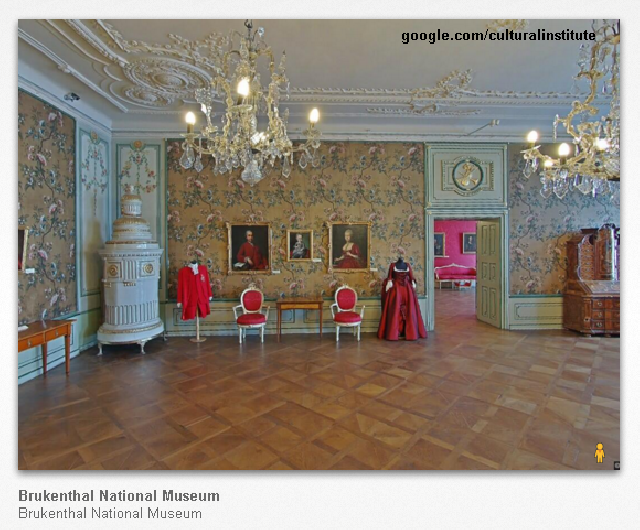
In 1745, Baron von Brukenthal married, Sofia, a discreet and cultured woman, whose social connections helped him even more. Unfortunately, little is known about her. In 1779, the baron started building the mansion that now bears his name, in late Baroque style. In 1803, the baron passed away with no direct heirs, and he bequeathed the mansion, now called the Brukenthal Palace along with his collections to the Evangelical Church and Gymnasium of Sibiu.


The building, which used to be the official residence of the governor of Transylvania, can be admired in the Grand Plaza of Sibiu; since 1817 it has been housing the Brukenthal Museum. Initially it had on display the baron’s collections, as written in his will. In time, the museum added to the collections, and is now one of the best-known cultural institutions of its type in Europe.
Sergiu Celibidache (1912-1996)
RRI Encyclopaedia Sunday, 18 October 2026

The Institute of Forensic Medicine, or Bucharest’s lost heritage

  On the left bank of the Dâmbovița, after the river leaves the central area around Unirii Square, stood until 1985 the building of the Institute…

The Institute of Forensic Medicine, or Bucharest’s lost heritage
RRI Encyclopedia
RRI Encyclopaedia Sunday, 11 October 2026

Alburnus Maior, Roșia Montană

Alburnus Maior is the ancient Roman name for the town of Roșia Montană, located in central Romania, in the historical region of Transylvania, in the A…

Alburnus Maior, Roșia Montană
RRI Encyclopedia
RRI Encyclopaedia Saturday, 03 October 2026

Forensic Medicine in Romania

Forensic medicine is the branch of medicine that makes it easier to establish the truth and ensures that the law is applied fairly. The institutional …

Forensic Medicine in Romania
RRI Encyclopedia
RRI Encyclopaedia Sunday, 27 September 2026

The “Anastasie Fătu” Botanical Garden in Iași

The “Anastasie Fătu” Botanical Garden in Iași is celebrating its 170th anniversary — 170 years devoted to science and culture in the service of nature…

The “Anastasie Fătu” Botanical Garden in Iași
RRI Encyclopaedia Sunday, 20 September 2026

The Sip Canal

The most spectacular section of the Danube, along its 2,850-kilometer course from the Black Forest Mountains in Germany to its mouth on the Black Sea …

The Sip Canal
RRI Encyclopaedia Sunday, 13 September 2026

Historian Gheorghe Brătianu

Among the leading figures in 20th-century Romanian historiography, Gheorghe I. Brătianu holds an important place. Gathered around the ‘Revista Istoric…

Historian Gheorghe Brătianu
RRI Encyclopaedia Sunday, 30 August 2026

Princely and Royal Thrones

  A symbol of royal authority, thrones held a central place in the representations of power in the Romanian space. Before 1945, they were a natur…

Princely and Royal Thrones
RRI Encyclopaedia Saturday, 29 August 2026

The University Museum in Bucharest

The University of Bucharest was established and has operated under this name since 1864, following the founding of Romania through the union of the Pr…

The University Museum in Bucharest

Partners

Muzeul Național al Țăranului Român Muzeul Național al Țăranului Român
Liga Studentilor Romani din Strainatate - LSRS Liga Studentilor Romani din Strainatate - LSRS
Modernism | The Leading Romanian Art Magazine Online Modernism | The Leading Romanian Art Magazine Online
Institului European din România Institului European din România
Institutul Francez din România – Bucureşti Institutul Francez din România – Bucureşti
Muzeul Național de Artă al României Muzeul Național de Artă al României
Le petit Journal Le petit Journal
Radio Prague International Radio Prague International
Muzeul Național de Istorie a României Muzeul Național de Istorie a României
ARCUB ARCUB
Radio Canada International Radio Canada International
Muzeul Național al Satului „Dimitrie Gusti” Muzeul Național al Satului „Dimitrie Gusti”
SWI swissinfo.ch SWI swissinfo.ch
UBB Radio ONLINE UBB Radio ONLINE
Strona główna - English Section - polskieradio.pl Strona główna - English Section - polskieradio.pl
creart - Centrul de Creație Artă și Tradiție al Municipiului Bucuresti creart - Centrul de Creație Artă și Tradiție al Municipiului Bucuresti
italradio italradio
Institutul Confucius Institutul Confucius
BUCPRESS - știri din Cernăuți BUCPRESS - știri din Cernăuți

Affiliates

Euranet Plus Euranet Plus
AIB | the trade association for international broadcasters AIB | the trade association for international broadcasters
Digital Radio Mondiale Digital Radio Mondiale
News and current affairs from Germany and around the world News and current affairs from Germany and around the world
Comunità radiotelevisiva italofona Comunità radiotelevisiva italofona

Providers

RADIOCOM RADIOCOM
Zeno Media - The Everything Audio Company Zeno Media - The Everything Audio Company

























