Greeks in Bucharest
The conquest of Constantinople by the Ottomans in 1453, a fundamental event in world history, had profound implications for the Romanian territories at the time.
România Internațional, 04.01.2014, 16:22
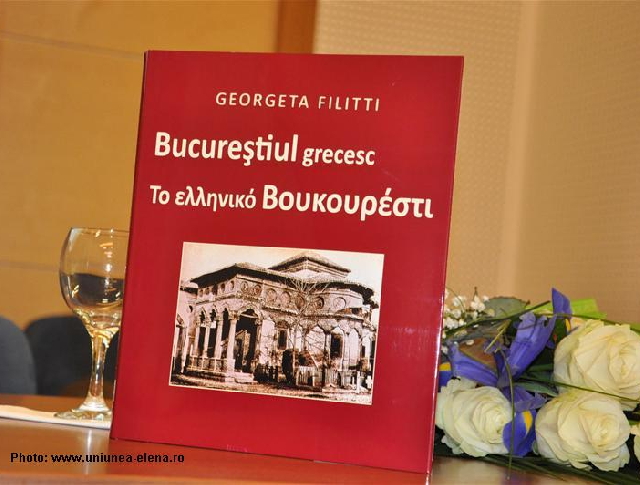
The conquest of Constantinople by the Ottomans in 1453, a fundamental event in world history, had profound implications for the Romanian territories at the time. Many Greeks left their homes to save their lives, taking with them what they could of their wealth. Some of them found a new home in the Romanian principalities, especially in what was then a small fair town, Bucharest. They made important contributions to its development, in both trading and cultural terms. Georgeta Filitti, author of the book “Greek Bucharest”, told us about the Greeks who took refuge in the town after 1453.
“Who are these Greeks who start coming in smaller or larger groups here? They all had some kind of trade, they didn’t learn it here. We are talking of doctors, teachers, financiers, diplomats. The term ‘diplomat’ must be understood in the Medieval or Renaissance sense of the word, which involves the fact that a lot of times diplomats also dealt in espionage. There were also a lot of clerics. There is a Romanian tradition, which started in the 16th century, continuing into the 19th century, that of dedicating religious venues to the holy places, which were considered to be Mount Athos, the Holy Sepulchre, Mount Sinai, Alexandria or Antioch. This link between us and the Greek space, under Orthodoxy, led to circulation of monks.”
Meanwhile, in order to settle here solidly, the Greeks took Romanian spouses, formed mixed families, and secured property in town. In addition, they brought with them elements of urban civilization, which was poorly developed in Bucharest at that time, and brought an important contribution to education, as Georgeta Filitti told us:
“Urbanism in the modern sense started being felt more in the 18th century, also as a contribution made by the Greeks. Early that century, the Turks set up in the Romanian principalities a form of administration, which brought the Greeks officially into our space. We are talking about the Phanariot rule, a century of official rule by the Greeks. The prince was Greek, his close associates were Greek, and the Romanian population, dominated by them, had to assimilate certain Greek elements. We have to specify that it wasn’t about a forceful influence. Many of the Phanariotes were enlightened rulers, they were enlightened people, people who understood that, in order to get the most out of their subjects, they have to find common ground. One of the most important of these elements was education. They organized an education system in which they introduced the first elements of education in the Romanian language. Math, physics, astronomy and geography were among the subjects taught. These people also put together extraordinary libraries. Even to this day, whoever wants to see the moral stature of these teachers can go to Volos, in Greece, or the villages around Volos, the place where many of these teachers came from. You can also find there some of their libraries.”
One statistic dating back to 1838, a sort of census, which states that Bucharest had 60,000 families, says a lot about daily life in the capital of Wallachia, which Bucharest was at the time:
“You can see that there weren’t that many Greeks at that time. Among the traders you can find Greeks, Armenians, Jews, but also Romanians, Serbs and Bulgarians. This paints a very vivid tableau, and Bucharest traders, in spite of being of variegated origins, had solidarity, they had an unwritten code of conduct, so much so that they enjoyed a great reputation. Maybe the most important thing happened only in the second half of the 19th century. Greek communities started forming. Thus far, we had Greeks as doctors, teachers, rulers, but you could not say that you had an ethnic community. Having a community meant that everyone who felt they were Greek had their own church, school, printing shop, they had a community life, with their own celebrations, with gatherings… This was made much easier by their having lived alongside Romanians for so many centuries, as well as by having the same religions. “
To this day, the Greek influence in Bucharest can be seen in the churches they built, but also in the many Greek names that Romanians bear, even though they may not be aware of that fact.