RRI Live!

Listen to Radio Romania International Live

Radio University

Radio had a major educational role in its early years. Many intellectuals, politicians and social thinkers believed that it could offer continuous education for the masses, in a precarious economic and cultural situation, lifting them up to the condition

Radio University
Radio University

, 06.07.2013, 12:24

Radio has been used for politics, for culture, propaganda and entertainment. Radio has also meant science education, and the feature that opened the road was Radio University. As the name indicated, Radio University, which debuted in 1930, was meant as a tool to propagate science and culture, since the two often walk hand in hand. Radio University was a platform for intellectuals to disseminate science and culture in a way easily understood by regular people, especially those lacking education.


Throughout political changes, or better said in spite of them, Radio University was one of the few radio features to stand the test of time, due to its prestige and to the fact that even dictatorial regimes put up with it, understanding the value of science and culture in inculcating their ideology.


The most prestigious names in Romanian science and culture have been heard on air as part of that feature, as either guests or lecturers. The feature allowed millions of people to hear what previously only a select few could, in university auditoriums. Shortly after Radio Romania had started broadcasting for the first time ever, on March 1, 1930, more exactly, that prestigious feature had its opening edition, and became the longest lived and most popular science and culture show in the history of the Romanian media. Its structure was simple: three lectures of about 20 minutes between 7 and 8 p.m.


On July 31 1934, legal consultant Radu Patrulius opened a series of lectures with a talk called “The Role of Elites”. Patrulius said that being a member of an elite was similar to being part of a brotherhood, in which the individual constantly strives to better himself, and is never content with the things he knows. He has to break through the barriers of knowledge, of cognitive conformism, to find explanations for the things that cannot be unexplained or that are insufficiently explained.


The member of an elite has to be a scientist, but also needs noble traits to help him keep above the pettiness of life, and dedicate himself to the good of the community. This idyllic vision of the scientist was similar to that envisaged for artists in the 19th century, rising above the lust for material things, living for the eternal glory of his breakthroughs.


In its over 80 years of existence, Radio University was a voice for the best in Romanian science. Mondays were usually reserved for science, and each consecutive day of the week had another focus. The first great name in Romanian science to be invited as a guest was biologist Grigore Antipa, the founder of the museum of natural history in Bucharest.


On 16 February 1933, he raised an issue that had less to do with sciences: why are Romanians so poor in such a rich country? Antipa concluded that Romanians, in spite of their intelligence and capacity for hard work, were handicapped by the shortcomings of their ruling classes, that failed to channel the energies of the people in a good direction. As such, he was blending science, politics and the economy.


Grigore Antipa was thus the first great name to take up the microphone in the attempt to raise awareness of important issues across the nation. A whole array of the greatest names in Romanian sciences followed his lead, such as geographer Simion Mehedinti, archeologist Vasile Parvan, sociologist Dimitrie Gusti, historian Constatin C. Giurescu, aesthetician Eugen Lovinescu, and physician Gheorghe Marinescu, to name just a few.
Sergiu Celibidache (1912-1996)
RRI Encyclopaedia Saturday, 28 November 2026

Public parks and gardens in Bucharest

In the new urban landscape of Bucharest, woodlands, green spaces, public gardens and parks came to play an increasingly important role. Their purpose …

Public parks and gardens in Bucharest
RRI Encyclopedia
RRI Encyclopaedia Sunday, 22 November 2026

Joan Miró’s  “The Flood”

  In 1970, following the floods that struck Romania, an image by Joan Miró was featured on a Romanian postage stamp. The Catalan artist created a…

Joan Miró’s  “The Flood”
The 1906 Romanian General Exhibition
RRI Encyclopaedia Sunday, 15 November 2026

The Romanian General Exhibition of 1906

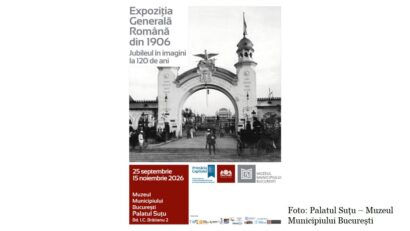
  120 years ago, on June 6, 1906, a major exhibition opened in the Romanian capital city to mark a triple celebration: the 40-year reign of King …

The Romanian General Exhibition of 1906
Photo: eteatru.ro
RRI Encyclopaedia Sunday, 08 November 2026

Theatre at the Microphone

The National Radio Theatre (TNR) also referred to as the National Radio Drama Department is the institution that produces drama for Radio Romania; its…

Theatre at the Microphone
RRI Encyclopaedia Sunday, 01 November 2026

The Ciotori Collection: A Remarkable Legacy of European Cartography

Born in 1885, Ciotori was an English speaker and the author of texts about Romania through which he sought to introduce his country to the English-spe…

The Ciotori Collection: A Remarkable Legacy of European Cartography
RRI Encyclopaedia Sunday, 25 October 2026

The Coțofenești Helmet

The Coțofenești helmet is one of the most valuable gold artifacts ever discovered on the territory of Romania, belonging to the Thraco-Getic civilizat…

The Coțofenești Helmet
RRI Encyclopaedia Sunday, 18 October 2026

The Institute of Forensic Medicine, or Bucharest’s lost heritage

  On the left bank of the Dâmbovița, after the river leaves the central area around Unirii Square, stood until 1985 the building of the Institute…

The Institute of Forensic Medicine, or Bucharest’s lost heritage
RRI Encyclopaedia Sunday, 11 October 2026

Alburnus Maior, Roșia Montană

Alburnus Maior is the ancient Roman name for the town of Roșia Montană, located in central Romania, in the historical region of Transylvania, in the A…

Alburnus Maior, Roșia Montană

Partners

Muzeul Național al Țăranului Român Muzeul Național al Țăranului Român
Liga Studentilor Romani din Strainatate - LSRS Liga Studentilor Romani din Strainatate - LSRS
Modernism | The Leading Romanian Art Magazine Online Modernism | The Leading Romanian Art Magazine Online
Institului European din România Institului European din România
Institutul Francez din România – Bucureşti Institutul Francez din România – Bucureşti
Muzeul Național de Artă al României Muzeul Național de Artă al României
Le petit Journal Le petit Journal
Radio Prague International Radio Prague International
Muzeul Național de Istorie a României Muzeul Național de Istorie a României
ARCUB ARCUB
Radio Canada International Radio Canada International
Muzeul Național al Satului „Dimitrie Gusti” Muzeul Național al Satului „Dimitrie Gusti”
SWI swissinfo.ch SWI swissinfo.ch
UBB Radio ONLINE UBB Radio ONLINE
Strona główna - English Section - polskieradio.pl Strona główna - English Section - polskieradio.pl
creart - Centrul de Creație Artă și Tradiție al Municipiului Bucuresti creart - Centrul de Creație Artă și Tradiție al Municipiului Bucuresti
italradio italradio
Institutul Confucius Institutul Confucius
BUCPRESS - știri din Cernăuți BUCPRESS - știri din Cernăuți

Affiliates

Euranet Plus Euranet Plus
AIB | the trade association for international broadcasters AIB | the trade association for international broadcasters
Digital Radio Mondiale Digital Radio Mondiale
News and current affairs from Germany and around the world News and current affairs from Germany and around the world
Comunità radiotelevisiva italofona Comunità radiotelevisiva italofona

Providers

RADIOCOM RADIOCOM
Zeno Media - The Everything Audio Company Zeno Media - The Everything Audio Company