The history of black gold exploitation
Alongside the white gold (salt) and the red gold (the metal proper), the black gold (crude oil) is an extremely important underground resource in the Romanian space, reason for progress, but also cause for trouble, throughout history
Christine Leșcu, 10.02.2018, 15:15
The crude oil that was found North of the Danube, as such oil reserves have never been identified South of the Danube, had been exploited since ancient times, on the Dacian territory.Back then and for many centuries, fuel oil was the main product obtained from crude oil. Fuel oil was mainly used to grease the cart poles. Fuel oil was also used in the treatment of a series of conditions, as well as in the making of lighting torches. The first documents attesting the existence of crude oil date as far back as the Middle Ages. The documents also include mentions of the areas where oil has been and is still exploited in Romania: the Bacau region, in Moldavia, Prahova County, nearby the city of Ploiesti, in Wallachia.
Fuel oil was first mentioned in Wallachian documents in 1517, during the rule of prince Neagoe Basarab, in a village called “La Pacuri. In Moldavia, there is even earlier documentary evidence of fuel oil in the region. With details on that, here is Radu Lungu, the author of the book “The Black Gold and the Romanians, brought out by the Paideia Publishers in Bucharest.
Radu Lungu: “Documentary evidence of the existence of fuel oil and not necessarily about its exploitation in Moldavia dates back to 1440. The documents mention a village nearby Moinesti, Bacau County, where crude oil is still being extracted. There‘s also another interesting thing about Moldavia, the ruling prince Dimitrie Cantemir, who wrote the Description of Moldavia in 1716, mentioned the fuel oil springs of Moinesti, along the Trotusul Sarat River. And it is also along the same river that the Targu Ocna salt mines can be found. He actually mentions those springs of crude oil mixed with water, specifying that water should be separated from the crude oil, because the fuel oil can thus be more efficient in lighting, for instance.
Belonging to boyars, monasteries, the ruling prince as well as to the free peasants, these fuel oil reserves were exploited with primitive means in the Middle Ages, says Radu Lungu: “Exploitation was made with primitive means. People dug shafts in the areas where there were no springs or pits, as the crude oil was literally found at the surface. In the late 17th Century and early 18th Century, peasants, as well as people at the boyars courts, started using crude oil for torch or barrel lighting. In homes, they were used to a lesser extent, though. You rather found them outside, in courtyards or along the lanes.
The rudimentary exploitation and limited use of oil came to an end in the second half of the 19th Century, the year 1857 marking the birth of the Romanian oil industry.
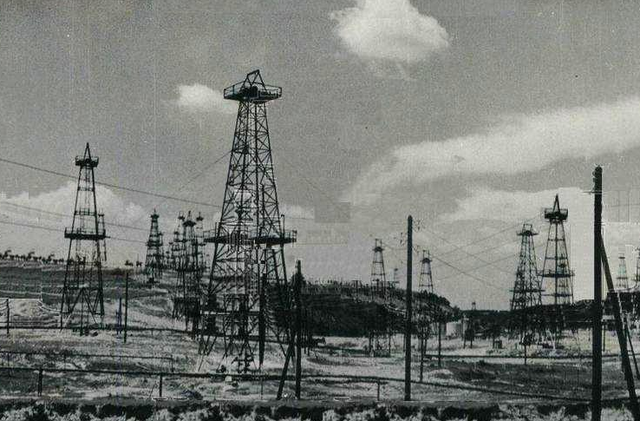
Radu Lungu: “It was discovered that one of the oil by-products, namely lamp oil, obtained through distillation, was good for lighting homes and cities. In this context, 1857 is an interesting year, as the first oil refinery or factory for crude oil distillation called St. Dumitru – Saint Demetrius was set up in the slums of the city of Ploiesti. The one who set up the refinery was Teodor Mehedinţeanu. One year before, he had obtained an exclusive contract from the Bucharest City Hall to supply the capital with lamp oil. Thus, in 1857, lighting in the capital city was made by means of lamp oil, Bucharest becoming the first city of the world with this lighting system. Also in 1857 Romania was mentioned in the first world statistics on oil exploitations on the top position with 275 tons of oil annually. It was not much, but the date was important.
After Bucharest, the next city lighted by lamp oil was Iasi, in north-eastern Romania, in 1858, and Vienna followed in 1859. In Romania industrial exploitation of oil actually developed after 1900. And the Romanian oil was not only an opportunity for the countrys economic development but also a strategic and military opportunity during the two World Wars.
Radu Lungu: “When Romania entered the war on the side of the Entente in August 1916, the Germans were losing all the European resources of cereals and oil. One of the priorities of the German Strategic Command was to conquer Romania to regain the resources. A priority that was eventually materialized. On December 6, the Germans were in Romania and exploited these resources from December 1916 until 1918.
Germany showed the same great interest 20 years later, during WWII. Allied with Nazi Germany starting in June 1941, Romania had to cope with pressures under which all its oil production had to go to Germany, something that was 80% achieved during the period when Romania was Germanys ally.