The Constanta Traditional Art Museum
The Constanta Traditional Art Museum is starting a new project
Daniel Onea, 23.04.2020, 14:00
Even though all museums are closed these days, the Constanta Traditional Art Museum is starting a new project. Under the name ‘Romanian Wall Hangings from the Constanta Traditional Art Museum Collections’, you are invited each month to discover on the museum’s Facebook page and on their website the picture of a wall hanging and information about it. And, to convince you to stop over when you next come to the Romanian seaside, let’s go on a virtual tour.
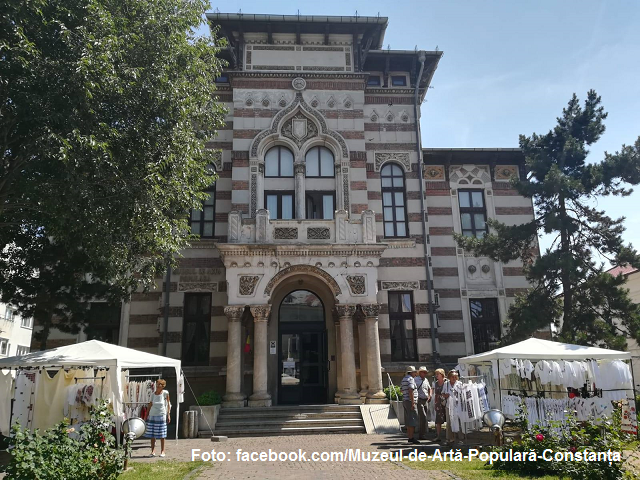
Ioana Tompe, a museographer with the Constanta Traditional Art Museum, tells us that we can get to know an institution that presents not only Dobrogea’s traditions and history, but of the entire Romanian space: “We gave the permanent exhibition a national character. We are displaying all the ethnographic areas of the country: Transylvania, Moldavia, Wallachia, Oltenia, Dobrogea, and the main handicrafts that define the Romanian civilization. The building is the first city hall of Constanta, the Communal Palace, erected in 1826, designed by architect Ioan Socolescu, an architect that designed many historic buildings in Romania, in the neo-Romanian style. It is a blend of old architecture, with columns and capitals, and the Brancovenesc style. City hall was set up here for a short time, then it became the Post Office Palace. The museum first opened in 1871, with an exhibition of Dobrogea art. We managed to put together a collection that addresses Dobrogea, the Romanians who lived on the banks of the Danube, in villages from Ostrov to Harsova, reflecting the multicultural character of the area.
Ioana Tompe told us that, after putting together the Dobrogea collection, they focused on the other areas of the country: “We have a collection of traditional garb from all areas of the country, representing the typology of Romanian peasant dress. We have interior decoration objects, weavings from all ethnographic areas of the country, and the permanent exhibition will feature all areas with their specificity. We have cotton and silk fabrics, towels, tablecloths, sheets. We have jewelry worn by Romanians. On the ground floor, the space is set aside for peasant icons painted on glass. It is a very valuable collection with icons from the major icon making centers that have always existed in Transylvania. We present the stylistic and chronological evolution of this handicraft. We have a whole room dedicated to liturgical objects, icons painted on wood, icons made by Dobrogea Romanians influenced by the neighboring Lipovans, from northern Dobrogea, and Greek icons.
The much admired glass painting was not unique to Transylvania. The region was a part of the Hapsburg Empire, later the Austro-Hungarian. Ioana Tompe museographer with the Constanta Traditional Art Museum, helped us understand the origin of this art form: “Romanians did not adhere to the state religion, and did not speak the official language. They sometimes had their churches taken down, and therefore Romanians had to paint icons in their own households. This is how the phenomenon of painting icons on glass appeared in Transylvania. This handicraft started in the villages of Nicula and Gherla, near Cluj, once glass manufacturing started there. It had to be in a forested area, in order to have wood to melt the sand to get the base material. Held up to the light, the glass is uneven, with air bubbles, which shows how the glass was hand manufactured. The phenomenon of glass icons is not unique to Transylvania. There were many centers, which spread throughout Transylvania starting from the Cluj area.
There are sections in the museum which try to reproduce an authentic peasant household, with tools and objects. One very rich section is that dedicated to vessels, some ceramics, some metal. Here is Ioana Tompe once again: “Ceramics were not as developed in Dobrogea as in the other areas of the country. Even though, paradoxically, we have a long tradition in ceramics, going back to the ancient Greeks and Romans. Ceramics making developed in city centers on the sea shore as long as they had stable administrations, such as Greek and Roman. In the Middle Ages, in the modern era, when several wars were fought on the territory of Dobrogea, when the territory was taken over by the Ottoman Empire, ceramics could no longer be made, because they are perishable products. A people that can show an evolution in time for ceramics is a people that can prove its continuity. Metal vessels that we showcase in the exhibition are common to the entire area of the Balkans, which had the economic and political fate of Dobrogea. First and foremost, being made of metal, they don’t shatter. They are made of tinned brass. We gathered in this place vessels made by Romanians, Aromanians, Turks, and Tartars. You can tell them apart by the differences in the decorative style.
CC