The National Village Museum
Right in the center of Bucharest, visitors have the joy of seeing a real Romanian village

Daniel Onea, 21.05.2020, 14:00
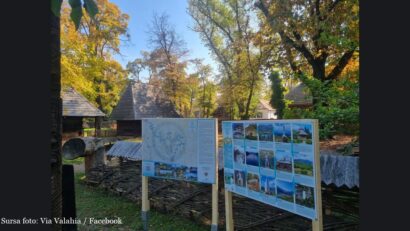
Right in the center of the Romanian capital, visitors have the joy of seeing a real Romanian village, with monuments and artifacts dating from the 17th to the early 20th century. Representative buildings from major ethnographic areas gained a new life in the Dimitrie Gusti National Village Museum.
Paula Popoiu, general manager of the museum, told us that the institution in her care turned 84 years old on May 17th.
“It is a fairly interesting age for a cultural institution, as the oldest in Europe after the Skansen Museum in Sweden. The Village Museum opened to the public after ten years of research in 600 Romanian villages, during which time the Sociological School, led then by sociologist Dimitrie Gusti, gathered this rich material which it converted later into several institutions, among them this museum. After 1946, when Dimitrie Gusti was banned by the communists, the National Village Museum remained the only institution created by the Sociological School of Bucharest. This, at its time, during the two world wars, gathered together the most enlightened minds and the best people in culture, PhDs, interdisciplinary teams, which ran the research that is preserved in the archives of the museum.”
The history of the museum is rather tumultuous. It started between the two world wars, and continued during the communist period, after 1947, with director Gheorghe Focsa, which was on one of the monograph teams under director Dimitrie Gusti.
“With great diplomacy, he managed to trick, in a way, the communist regime into carrying further the ideas of the Sociological School. He continued to build the museum based on the blueprints put out by Victor Ion Popa, and continued to transform into a museum the monuments from Romanian villages. These were set up to mimic the great historic regions of Romania. At a certain point, the Village Museum entered a quiet period, because it was not favored by the communist regime. Dictator Ceausescu, for instance, never visited it. After the 1989 Revolution, the Village Museum continued its scientific life, continued to develop its collection, and, very importantly, continued to gather prestige.”
Right now, the Village Museum is the most widely visited museum in the country. Here is general manager Paula Popoiu:
“Last year we had 900,000 visitors. Starting in 2008, we added three and a half more hectares to the museum. We called this area The New Village, and we transferred to it thirty monuments rescued from Romanian villages. We believe that the Village Museum can be seen as a royal endowment, because it was helped by King Carols foundations, during the time it was being built. King Carol visited the museum many times, and made moral and material contributions to its building. The Village Museum now stretches over 15 ha, has 382 constructions that we can refer to maybe as monuments too, because they are unique objects taken from villages. Its collections have 600,000 objects. The peasant garb collection alone has over 15,000 objects. Also, we have over 250,000 archive objects, left from the archive of the Bucharest Sociological School, which cover monograph team research from those 600 villages. We have photographs, glass photo plates, manuscript documents. Therefore here at the museum we are the guardians of a small treasure.”
Before this pandemic, when tourists stopped visiting, the Village Museum was filled, especially in summer, with tourists from all over the world. You could hear on its alleys almost all the languages of the Earth, according to general manager Paula Popoiu:
“We have all kinds of contracts with tourism companies, which were bringing in, and hopefully they will do so again, hundreds of thousands of foreign visitors. That happened not only because the museum had a tourism plan, but also because here, at the Village Museum they found all the time craftsmen in a living museum, with information about traditional Romania, a festival, presentations of customs, workshops for children. Practically, the attraction of the Village Museum is also due to the many actions and workshops for all ages. During this time of shut down, we got many phone calls, messages on social media, with people asking when we will open the museum, sending their love and encouragement. Our ties with the public are permanent.”
And, on a final note, some good news. On May 21, at 10 AM, the Village Museum will open its gates. Paula Popoiu:
“My invitation is to come see the museum, asking you kindly to observe all standing orders or laws, taking care of yourselves and others, as well as the collections. All these rules will be posted at the entrance, and we are apologizing in advance if some do now observe them, and will be barred from the museum. This is imposed by this period to which we must adapt. I gladly invite you to visit the museum, and I am very sorry you will find a museum more quiet than its ever been”.
The meetings with artisans, as well as events, will happen less, but the museum itself remains a special place. Right now they are seeking methods to continue to present Romanian village life, its people, not just its buildings.