Gender equality during the pandemic
According to the Gender Equality Index, in 2021 Romania ranked 25th in the EU
România Internațional, 09.03.2022, 14:00
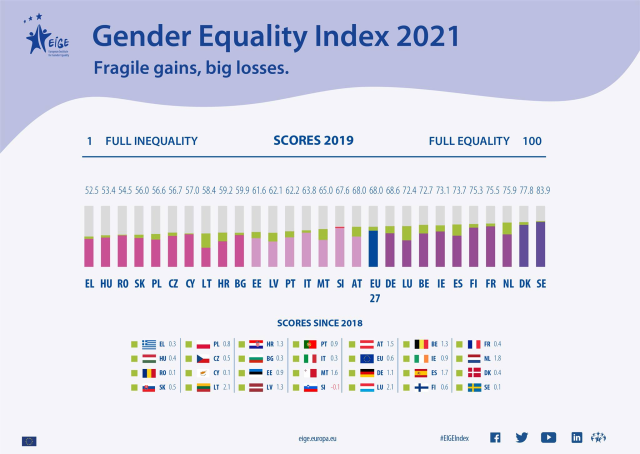
Every two years, the European Institute for Gender Equality in Vilnius publishes the European Gender Equality Index, which measures the equality of gender based on several indicators. According to this measurement, in 2021 Romania ranked 25th out of the 27 members states, with a score of 54.5 out of 100. This score is by 13.5 points less than the EU average.
Oana Baluta, a publicist and Associate Professor at the Faculty of Journalism and Communication Sciences of the Bucharest University tells us more:
“Over the years, Romania has remained at the bottom of the rankings. By 2021, the most significant inequalities were reflected by two indicators. The first is the “power” indicator where Romania had accumulated 34.7 points. Here inequality had increased compared to 2020. Another indicator that showed major gender inequalities was the so-called “time”. The European Gender Equality Index measures gender gaps in several areas: work, money, knowledge, time, power, health, violence and cross-sectoral inequalities. But beyond these figures for 2021, it is important to note that these data tell us that Romanias progress is much slower compared to changes in other EU Member States and the gap between Romania and other EU countries is deepening.”
In the Gender Equality Index, the “power” indicator refers to the power to make political and economic decisions. Here, Romania needs the biggest improvement in the gender balance, the decisions with the greatest economic and political impact being taken mainly by men, although they also affect all women, Oana Baluta says.
“The “power” indicator is used to examine the differences in representation in political and economic groups. If we look at politics, we see that the share of women representation in government or in parliament or in local councils and town halls is extremely low. In the representative democracy in which we live, political parties are the main platforms through which people run for political office, so the change should be operated here. Political parties also build hierarchies based on the women and men on the list. And, if we look at these electoral lists, we see that, on the one hand, in the nomination stage of the candidates, the parties nominate far fewer women, not even up to 30%. And we notice that in the eligible places women are much less nominated compared to the ineligible places and of course men.”
Examples of desirable political or public policy decisions that could restore gender balance are those aimed at equitable accountability of men and women. For example, according to the Gender Equality Index, the number of Romanian women employed on the labor market is much lower than that of men. Oana Baluta tells us which are the main causes of this situation.
“Compared to other countries in the European Union, in Romania women spend a large number of hours doing care work and domestic work. And the fact that men have less responsibilities in the household has very concrete consequences: from overwork and less free time to a much lower share of women in the employed population in the period 2016-2020. Between 2016 and 2020 we had the lowest level of participation of women in the labor market compared to men in the last two and a half decades. And the main cause, as it is identified by women, is the care of adults, people with disabilities or children. We know this from another study published in December last year, a study that looks at gender economic inequalities in Romania.”
Unlike in previous years, in 2021 the Gender Equality Index did not include data on domestic violence. However, a recent Eurobarometer shows that 77% of women in the European Union believe that the COVID-19 pandemic has led to an increase in mental and physical violence against women in their country. Here is Oana Baluta again:
“Unfortunately, we also know from the data collected by non-governmental organizations or from data reported by the police that violence has increased during the pandemic. Not only has violence increased, but so has the incidence of certain types of violence, including sexual violence. At the same time, the way in which the state institutions in Romania approached the issue of violence shows again that the pandemic unfolded in a context of structural inequalities, including with regard to preventing and combating violence. (MI)