Risks for mothers and children in Romania
The well-being of mothers and children is an indicator of economic growth, but also of efficient social policies.
Christine Leșcu, 03.09.2014, 13:27
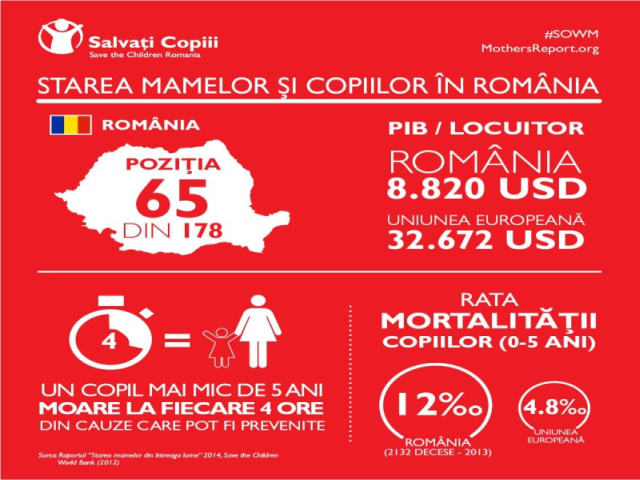
The well-being of mothers and children in a given state is not only an indicator of economic growth, but also of the efficiency of social policies. Unfortunately, in Romania this indicator is rather poor, according to an international survey launched by the “Save the Children” Organisation. Conducted on an annual basis for the last 15 years, the survey includes a study on Romania, for which data provided by the National Statistics Institute were contrasted with information from Europe-wide mother and child health research. Adina Clapa, a member of “Save the Children” Romania, gives us details, based on official 2012 data:
Adina Clapa: “The survey covers 178 countries. We realized that, once again, in terms of the best countries to raise your children in, topping the standings are the Nordic states, with Finland ranking first. Romania is once again, for the 15th time, the last in the EU and 65th in the world. Romania has the highest infant mortality rate, nine per thousand, which is almost double the European average of 4.3 per thousand. The absolute figure is nearly 1,812 deaths among children less than one year of age. This is disquieting and shameful. Premature birth is the main cause, followed by breathing or digestive disorders and household accidents. The conclusion is that one-third of these deaths can be prevented.”
Besides poverty, one of the causes of the problems facing women and children in Romania is the level of education and information of mothers to be. Many of them do not see a doctor for regular check-ups and after birth they do not have their babies seen by doctors either. The situation has not improved lately, as shown by another study made by “Save the Children”. Ciprian Porumbaru, a member of the foundation, explains:
Ciprian Porumbaru: “The study was conducted in all the 28 EU Member States, and also in Iceland, Norway and Switzerland. We saw that 28% of the children, including young people up to 18, are threatened by poverty and social exclusion. This happens against the backdrop of a deep gap between rich and poor, as the study has also revealed. On the other hand, the percentage in Romania is significantly higher, almost double, as 52% of the children are in this situation. We actually share the first position with Bulgaria. Another element highlighted by the study, which is very important in Romania’s case, is that although household work is at the highest levels in Europe, still many children live in poverty. Another important conclusion is that in Romania poverty particularly affects children, whose social exclusion risk rate is 13% more than among grown-ups.“
Given that Romanians work harder and more hours than other peoples, why is the poverty risk higher? A possible answer could be the lower salaries they get. Ciprian Gradinaru also attempts an answer:
Ciprian Gradinaru: “The labour intensity indicator measures how many members of a household are employed. In Romania more members of a household need to work for the family to be able to survive. And so we reach the sensitive issue of child exploitation through labour. A large number of children from Romania are active economically, and not only in the rural areas. That is why, even if the labour intensity index is high in Romania, this does not entail a lower poverty level.”
Another NGO, World Vision, has approached the degree of children’s involvement in supporting the household. Here is Daniela Buzducea, advocacy director with World Vision Romania:
Daniela Buzducea: “We were glad to note that Romania’s economic growth last year, which was reported as significant, albeit somewhat surprising, was also reflected in a general increase in living standards. There was a drop from 75 to 66% in the number of families who say they find it difficult to cover their daily needs. What is however worrying and sad is the fact that this increase in living standards is not reflected in children’s case. For example, the number of children who say they go to bed hungry has grown by 2%, as has the number of children who say they have to work and sometimes miss school because of this. This refers to work performed in their own households or for their neighbours for more than 2 hours per day.”
Poverty and the fact that children have to work also explain the high dropout rates. European funds may be a solution, provided they are spent wisely and efficiently. Another solution may be an inter-institutional collaboration between the education system, the social protection system and local authorities, to create a stronger feeling of solidarity and community that could prevent school dropout.