Gipsy Queen – identity and courage
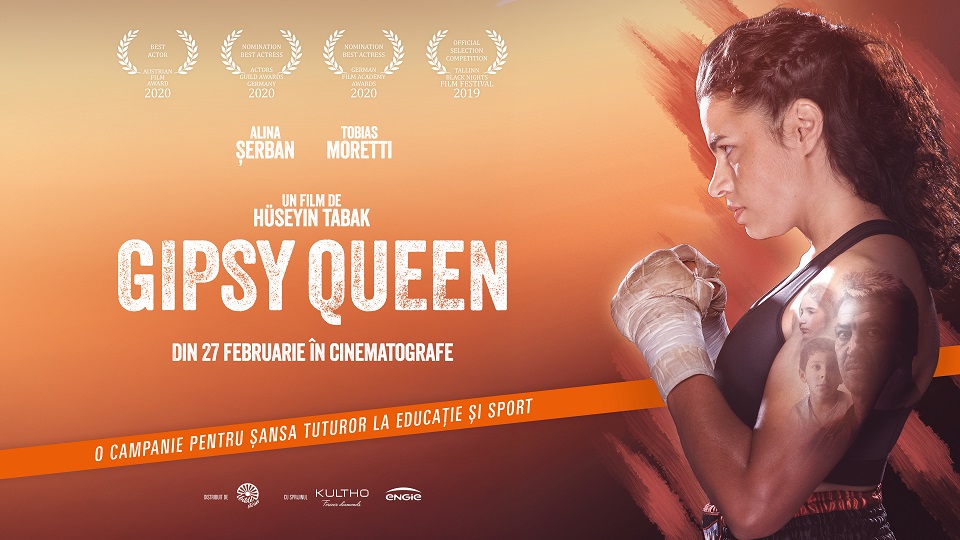
"Gipsy Queen", a film released in Romanian cinemas this year, is an Austrian-German co-production, directed by Hüseyin Tabak, with Romanian Alina Șerban in the lead role.
Corina Sabău, 01.08.2026, 13:50
Alina Șerban, the first Roma artist decorated with the “Cultural Merit” Order in Rank of Knight, built her career at the intersection of social theater, film and cultural activism. Alina Șerban studied acting at the “Ion Luca Caragiale” National University of Theater and Cinematography and at prestigious international institutions such as the Royal Academy of Dramatic Art in London and the School of Arts of the New York University. She represented Romania at the Cannes Film Festival with the film “Alone at my wedding”, achieving international recognition and awards for Best Actress. She also starred in “Housekeeping for Beginners”, awarded at the Venice Film Festival and proposed by North Macedonia for the Oscars, and in 2024 she won first place in the debut section of the National Cinematography Center for her first feature film, “I matter”.
“Gipsy Queen”, a film released in Romanian cinemas this year, is an Austrian-German co-production, directed by Hüseyin Tabak, in which Alina Șerban plays the lead role, Ali – a mother who fights for the future of her children in a world marked by inequalities. The film follows the story of a Roma woman who leaves Romania for Germany and tries to rebuild her life. Beyond the ethnic identity of the protagonist, the film tells a universal story, and the character Ali is built as a complex, dignified and strong woman, far from stereotypes. Alina Șerban: “Ali is a woman who leaves Romania for Germany and ends up doing all kinds of jobs, side by side with men, working even on construction sites, just to put bread on the table. Maybe she physically wouldn’t always have the strength for it, but she finds it. Because when you fight for your loved ones, you discover resources within yourself that you didn’t even know you had. But Ali also fights another battle: the battle with the difficult situation of being a single mother and the desire to be respected. For me, it was important to be able to play Ali as a mother. I don’t have the experience of motherhood yet, but it was easier for me to build this side of the character. It was more difficult to become Ali, the boxer and, of course, to speak German. The story also touched me because I saw many women around me who fight and who, often, are not represented. That’s why it was an honor to be able to bring this story to the screen. Director Hüseyin Tabak also told me from the beginning that the film is dedicated to his mother. Unfortunately, she died suddenly, shortly before filming began, and that made me even more responsible. After all, Ali’s fight is all of our fight. It is the fight with life, with its ups and downs, especially when you start your journey without the best chances and you have to prove three times more than others to make your way in a world that doesn’t wait for you.”
The film also has some spectacular production elements: it includes the longest boxing scene ever filmed in cinema (approximately 7 minutes), and the cast includes world boxing champion Maria Lindberg and former German boxer Jürgen Blin, known for his match with Muhammad Ali. Alina Șerban: “We went through a lot of physical and mental challenges, and until the last day of filming, we didn’t know if we were going to make it. Putting an actress in the ring with a world champion is obviously risky. The punches in the film are real and dangerous. Maria had to box, not just pretend to do it, and so did I, but we were trying to maintain a balance – to make it believable, but without reaching maximum strength. The experience itself was almost like a separate film. There were also people who told me, even before filming, to give up, that it was impossible to succeed. But I continued, primarily because the film was dedicated to the mother of director Hüseyin Tabak, and for me this story was too important to give up. I wasn’t convinced that I could finish the scene either, because I had never boxed before, but I promised myself that I wouldn’t give up. And I didn’t. When I look back at that scene now, it’s like I don’t even recognize myself anymore. I had to become that character, make her as real as possible, and then detach myself from her. And, honestly, even now, after all these years, I still sometimes feel Ali’s traces in my body, the slightly tense shoulders, that fighter’s stance, and I still try, from time to time, to get Ali out of me.”
The film received 11 international nominations and 7 awards, including the Ecumenical Jury Prize at the Tallinn Black Nights Film Festival and nominations at the European Film Awards, the Austrian Film Awards and LOLA – German Film Academy Awards. For Gipsy Queen, Alina Șerban received four awards for Best Actress, including “Best Actress of Germany” at the German Actors Guild Awards, without Alina speaking German. Along with the premiere, “A campaign for everyone’s chance at education and sports” was launched, carried out together with Cinema City, in the context of the high school dropout rate in Romania reaching 16.8%. Thus, the amounts from tickets sold in the Cinema City network were entirely directed to two placement centers that support children at risk of school dropout, centers that Alina has been supporting for 5 years. (EE)