Stories from the Garden
An urban redevelopment project has been brought back to life
Ana-Maria Cononovici, 15.09.2026, 14:08
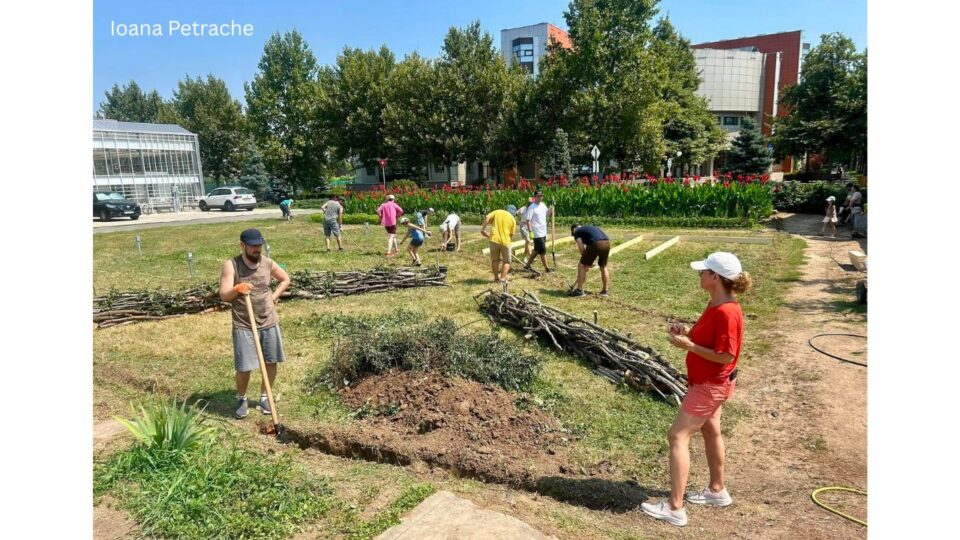
I live in the capital city, in a district where urban planning has resulted in a multitude of construction sites. The residents—mostly from the area near the University of Agronomic Sciences and Veterinary Medicine in Bucharest—have for several weeks now been bringing an urban redevelopment project to life: HortiURB.
This is a project I discussed with Ioana Petrache, the initiator of the HortiURB community garden:
Ioana Petrache: “I am an experienced landscape architect, and after many years in the field—upon returning to the Faculty of Horticulture for the ‘Urban Horticulture’ master’s program—I realized that the most sound approach is precisely productive landscaping. This means we can reclaim urban land where communities can engage actively around a garden. And this is exactly the dream I envisioned and am now bringing to life here, at the Faculty of Horticulture, together with the community.”
The Bucharest Community Foundation is providing funding for the project—and, of course, there are sponsors involved—but the people from the local area are the ones most deeply engaged, as Ioana Petrache explained: “During this first year, the community is actively participating in every aspect of creating the garden’s infrastructure. Specifically, we are building pathways, pergolas, and very sturdy raised beds—made of charred wood treated with linseed oil—as well as the garden’s overall structure. After this first year, during which we will also carry out the planting, we will enjoy the garden’s harvest, and the community will grow. As capacity allows, we will welcome new community members and volunteer gardeners. At the same time, the garden serves as a best-practice model for community gardens, which is why it is being closely watched by municipal authorities in Bucharest and across the country.”
But what plants will be found here?
Ioana Petrache: “The selection we’ve made for this garden is based on the concept of a productive urban garden—hence the name *HortiURB* (urban horticulture). We have fruit trees—not just any kind, but acclimatized and newly introduced species, such as those you might also find at the Faculty of Horticulture. Examples include the pawpaw (*Asimina triloba*), or ‘northern banana,’ and the American persimmon (*Diospyros virginiana*); these are lesser-known but very easy to grow, even for novice gardeners and right here in the city. We have many fruit-bearing shrubs, including the lesser-known *Amelanchier* (serviceberry or ‘raisin tree’); it is extraordinary, offering great landscape value alongside delicious fruit. Everything here is also intended to foster biodiversity. We aim to encourage vigorous activity within the soil, as well as among insects and birds—and why? Because this ecosystem is self-sustaining; usually, we are the ones who disrupt it. Here, we are trying to make peace with nature, even within the city. We have an area for perennial vegetables—which are less common in our temperate continental climate than in warmer regions, though they do exist (asparagus being one example). We will practice crop rotation in these raised beds. There are six raised beds—each measuring 4 by 1 meters and 50 centimeters high—and we will rotate the crops annually in groups of three. This allows us to avoid using any chemicals or fertilizers, as we produce our own compost and vermicompost, aided by earthworms. Consequently, an apple picked straight from the garden offers not only the value of a healthy piece of fruit but also, for us, a value…” …sentimental, because this community means more than just production; it means socializing and sharing common values. We are one big green family there.”
Many of the volunteer gardeners actually seem to know what they’re doing—something I found amazing for city dwellers. Ioana Petrache explained:
Ioana Petrache “It’s in our nature. I don’t know if it’s in our nature as Europeans, but it is in our nature as Romanians. It’s a sort of instinct. Even if we haven’t practiced gardening—not even in our childhoods—for us as Romanians, it is very easy to bring these habits and this closeness to the garden back into our lives. And for that, I have nothing but admiration for Romanians.”
Who are the gardeners, and how old are they?
Ioana Petrache: “The average age is over 40; the majority of the community consists of neighbors living near the Agronomy campus—though that is partly because students are currently on break. However, starting in October, students from the university’s various faculties will also be participating. That said, the heavy lifting is largely done by those over 40, over 50, and even over 60. Many of my fellow community members bring their children along, and we plan to organize regular activities for the kids—opportunities for them to learn gardening, learn amidst nature, and rediscover these innate skills.”
HortiURB is waiting for us. The garden has already taken shape and acquired a defined layout—complete with a plan outlining its various sections—and once there, we can also enjoy a walk through the entire campus, as the Faculty of Horticulture maintains a botanical garden that is not to be missed.
(bill)