The ‘Picasso en visite’ Exhibition
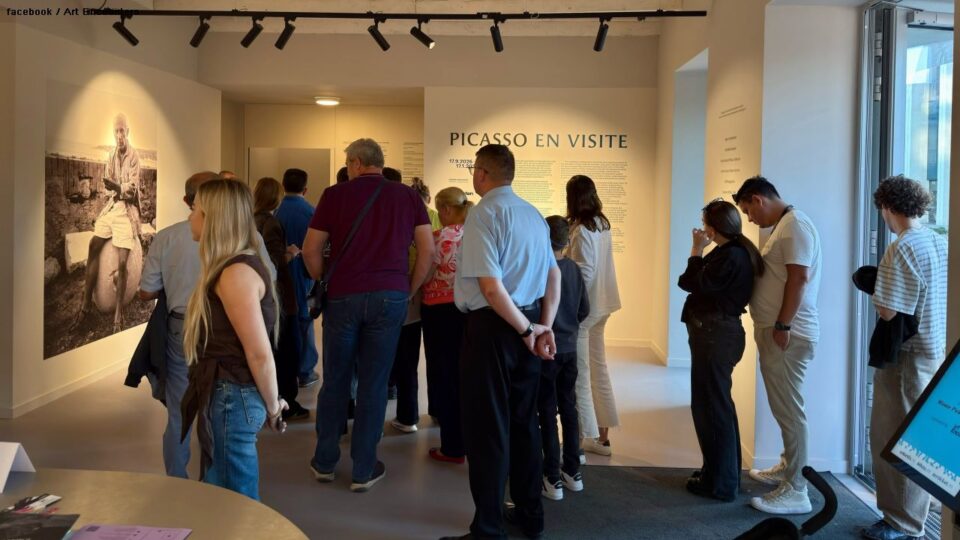
“Picasso en visite” opened in Timișoara on 17 September, presented by the Art Encounters Foundation in partnership with the Musée Picasso in Antibes.
Eugen Cojocariu and Ion Puican, 31.10.2026, 13:00
The landmark exhibition ‘Picasso en visite’ opened in Timișoara, western Romania, on 17 September. It is presented by the Art Encounters Foundation in partnership with the Musée Picasso in Antibes, the world’s first museum dedicated to Pablo Picasso, who lived from 1881 to 1973. The Spanish artist is widely regarded as the most brilliant artistic figure of the twentieth century. A co-founder of Cubism, he broke with traditional perspective and redefined the way reality is represented on canvas, transforming forms into complex geometric structures. His remarkable, prolific and lengthy career changed the course of art history.
On 17 September 1946, Pablo Picasso first stepped inside the Château Grimaldi in Antibes. This exhibition marks the eightieth anniversary of that visit. It brings together 69 works: paintings, drawings, engravings, lithographs and ceramics, none of which has previously been exhibited in Romania. The curator is Jean-Louis Andral, director of the museum in Antibes. The selection reveals a Picasso inspired by Mediterranean light, nature and mythology, an artist moving freely from one technique to another. Eugen Cojocariu spoke about the exhibition to Ovidiu Șandor, President of the Art Encounters Foundation:
“We’re delighted to be hosting a Picasso exhibition in Timișoara, a very special exhibition featuring works from the Picasso Museum in Antibes, with an exceptional loan of almost 70 pieces. These include paintings, drawings, engravings, ceramics and books illustrated by Picasso. We’re pleased to be able to offer people in Timișoara, as well as visitors to the city, the chance to see works by such a great artist. I think that, in a world where we’re bombarded with digital images, including images of artworks and so on, it’s important to have the opportunity to see the works themselves, ‘in the flesh’ — on canvas, on paper and so forth. And yes, we believe this exhibition will appeal to a very broad audience. I think we’ve all heard of Picasso, and each of us knows something, however much or little, about his work and the man himself. This exhibition is an opportunity to rediscover Picasso, perhaps to gain an understanding of other aspects of his work. For example, his ability to move so easily, so effortlessly, from one medium to another. We’re also working to build a busy programme of activities and events around the exhibition. …”
The exhibition also inaugurates the new Art Encounters centre, refurbished by Attila KIM Architects to meet international museum standards. The centre includes a learning space for children, a library, an art bookshop, a café and a garden. Ovidiu Șandor tells us more about this new exhibition and cultural venue:
“As for the space, yes, it’s actually much more than just a space. It is certainly larger than the foundation’s previous premises. First and foremost, we’re talking about bringing the upstairs exhibition space up to the appropriate museum standards. It now meets all the requirements for temperature and humidity control, as well as security, which has become an even more critical consideration recently. That’s what makes it possible for us to host the Picasso exhibition. But beyond that, the ground floor has become a space that opens out to the city, to the public, to the community, offering all the facilities you’d expect in a small museum, so to speak. There’s a bookshop, primarily devoted to art books, of course, but also selling work by local designers, items relating to Timișoara and so on. The Picasso exhibition is the first of these exhibitions. Our aim is to host an exhibition like this once a year, featuring a celebrated artist and appealing to a very broad audience. Alongside that, of course, we’ll continue our programme devoted to contemporary art: a programme for living artists, for young artists and for established figures in the history of contemporary art, from Romania, Central and Eastern Europe, and around the world.”
Among the works on display in ‘Picasso en visite’ in Timișoara are ‘The Centaur and the Ship’, ‘Seated Fisherman with a Cap’ and ‘Bacchanal with a Black Bull’. Diana Marincu, Artistic Director of the Art Encounters Foundation, gives us a brief tour of the exhibition:
“The exhibition takes a broadly thematic rather than strictly chronological approach, exploring several recurring themes in Picasso’s work. The first room serves as a kind of introduction, bringing things together, and also includes a timeline of Picasso’s life. Throughout the exhibition, there are some beautiful photographs from the Sima collection, showing Picasso at work, immersed in this Mediterranean world, if you like. Then the themes of the studio, the muses who inspired him, still lifes, mythological motifs and the animals that appear again and again in his work provide a structure for the visitor’s journey. But the common thread that I think best connects all the works is Picasso’s extraordinary versatility and the way he moves between different forms of expression. We have paintings, drawings, engravings and ceramics in the exhibition. He was tireless in his search for different materials through which to express himself artistically. …”
Finally, we spoke to architect and designer Attila Kim, who designed ‘Picasso en visite’ and transformed the new Art Encounters premises into a cultural hub. How difficult was it to bring a building in Timișoara up to international museum standards? Attila Kim:
“These days, when you exhibit art, the requirements are, to my mind, quite normal rather than exceptional. Air quality, humidity and temperature control, along with security, should now be standard features of galleries and museums alike. I’m very pleased to see private initiatives like this helping to make that the norm. We should no longer think of museums as the only institutions capable of providing the basic conditions needed to display works of cultural heritage. Private institutions can do that too. I believe this is the future. It’s the direction we’re heading in, and it should no longer be seen as a luxury. (MI)