Children with Learning Disabilities
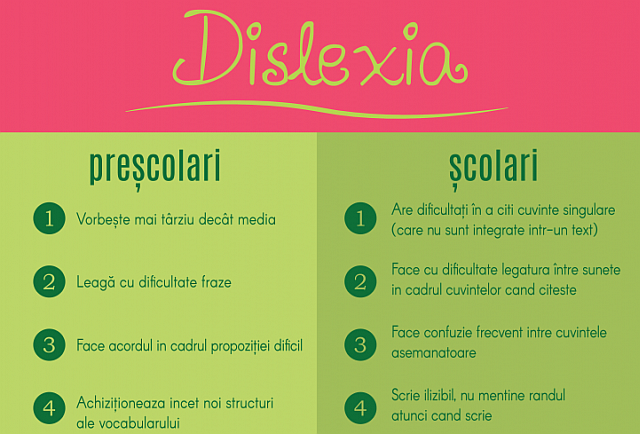
One of the best-known learning disabilities is dyslexia.
Christine Leșcu, 01.02.2017, 13:11
We all know, either from our own school, professional or parent experience or from hearsay, that some of the children with lower marks are considered lazy, or inattentive or disinterested. That is the old-fashioned approach to the problem. But ever since specific learning disorders were clearly defined and diagnosed, that approach has started to change in Romania as well.
One of the best-known learning disabilities is dyslexia. A reading and writing disorder, taking the form of dysgraphia or dyscalculia, dyslexia cannot be cured. Children suffering from dyslexia can only hope that by steady practice their condition can improve. Linguist Roxana Din, a therapist for dyslexic children, explains this disorder:
Roxana Din: “These children use their right brain more than their left one. So, they dont learn to read as normal kids do. The first signs appear when children start learning to read and write. They read backwards: for instance, they read “no instead of “on, “n instead of “m, “b instead of “p and so on. Some of them have an attention deficit too. There are theories according to which dyslexic people have memory problems too and that is why, sometimes they have mathematics learning disability.
But dyslexia is not accompanied by intellectual disability. On the contrary, many diagnosed dyslexics are creative people, with above-average intelligence quotients. This is why specialists recommend early diagnosis, if possible in the first years of pre-school or school, precisely in order to enable these children not only to improve their condition, but also to fully use their true potential. Mirela Nitu is the mother of a five-grader diagnosed with dyslexia in his second year at school. Here is what she told us about her experience:
Mirela Nitu: “In the second grade, his teacher advised us to see a speech therapist, and there we basically started therapy for dysgraphia, because he was mixing up the letters when writing. He had no speech problems whatsoever, and until that moment we had never thought there could be a problem. He had got top scores in kindergarten and school assessments. It was only during the second grade, when the more complicated homework and the longer dictations came up, that we noticed that certain mistakes were recurrent.
After the diagnosis, therapy followed, and gradually the results as well.
Mirela Nitu: “He still tends to play more and to avoid more difficult situations, like homework. He still makes mistakes when he is tired or not focused enough. However, he has good marks, because he pays attention and is active in class, he has no problems at school overall. But he will probably continue to make spelling mistakes.
Mirelas son goes to individual therapy once a week, and has weekly group therapy sessions, with other dyslexic kids, as well. It is a constant effort, for him and for his parents, but an effort worth making.
Mirela Nitu: “Indeed, extra effort is required, both from the child and from the parents. It includes taking part in various activities and going to therapy. Moreover, homework takes longer than with other children. We need to do extra work on a regular basis. And you always think about what other learning methods to use. As a parent, you need more patience and you need to support these children permanently. We hope he will be okay and will reach his maximum potential and become the adult he wants to be.
A lot of work is also necessary in terms of self-confidence, because the labels attached by the others leave deep traces. Speech therapist Roxana Din has more details:
Roxana Din: “In many cases we need to work with them to strengthen their self-confidence, because many times they are seen as lazy and they must live with this stigma. Sometimes even their class mates believe them to be lazy. So dyslexic children need to be encouraged and to feel listened to and understood.
Roxana Din and Mirela Nitu met at the EDULIER centre, one of the few centres in the country devoted to therapy for dyslexic children. Last year, when it was opened, director Cristiana Ionescu discovered that she could not find the expertise required for such a centre in the country, so she had to resort to foreign experts.
Cristiana Ionescu: “We first asked experts in Norway and the UK. They all told us that they can show us the basic principles of this kind of therapy, but that it must be adapted for the Romanian language. After one years work, on April 7, 2016, we opened our first centre, and we have been working ever since to put together learning and therapy kits for Romanian and maths for children with dysgraphia and dyscalculia. We are trying to set up teams made up of the child, parents, therapist and the teachers. We thought about bringing in linguists, speech therapists, psychotherapists. We have been searching extensively for such experts, because we wanted to have not only people who are familiar with the problems entailed by dyslexia, but also who are not afraid of new, ground-breaking projects.
At present, 20 children come to EDULIER every day. Cristiana Ionescu tells us what they do there:
Cristiana Ionescu: “They take part in either educational therapy, or animal-assisted therapy, or work in the digital hall where they use the interactive digital wall to learn to assess their own work and correct their own mistakes. Similarly, we pay a lot of attention to psychotherapy. The earlier we evaluate the children, the more attention we pay to the signals our children try to convey, the more we can help them. And this is how the gaps between them and the other kids can be bridged more quickly.
The centre also offers support group sessions, where the parents of dyslexic children can come and share their experience with each other.