The I.L. Caragiale Museum in Ploiesti
This memorial house is dedicated to the greatest Romanian playwright
Ion Puican, 28.08.2021, 14:00
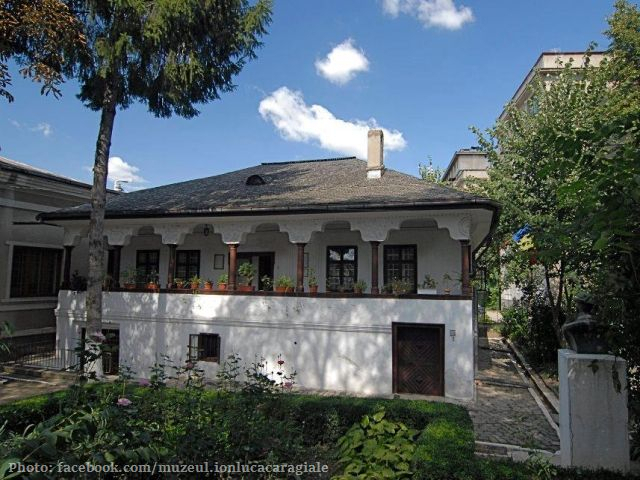
Close to the center of the city of Ploiesti, in Prahova County, 60 km north of the capital, hidden behind a line of blocks of flats typical of the communist period, lies a white house of the early 20th century, which houses the Caragiale museum, dedicated to the greatest Romanian playwright.
He wrote what are maybe some of the best known plays in Romanian literature, a fresco of Romanian society in late 19th and early 20th century, which passed the test of time, and are relevant to this day. We crossed the threshold of the white house to talk to the museum curator, Monica Bostan, and asked her about the history of the place:
“The museum opened on January 30, 1962, by the effort and care of Professor Nicolae Simache, who opened most of the museums in Prahova County. It was an homage paid by the people of Ploiesti to our great playwright to celebrate the 110th anniversary of his birth. Caragiale was born on January 30, 1852, in Haimanale, a village in Dambovita County, which now bears his name. He moved with his family in the city of Ploiesti when he was 6. All his school years, the most beautiful in our lives, he spent here, in Ploiesti.
We asked Monica Bostan to tell us more about the great writer’s youth:
“In the second grade, there was the memorable visit to Ploiesti paid by then ruler Alexandru Ioan Cuza, and it was at the school where Caragiale was studying. His teacher was Vasil Dragosescu. He evoked the moment in his writing ’50 Years Past’, naming him his spiritual parent, saying that his Romanian language, such as it was, he owes to his teacher. Here in the museum we also find Zaharia Antinestu, his French language teacher, of whom he said that it was the model for the character Zaharia Trahanache from ‘A Lost Letter’. In 1864 the SS. Peter and Paul Gymnasium was set up in the city, and the writer signed up for the 2nd year, and graduated in 1867, the fifth of eight students. We have the transcript from his last year of gymnasium, school year 1866-1867. There, written in red, we have the school situation for pupil Caragiale, who, as I said, graduating fifth of eight pupils, was not a top student, his grades in Romanian classes were not very good, as we would expect, but had very good grades in French, math, and history. He later taught French at a private high school in Bucharest. In the building of the Peter and Paul Gymnasium we now have the Prahova County Museum of History and Archaeology, and there we can see a plaque informing visitors that this is where Caragiale studied. After graduating this school, Caragiale took another year of school in Bucharest, and then went on to study the art of declamation at the Bucharest Conservatory of Dramatic Arts with one of his uncles, Costache Caragiali, one of his father’s brothers, who had some of the first theater troupes in our country, which we can actually call the founders of modern Romanian theater. Even the national poet, Mihai Eminescu, was a prompter in Caragiale’s uncles’ theater troupes, and that started their friendship.
Curator Monica Bostan led us on a brief tour of the museum, highlighting some of the exhibits:
“In the second room we reconstituted the universe in the houses that Caragiale had lived in. it is well known that the writer never had a house of his own, he always rented, hence his novella ‘Looking for a Home’, it seems as if he was always in the search for an ideal home. On the wall we have the crystal mirror with a rosewood frame that belonged to the writer, as well as a small round coffee table, as well as other furniture, a table, chairs, a sofa, the carpet on the wall also belonged to the writer, as well as the two original paintings, the china pitcher and the beer mug with a cover, these all belonged to the writer. Here we also have a portrait of poet Eminescu, which is painted on glass, a rare procedure for its time. Even though it is well known that the two had differences at some point, in spite of the fact that they were friends since their school years, upon Eminescu’s death, on 15 June 1889, Caragiale dedicated to him the article ‘Nirvana’, in which he described Eminescu as a fair angel descended from an old icon. Here in the hallway we are met by the photos of Eminescu and Caragiale in their adolescence, another, lesser known photo of Caragiale at the age of 20, when he was studying under his uncles at the Conservatory of Dramatic Arts, and a bust of the writer by sculptor Ion Jalea. We also have caricatures, costume sketches, a gallery of portraits with some of the actors that gave life to some of his characters on stage, and a portrait of his daughter, Ecaterina, in maturity, made by painter Rodica Maniu. Above we have the painting of his house in Bucharest, which still exists on Maria Rosetti street, which opposite has a statue of the writer, moved a few years ago from the National Theater. It has a plaque that reminds passers by that this was a home for Caragiale and his family around the year 1900.
At the end of the tour, Monica Bostn told us about the museum schedule:
“Information about the activities at the museum, and lesser known information about the exhibits in our patrimony can be found on our Facebook page, and on the website of the Prahova County Museum of History and Archaeology. You are eagerly awaited to get to known the fascinating world of Caragiale, along with his memorable characters.