The Romanian avant-garde movement
The Romanian avant-garde movement, which gained momentum after WWI, can be traced back to the early 20th century.
Christine Leșcu, 12.07.2014, 12:00
We owe the birth of the Dada movement at Zurich’s Cabaret Voltaire in 1916 to the Romanian poet Tristan Tzara and the architect and fine artist Marcel Iancu. Professor Cristian Robert Velescu tells us more about the combination between literature and the fine arts, which characterised the avant-garde movement, both in Romania and Western Europe.
Professor Cristian Robert Velescu: ”An important Romanian avant-garde name in the area of fine arts is that of Victor Brauner, who is closely linked to leading avant-garde magazines in Romania, such as 75 HP, Integral and UNU, which was founded by Sasa Pana and was the only Romanian publication open to surrealism, the founding trend for the European avant-garde movement. The fine arts component of the avant-garde goes hand in hand with its literary component, as artistic synthesis is typical of the avant-garde movement worldwide. I’ll give you the well-known example related to the birth of the 75 HP magazine, which was very open towards dadaism. In the pages of the magazine, its two founders, the painter Victor Brauner and the poet Ilarie Voronca, created a particular phenomenon known as pictopoetry. This is neither painting, nor poetry, but a synthetic phenomenon.”
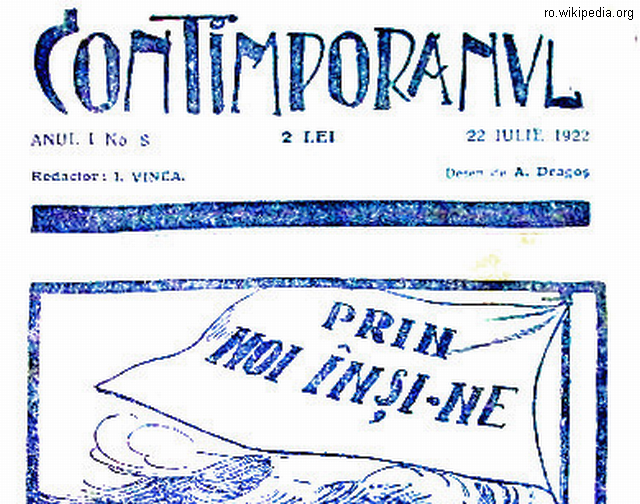
Dadaism came to an end in 1922, as its very founder Tristan Tzara bluntly put it at the time. Tthe avant-garde movement, however, continued in the form of surrealism and constructivism. In Romania, the avant-garde movement flourished following the appearance of a great number of magazines, such as Contimporanul, a magazine founded by the poet Ion Vinea and the architect Marcel Iancu, who had returned to Bucharest from the West. In the first issue of this magazine, dated May 1924, Ion Vinea published an inflammatory article in which he urged artists to abandon the outmoded means of expression they had been indulging in until then and try something new. Titled Activist Manifesto for the Youth, Vinea’s text may be viewed as the platform of the Romanian avant-garde. A number of likeminded artists clustered around Marcel Iancu and the Contimporanul magazine. One such artist was one of Constantin Brancusi’s former students, Milita Petrascu, who would go on to become one of Romania’s leading sculptors, as well as an accomplished graphic artist. Here is Professor Cristian Robert Velescu again, speaking about Milita Petrascu’s artistic affiliations”
Professor Cristian Robert Velescu: “Milita Petrascu is a phenomenon in itself, as she is placed at the crossroads of two leading trends of her time: modernity and the avant-garde movement. Modernity was a wider phenomenon that also had close ties with the artistic tradition, while the avant-garde movement was an iconoclastic trend. Constantin Brancusi, in whose studio Milita Petrascu worked for a while is, in my opinion, a representative of modernity that embraces a classical vein. Milita Petrascu left Brancusi’s studio, remaining on friendly terms with her mentor, and she returned to Bucharest where she joined the avant-garde movement. She became an important representative of the fine arts activity of the Contimporanul magazine and fully complied with the ideological programme laid out by Ion Vinea and Marcel Iancu. After her avant-garde experience, Milita Petrascu became more balanced in her works, which is not to say that she betrayed her creed, but that she found in portrait art an area of expression to which she lent a special dimension. Hers is not a conventional form of art, but a kind of art that feeds on creativity. Traces of her avant-garde endeavour can also be found in her new works created in the inter-war and post-war years. It may, perhaps, be worth noting that Milita Petrascu lived in a house designed by Marcel Iancu, in a very avant-garde environment.”
Born in 1892, Milita Petrascu died in Bucharest in 1976. Marcel Iancu, who was born in 1895 and became settled in Palestine in 1940, died in Israel, in 1984.