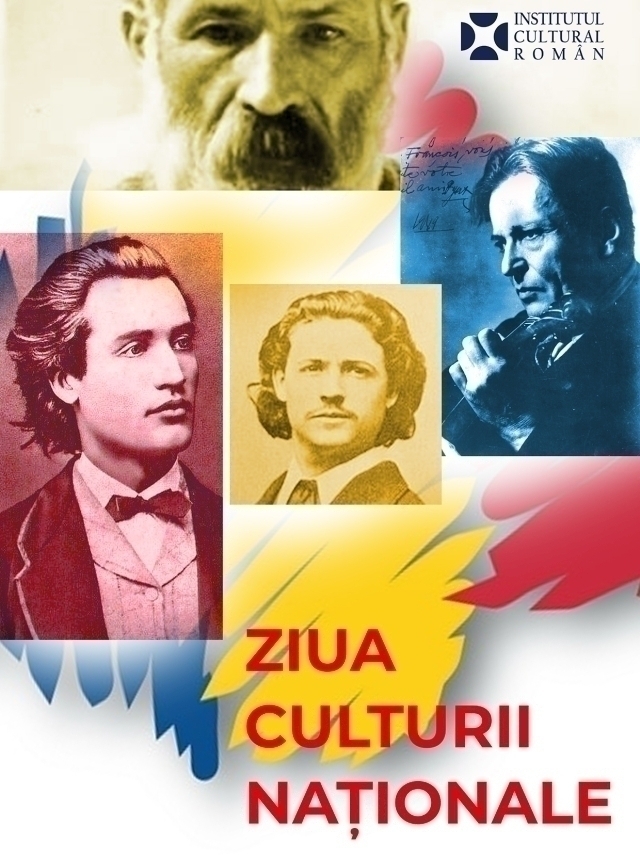
Mihai Eminescu
Mihai Eminescu, Gheorghe and Raluca Eminovici’s seventh
of eleven children, was born in Botosani on January 15, 1850. He started school
in 1858 in Cernauti, in the Austro-Hungarian Duchy of Bukovina. Even though he
was an outstanding student, in 1863 he dropped out, and joined the Fanny
Tardini-Vladicescu theater troupe, which he developed a fascination for. He
worked for a while as a clerk in Botosani, at the court and city hall.
Corina Sabău, 20.01.2018, 13:55
Mihai Eminescu, Gheorghe and Raluca Eminovici’s seventh
of eleven children, was born in Botosani on January 15, 1850. He started school
in 1858 in Cernauti, in the Austro-Hungarian Duchy of Bukovina. Even though he
was an outstanding student, in 1863 he dropped out, and joined the Fanny
Tardini-Vladicescu theater troupe, which he developed a fascination for. He
worked for a while as a clerk in Botosani, at the court and city hall.
Eminescu made his debut in 1866. He was in Bukovina, as
a tenant of his teacher Aron Pumnul, when the latter passed away. In memory of
their teacher of Romanian, a few students put out a brochure where we can find
a poem entitled At Aron Pumnul’s Tomb, signed M. Eminovici. One month
later, the magazine Family in Budapest, published his poem Were I to Have.
Iosif Vulcan, the magazine director, changed his name from Eminovici to
Eminescu, a name he kept for the rest of his life. This was only the beginning
of his collaboration with the magazine, which published five more of his poems
that year.
In 1867 he joined Iorgu Caragiale’s theater troupe as a
prompter and copyist. That year the magazine Family published his poem What
I Wish for You, Sweet Romania’.
He moved as a prompter and copyist in Mihai Pascaly’s
troupe. Pascaly was one of the most important promoters of theater in Romania,
as director of the National Theater in Bucharest. During his time with the
troupe, Eminescu met I.L. Caragiale, who had not yet had his debut as a
playwright. Between 1869 and 1872, upon advice from his father, he studied law
and philosophy in Vienna. He was active in student organizations, made friends
with novelist Ioan Slavici, and debuted as a columnist at the Albina (The
Bee) newspaper in Budapest.
He started contributing to the Convorbiri
Literare magazine, the publication of the Junimea Literary Society of Iasi.
In his study on the so-called New Direction, critic Titu Maiorescu praised
Eminescu’s qualities as a poet, saying he was second only to Vasile Alecsandri.
In 1872 he met poetess Veronica Micle, who would inspire him to write most of
his romantic poetry. That same year Convorbiri Literare published one of his
most important pieces of fiction, Poor Dionis, and started writing his major
poems Calin and The Morning Star.
He returned to his country, living in Iasi between 1874
and 1877, working as a director of the Central Library, a substitute teacher,
school inspector for Iasi and Vaslui, as well as editor of the Iasi Courier
newspaper. He continued publishing in Convorbiri Literare. He made good
friends with writer Ion Creanga, whom he brought into Junimea. In 1877 he
moved to Bucharest, where he worked for the Timpul newspaper, first as an
editor, then as an editor-in-chief. He was exceptionally active as a
journalist, and continued to work on some of his most important poems that
highlight his mature stage as a writer, such as his Epistles and The Morning
Star.
However, due to health reasons, his literary activity
went into decline. In June 1883, the poet fell gravely ill, was admitted into
Sutu hospital, then into an institute near Vienna. His volume Poems was
published in December, with a foreword by Titu Maiorescu, who had made the
selection. It was, in fact, the only volume of poetry he published during his
lifetime. He passed away on June 15, 1889, in the Sutu sanatorium, and was
buried in Bellu Cemetery in Bucharest. His pall bearers were four students from
the Teaching College. (Translated by Calin Cotoiu)