RRI Live!

Listen to Radio Romania International Live

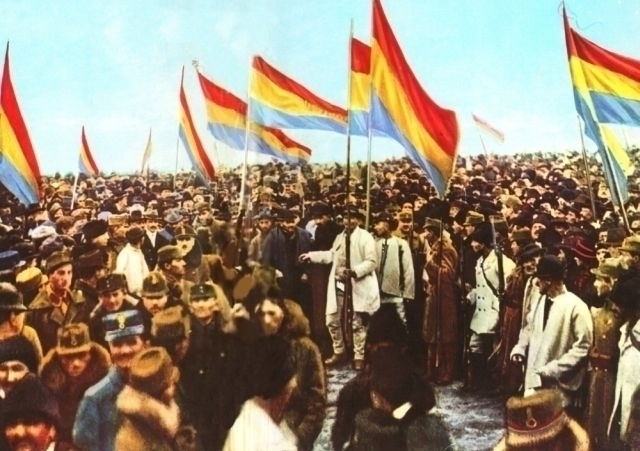
The National Assembly in Alba Iulia on December 1st, 1918

World War One veterans reminiscing about the Great Union
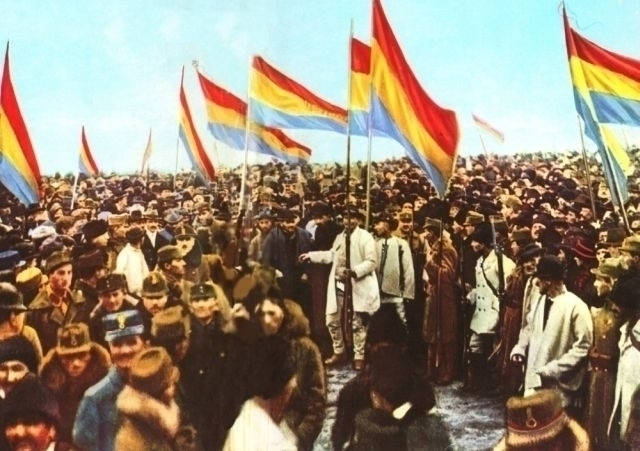
The National Assembly in Alba Iulia on December 1st, 1918

, 07.12.2019, 11:00

The National
Assembly in Alba Iulia on December 1st, 1918, proclaimed the Union of
Transylvania with the then Kingdom of Romania, The 1,228 delegates thus confirmed
the fact that Romanians in the Austrian-Hungarian Empire were part of the
Greater Romania project, initiated by King Ferdinand I and Queen Marie.

December the 1st,
1928, was a cold winter day, yet it was also a day of joy. The Romanians do
have a penchant for festivities, so today’s celebrating mood might make us
believe the general enthusiasm back then was a moderate one. Nevertheless,
documents of the time reveal the fact that crowds of people openly expresses
their joy around December 1st. It was the joy marking the end of a
bloodcurdling ending, that of the trench war, a joy that was blended into the
advent of peace and the access to a new country, to Greater Romania, which
claimed the lives of millions of servicemen on the front lines in the Carpathians
or around river Danube. The joy of the Romanians living in the
Austrian-Hungarian Empire was also bolstered by the fact that a great many of
them had been in the line of duty for the whole four years of the war. They had
fought on the front line and had seen death in all its harrowing forms. The 12
battles on the Isonzo river alone, along Italy’s border with Slovenia, according
to the testimonies of Transylvanian Romanians who fought there, were also
reasons for everybody to hail peace, from the bottom of their hearts.


The press of
that time, the correspondence, diaries and memoirs back then are written
evidence for the enthusiastic atmosphere around the day of December 1st,
1918. People wanted to organized themselves, to do away with the after math of
the war, to bring back peace, economic prosperity and personal safety. The
early days of winters were also the days of the first snowfall, what with the
fact that winter holidays were drawing near, while the return to normality made
everybody view events with great optimism.


Clement Bolfă was
from the commune of Maieru, the County of Bistrița-Năsăud. He was 90 in 2000.
He recalled that in 1918, when he was an eight-year old child and a 1st-grader,
mobilizing joy seized the adults around him.

I remember I was in
school and I had a school teacher, Barna Ionuc, and he told us he had to travel
to Alba Iulia to take part in an assembly, because Transylvania united with the
Mother Country. And when he came back he told us how it was and then taught us children
to sing The Union is written on our flag, The Great Round Dance , Join
your hands and never part/ all ye with Romanian heart. I was on the verge of
tears…The schoolteacher told us how Transylvania got united and how they cried
out in support of the union. When he came from Alba Iulia he set up a festivity
here and we were singing and there was such a joy! Those were the days!


Emil
Wagner was a former member of the National Peasant Party and a member of the
Romanian National Party before 1918. He knew Iuliu Maniu, the leader of the
National Peasant Party very well. In 2000, when he was 104 years old, he
recalled the circumstances prior to December 1st 1918. Wagner was a
member of the delegation that was to get in touch with the Romanian National
Party of Bukovina, being sent by Maniu together with Ilie Lazar, another
important leader of the National Peasant Party. Wagner recalled how in August
1981 Alexandru Vaida-Voevod, a leading politician of the Romanian National
Party and deputy of the Parliament in Pesta, had been empowered to demand the
independence of Transylvania on behalf of the party:

Vaida took the floor in the Hungarian Parliament and demanded the
independence of Transylvania. Count Tisza, who was head of government, said
that Vaida was a traitor. Then Iuliu Maniu took the floor demanding the same
thing. Then, Ferdinand, a member of the Habsburg family addressed parliament,
saying We can’t blame these people as being traitors because they are our deputies,
they are not traitors. It is normal that they should demand the independence of
Transylvania! Then, it was demanded that the independence of Transylvania
should be subject to vote. Votes were cast, but Ferdinand did not vote.
However, his proposal exonerated Iuliu Maniu and Vaida and they were not
executed; Count Tisza had demanded that they should be executed.


The
women’s involvement in the achievement of the Great Union was no less important
than that of men. The mothers, wives, sisters or daughters of the great men who
achieved the union of December 1st 1918 were no less than their
sons, husbands, brothers and fathers. Lucia Mihaly of Apsa, the daughter of a
great Romanian lawyer, recalled that she had sewn the tricolour flag she had
hoisted in the balcony of their house in Sighet, Maramures. The new civil
servants swore allegiance to the Romanian state on that flag after December 1st, 1918.

Lucia Mihaly:


In 1918 my brother came from Cluj and brought a flag from Iuliu Maniu to
my mother. I sewed it with coloured silk and my brother and I took the flag to
the square in the middle of the town. Delegates from every village came there
to go to Alba Iulia and swore they would not come back without a result. They
either walked or went by wagon or on horseback because Hungarians didn’t let
them go by train to Alba Iulia. My brother and Ilie Lazar carried the flag. And
when my brother came back I put the flag on the balcony; it was October 24.


Can
there be a greater joy when a four year long destructive war is over? All the
more so when a new country is born.

Sergiu Celibidache (1912-1996)
RRI Encyclopaedia Sunday, 05 April 2026

The Micia Roman fort

Established in the 2nd century AD within the Roman province of Dacia, the fort served a vital strategic node: it controlled the road connecting...

The Micia Roman fort
Universitatea Bucureşti (foto: Mariana Chiriţă/RRI)
RRI Encyclopaedia Sunday, 29 March 2026

The University Museum in Bucharest

The University of Bucharest was established and has operated under this name since 1864, following the founding of Romania through the union of the...

The University Museum in Bucharest
Ion Dumitrana (AI geerated image)
RRI Encyclopaedia Sunday, 22 March 2026

Engraver and illustrator Ion Dumitrana

Ion Dumitrana (1923-1976) was one of the most important Romanian stamp artists, creating hundreds of postage stamp designs in the second half of the...

Engraver and illustrator Ion Dumitrana
Princely and Royal Thrones
RRI Encyclopaedia Sunday, 15 March 2026

Princely and Royal Thrones

  A symbol of royal authority, thrones held a central place in the representations of power in the Romanian space. Before 1945, they were a...

Princely and Royal Thrones
RRI Encyclopaedia Sunday, 08 March 2026

The George Severeanu Museum

The George Severeanu Museum is located in Bucharest, in a house built at the beginning of the 20th century and forms part of the Bucharest...

The George Severeanu Museum
RRI Encyclopaedia Sunday, 01 March 2026

Diplomat Grigore Gafencu

Grigore Gafencu served his country without reservation and sought to promote its interests both in his official capacities and during his exile after...

Diplomat Grigore Gafencu
RRI Encyclopaedia Saturday, 21 February 2026

A Scholar of international repute – Traian Săvulescu

Traian Săvulescu used to be one of the leading figures of the Romanian science in the 20th century, a biologist, botanist, professor and president...

A Scholar of international repute – Traian Săvulescu
RRI Encyclopaedia Sunday, 15 February 2026

General Henri Cihoski (1871-1950)

The history of the Romanians was also written by foreigners, just as Romanians are present in the history of other nations. Although a numerically...

General Henri Cihoski (1871-1950)

Partners

Muzeul Național al Țăranului Român Muzeul Național al Țăranului Român
Liga Studentilor Romani din Strainatate - LSRS Liga Studentilor Romani din Strainatate - LSRS
Modernism | The Leading Romanian Art Magazine Online Modernism | The Leading Romanian Art Magazine Online
Institului European din România Institului European din România
Institutul Francez din România – Bucureşti Institutul Francez din România – Bucureşti
Muzeul Național de Artă al României Muzeul Național de Artă al României
Le petit Journal Le petit Journal
Radio Prague International Radio Prague International
Muzeul Național de Istorie a României Muzeul Național de Istorie a României
ARCUB ARCUB
Radio Canada International Radio Canada International
Muzeul Național al Satului „Dimitrie Gusti” Muzeul Național al Satului „Dimitrie Gusti”
SWI swissinfo.ch SWI swissinfo.ch
UBB Radio ONLINE UBB Radio ONLINE
Strona główna - English Section - polskieradio.pl Strona główna - English Section - polskieradio.pl
creart - Centrul de Creație Artă și Tradiție al Municipiului Bucuresti creart - Centrul de Creație Artă și Tradiție al Municipiului Bucuresti
italradio italradio
Institutul Confucius Institutul Confucius
BUCPRESS - știri din Cernăuți BUCPRESS - știri din Cernăuți

Affiliates

Euranet Plus Euranet Plus
AIB | the trade association for international broadcasters AIB | the trade association for international broadcasters
Digital Radio Mondiale Digital Radio Mondiale
News and current affairs from Germany and around the world News and current affairs from Germany and around the world
Comunità radiotelevisiva italofona Comunità radiotelevisiva italofona

Providers

RADIOCOM RADIOCOM
Zeno Media - The Everything Audio Company Zeno Media - The Everything Audio Company