Romanian Easter traditions
Majority Christian Orthodox Romania celebrates Easter.
Monica Chiorpec, 02.05.2021, 14:00
The Christian Orthodox world is
celebrating Easter, one month after Western Christianity. We’ll be looking at
how this holiday is celebrated in Romania, which is a majority Orthodox
country. But first, let’s find out from ethnologist Delia Suiogan how the date
of Easter is calculated and why Catholic and Protestant Easter doesn’t usually
overlap with Orthodox Easter:
The spring equinox is the common
element in the calculation of the date of Easter in all calendars. Orthodox
Christians follow the Julian calendar, while Catholics use the Gregorian calendar.
There is a difference of 13 days between the two calendars. The spring equinox
falls on 8th March according to the Gregorian calendar and on 21st
March according to the Julian calendar. The date of the full moon is calculated
depending on the two moments. When the full moon falls on a Sunday for the
Orthodox, Easter will be celebrated a week later. The same for the Gregorian
calendar, except for the 13-day difference, which is why the resulting date is
different. It’s important to note that Easter is a celebration that takes into
account the moon and not the sun, as is the case for Christmas. This naturally has
a direct influence on traditions and customs. Catholic Easter is usually
celebrated before Orthodox Easter.
The week before Easter abounds in symbols.
The whole period is traditionally marked by restraint and decorum in all
aspects of social life. Sabina Ispas, the director of the Constantin Brăiloiu
Institute of Ethnography and Folklore in Bucharest, explains:
A service for the remembrance of
the dead is performed on Thursday before Easter. According to some records from
16th century, the family of the departed would gather at their
graves, where they would lament their passing and burn incense. Bonfires would
also be organised. This fire was not seen as destructive, but as encapsulating
the significance of light. It’s a form of expression of divine energy, which would
also come to manifest itself over the following days and nights. In the days
leading up to Easter, evening services are held after the sun sets. On Thursday
before Easter, for example, a service called the Mass of the 12 Gospels is held.
This particular Thursday is also when eggs are traditionally painted, lambs are
slaughtered and the Easter cake is made. Each activity performed in the
household has a symbolic, allegorical meaning and heralds the moment of
Resurrection on Saturday night. Friday before Easter symbolises the moment when
Christ was laid in his tomb. On this day, people would traditionally eat very little
or even fast all day. Bonfires would also be held in church courtyards, just
like on Resurrection night.
Saturday night before Easter is very
important. No one is to sleep on this night, and people used to light bonfires in
their gardens, while at midnight everyone has to be in church to receive the
light. The candle lit in church, which people would take home, was believed to protect
the family the entire year. The image of the people carrying lit candles is in
fact quite spectacular, and can still be seen today, not only in villages, but
in cities as well. A special basket containing samples of the Easter meal would
also be prepared in advance and taken to church to be blessed, as people in traditional
communities would never touch the food on special holidays such as Easter
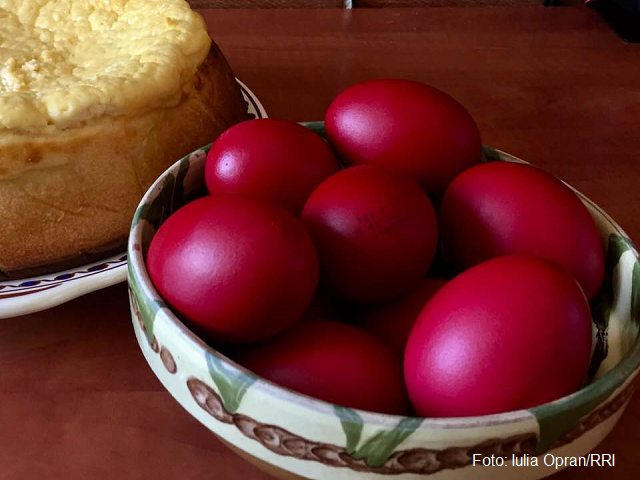
unless it was blessed. The central element of the Easter meal is the red-painted
hard-boiled egg. Painting the eggs and preparing the food to be consumed on
Easter were the main activities performed in the days leading up to this celebration.
The northern Romanian region of Maramureş still preserves many of these old
traditions. Sabina Ispas, the director of the Constantin Brăiloiu Institute of Ethnography
and Folklore in Bucharest, tells us more about the symbolism of the Easter egg:
The hard-boiled egg comes via Judaism.
The Passover plate has a yellow egg in the middle next to some bitter herbs. In
Romanian tradition, eggs are to be painted red. The modern practice of painting
the Easter eggs green, blue and different other colours and combinations, not
to mention their featuring all manner of images, such as cats, dogs and cartoon
characters, has nothing to do with the traditional holiday. Eggs had to be
painted red, and could only feature an image of the cross, of the grain of
wheat, of the fish, and, of a more recent date, plant leaves.
Lent, which is the long fasting
period before Easter, only ends early on Sunday morning, after people return
from church with the baskets of food blessed by the priest. The blessing itself
follows a specific ritual. The image of people gathering in front of churches
holding baskets full of traditional dishes and covered in beautifully decorated
hand-stitched cloths is truly impressive. But regardless of how it is
celebrated across different regions of the country, Easter still remains an opportunity
for shared joy and an important event that brings families and communities
together.