150 years since the birth of Nicolae Iorga
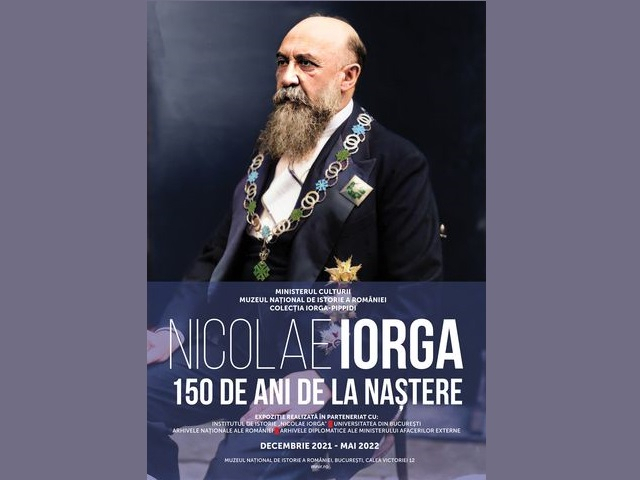
The National Museum of History of Romania hosts an exhibition marking 150 years since the birth of Nicolae Iorga
România Internațional, 22.01.2022, 18:12
Nicolae Iorga is the historian with the highest visibility in the cultural world in Romania, and not only. Streets, squares, educational and research institutions have been named after him. He was one of the most important Romanian historians of the 20th century, and some would even say the most important. He was admired by his contemporaries thanks to his impressive work, comprising some 20,000 titles, volumes, lectures, and articles, and his ambition to be an undisputed authority in the field of history.
He specialized in the study of the Middle Ages and the history of the Byzantine Empire, but became a novelist, Slavist, art historian and philosopher of history. Iorga was also a university professor and academician. Apart from the field in which he performed best, history and the editing of historical documents, Iorga also tried to be a literary critic, playwright, poet, encyclopedist, memorialist. He was also very much involved in the political life, and was a member of parliament and minister. On the other hand, his huge popularity is mainly due to his tragic death on the night of November 27, 1940, when he was killed by legionnaires, members of the fascist party in interwar Romania.
Nicolae Iorga was born in 1871 in Botoșani and had special intellectual abilities, in particular a very good memory. He was a polyglot and chose to study history at the Faculty of Letters of the University of Iași. In 1890 he went to study abroad in Italy, then in France. In 1892 Iorga went to England and again Italy. In 1893 he settled for a while in Germany where he enrolled in the doctoral program of the University of Berlin. He managed to get his doctorate from the University of Leipzig, one of the three members of the doctoral committee being the famous German historian Karl Lamprecht.
Iorga returned to Romania in 1894 and at the age of 23 entered the academic world. In the same year, he also started his journalistic and political activity, and became close friends with the lawyer and law professor A. C. Cuza, a nationalist and anti-Semite, by the side of whom he would have a hectic political career. Iorga was an exponent of conservatism, nationalism and agrarianism and founded the popular magazine Sămănătorul (the harvester). Iorga was also the typical intellectual flirting with extremism, being both an inspiration and a victim to it. He cultivated nationalism and fell victim to it in 1940.
The National Museum of History of Romania organized an exhibition marking a century and a half since Nicolae Iorga’s birth. It was the second event in Bucharest dedicated to Iorga in the last year, after the exhibition organized by the Romanian Academy. The director of the museum, Ernest Oberlander-Târnoveanu, says that the exhibition is an opportunity for anyone interested to understand better how big Iorga’s personality was:
This exhibition is dedicated to a human life as it was, as Iorga put it. It is a selection, but not because we did not want to exhibit more objects. On the one hand, the space is limited, on the other hand, Iorga’s activity and the marks he left in contemporary history are immense. We can only hope that one day we will create a Nicolae Iorga documentary archive in the virtual space. The National Museum of Romanian History can exhibit for the first time to the public and visitors essential documents: from his birth certificate to Iorga’s job description from the University of Bucharest, or the numerous diplomas of merit he received from various academies and scholarly societies. We also exhibited correspondence, photographs, family documents, objects and an impressive series of orders and decorations. Nicolae Iorga was the most decorated Romanian civilian of all time.
Historian, professor and academician Andrei Pippidi is Iorga’s nephew from one of his daughters. He owns most of the objects presented in the exhibition at the National Museum of History. Pippidi is one of the donors to the institution of culture of some personal objects of Iorga that will be exhibited in the permanent exhibitions and in the future thematic ones. Andrei Pippidi:
There are manuscripts everywhere, of history books, of the daily press articles or of plays, poems, letters scribbled on random pieces of paper. All are edifying for his intellectual value. Admirers keep records of how much he published, even recorded monologues have been preserved. And we can now read his lectures thanks to hard-working stenographers.
Nicolae Iorga’s personality left a significant mark on the Romanian culture of the 19th and 20th centuries. But such themed exhibitions are also meant to show the normal, mundane aspects of his life and work.