The legend of the Plum Brandy Train
The story of a famous train, told by a local writer.
Ana-Maria Cononovici, 02.12.2025, 14:00
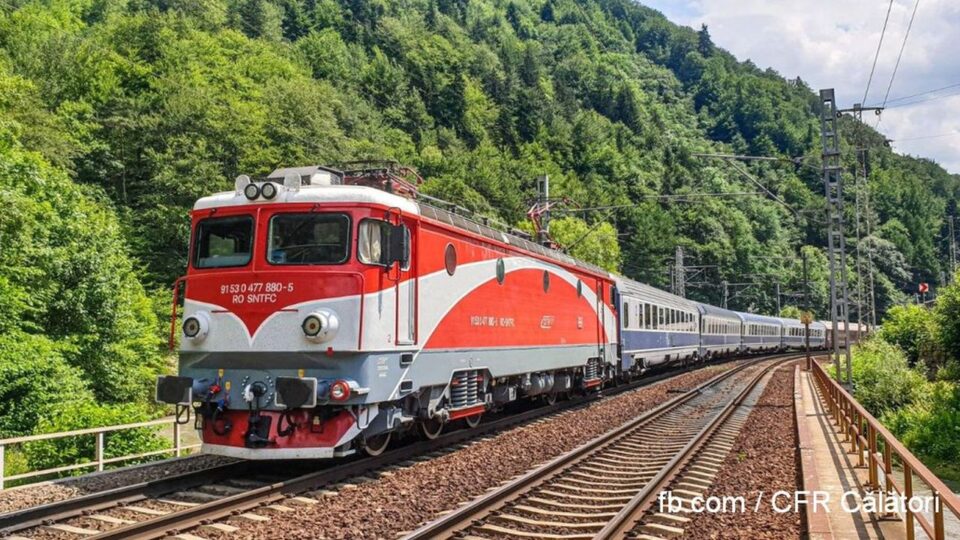
At present it is benefiting the purest air in the country, as the industrial activities in the area ended long time ago. But in the early 20th century the Buzau area knew such an economic boom that made the Buzau – Nehoiasu railroad a must. The railroad was also famous for the train running that route nicknamed ‘Ţuicarul’. According to the National Railway Company CFR SA, the Buzău-Nehoiaşu route covers almost 74 kilometers. The local writer Doru Brătulescu, tells us the story of the aforementioned train.
Doru Bratulescu: “The main vector in the social and economic development of the Buzau Valley, one of the most important valleys in Wallachia, was the construction of the Buzău-Nehoiaşu railway. In fact, that was the most used way of transport and when it became operational proved of vital necessity. Why vital? Because the development of the regions, the industries of woodcarving, textile, construction, mining and oil exploitation mainly hinged on this railroad. It was built by the Marmorosch Blanc & Comp bank, which had been granted the land concession by the Public Works Ministry in March 1907, which was confirmed through a Royal Decree back then. The Buzău railroad, which had the Nehoiaşu Stop as a terminus point had a length of 74-75 kilometers and was completed and ready for exploitation back in 1909. Postal services were also founded the same year, which was very important. They were available in almost all the stops of the Buzău-Nehoiaşu railway, which was the most important accomplishment at that time. That is why the Ţuicarul train included a locomotive and mail waggon. People were able to put their correspondence, envelopes and even parcels to the mail carriage themselves.”
Initially Ţuicarul was designed as a freight train for lumber transportation, but gradually turned into a long train with various types of carriages. Here is again at the microphone Doru Bratulescu with more on that famous train and its funny name, as ţuică in Romanian means plum brandy.
“Why was it called Ţuicarul (The Plum Brandy Train)? Considering that the entire Buzău Valley was known as one of those valleys where every household had plum trees, with orchards sometimes quite large, every house had a plum orchard, and most people made ţuică (plum brandy) from the plums. Very few made plum jam. There was even a special brandy from fat plums. And most of those who travelled by the train would carry brandy in their bags, whether going to a wedding or elsewhere. They couldn’t possibly travel without a small jug or a bottle of brandy. And it was even drunk on the train. Especially by commuters traveling from Buzău back home. Instead of glasses, they used the glass globes that covered the lightbulbs in the train cars: they unscrewed them, since they had threads, drank, and when they finished, they screwed the globes back on. That’s why it was called ‘The Plumb Brandy Train’. People would even joke that the engineer poured a glass of brandy into the locomotive’s fuel, so it could make its way through the winding valleys”.
In just a few years, the train would become a local legend. Doru Brătulescu told us more.
“The Plumb Brandy Train was the most beloved train of them all. It crossed dangerous, winding, narrow valleys in almost three hours, and many engineers wanted to work on this train, given the diversity of the railway and the scenery. It ran in such a way that you could see both left and right very well, and people standing in their gardens waved to the train, whether they had someone aboard or not. And commuting on this train was one of the most important activities, aside from freight transport. It was highly practical, but above everything else it held huge sentimental value. The stations were idyllic and lively, always lit up, even when the electricity was cut off”.
Doru Brătulescu recalls the 1980s, when under Nicolae Ceauşescu’s communist regime, electricity supply to homes was cut for hours under the pretext of saving energy. The train ran until the end of 1989, the year of the Revolution. Afterwards, stations were decommissioned, stations were abandoned, leaving behind an isolated railway, on the verge of disappearing. Even though the train today runs with two carriages, it seems to have no passengers, Doru Brătulescu told us.
“In the old days, a train set had 14 carriages. All of them were full. Those who managed to get a seat would count themselves lucky. Many times, people asked: ‘Go ahead and save me a seat in the compartment!’ In the morning, there were two trains leaving one after the other, and for return trip, another two. They would meet somewhere halfway, either at Măgura or at Pârscov. At Pârscov, someone had even opened a doughnut shop because you had just enough time to step off and buy yourself a doughnut”.
Adding to the number of passengers back then were students commuting from Berca, about 30–35 kilometers away, or from Nehoiu and Nehoiaşu, all coming to Pătârlagele, home to the only high school in the area. At that time, there were only five high schools in the entire Buzău County. (DB&VP)