Tighina Fortress
Tighina Fortress , located on the banks of the Dniester in Ukraine, is a 15th-century Moldavian fortress built by Stephen the Great
Eugen Cojocariu and Ion Puican, 08.02.2025, 12:53
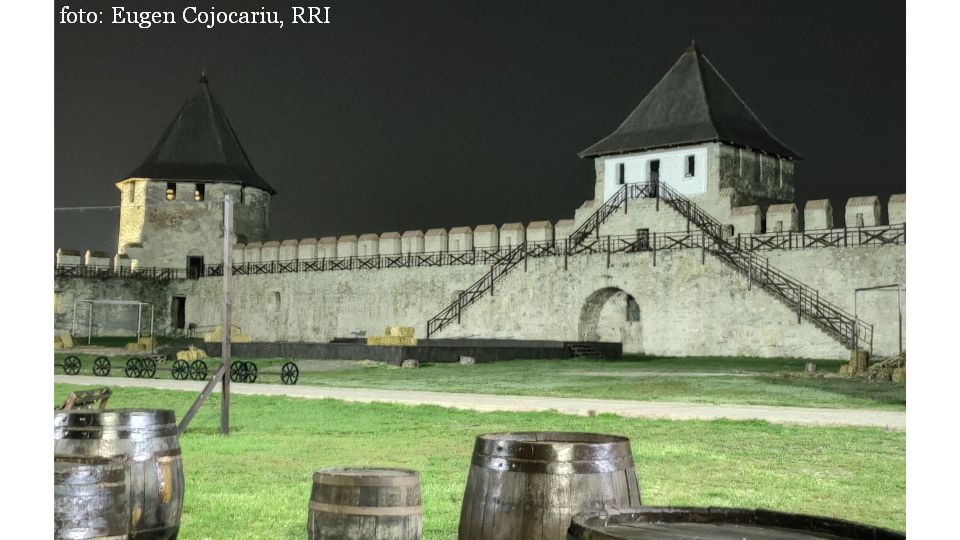
Tighina Fortress (renamed to Bender by the Turks), located on the banks of the Dniester in Ukraine, is a 15th-century Moldavian fortress from the reign of Stephen the Great, originally built of earth and wood, to defend the ford of the Dniester River from Tatars. The earthen citadel was probably round or semi-circular, with a defensive moat, and the bunk-type dwellings were made of wood, as archaeological excavations have shown. The fortress was rebuilt by the Moldavian ruler Petru Rareș and then conquered by the Turkish Sultan Suleiman the Magnificent in 1538, becoming the residence of the Turkish Raia (an administrative unit of the Ottoman Empire), and having its name changed to Bender (meaning river port or mooring place). During this period the citadel was rebuilt in stone and enlarged, and it was completed in 1541. The forress then had a tumultuous fate, coming under the control of the Russian Empire for a period, until 1812, when it began to lose its former strategic importance.
Cristina Rus, who is a tourist guide, told us more about Tighina Fortress and its history:
“Of course, there are many sources and the information actually differs depending on the origin of the guide who talks about it. If it is a guide from the left bank of the Dniester (Transnistria), they would prefer to say that it is a fortress that was built by Suleiman the Magnificent. I personally believe that this is one of the fortresses that were built by Stephen the Great, and we can defend this with information that confirms that Stephen the Great built on the right bank of the Dniester a defensive fortresses, to defend the borders in the eastern part of Moldavia. Among them are other fortresses, such as the Hotin fortress, Soroca, Tighina, but also the White Fortress. So, of all these 4 fortresses built by Stephen the Great on the right bank of the Dniester River for defense, today controlled by the authorities of the Republic of Moldova, only the Soroca fortress was left. Returning to the history of Tighina fortress, as I said, the first order to build the fortress came from Stephen the Great, although Stephen the Great’s grandfather, Alexander the Good, is the one who first mentions the town of Tighina. Then, Stephen the Great builds the fortress and Petru Rareș strengthens it with stone. Then, already in the 16th century, Suleiman the Magnificent conquers the fortress and with each conquest and each ruler that changes, it is absolutely normal for more changes to occur. So the way we see the fortress today, it does not look exactly like it did in the time of Stephen the Great. However, the fortress is included in the route “On the footsteps of Stephen the Great and the Holy”. The fortress was built of limestone with sand mixed with eggs and animal fur. In the old days, there were no other building materials, but these materials were strong and qualitative enough so the walls of the fortress have survived to this day. Some constructions on the territory of the fortress have not survived until today, because the fortress, until recently, had only a military purpose, and only in the 21st century it opened its doors for tourists.
Also, in recent years, a park was created at the entrance to the Citadel. The fortress has defense towers and is surrounded on three sides by a moat, which was empty and never filled with water, to prevent the enemies from easily entering the citadel. On the other side was the bank of the Dniester river. Being a fortress built on the bank of the river, it was always a very convenient place for trade. In the Middle Ages, merchants would come from the Black Sea on the Dniester River, go up and gather into a market organized especially for merchants from around the world. The local guides talk about the fact that there were also churches or places of religious worship for the different peoples connected with the trade in the space of the city. They speak of an Armenian church and a Greek church there. They also say that there would have been a mosque. So far there are no ruins to prove these things, so we have to take their word for it.”
Four fortresses were built by the ruler of Moldavia Stephan the Great as defense points along the Dniester river: Soroca, Tighina, Hotin and Cetatea Albă (the White Fortress), with an exit to the Black Sea. The history of these fortresses and their territories has been a turbulent in the more recent history, after 1812. Cristina Rus gave us some details about this period:
“The White Fortress and the Hotin Fortress are both fortresses built on the right bank of the Dniester River, by order of Stephen the Great. Today, these two cities are not on the territory of the Republic of Moldova and this happened after the Second World War, when the territories were divided. To better understand, I will go back a little in history. In 1812, our historical Moldavia was divided in two, using the Prut river as its natural border. This division of territories occured both after the Russo-Turkish War and after the war between the Ottoman Empire and the Romanian Principalities, when the Romanian Principalities lost the war, they had to give something to the Ottoman Empire. In the same year, 1812, the Ottoman Empire lost the war against the Russian Empire and so the Ottoman Empire had to give something to the Russians. …So the Russian Empire started investing in Bessarabia. … The Russian Empire needed a city to turn into a regional capital, so that it would be easier for them to control all the space. Thus, they decided to choose Chisinau, which was quite a small village until that moment. … First World War. Many European countries had their borders changed … And then, during that exceptional period of revolution, the Russians failed to act quickly enough. But they understood that they had lost a piece of land in which they had invested for the last 100 years. From Bessarabia, which had just entered the composition of the Soviet Union, they took the exit to the see, where we had the White Fortress, and Northern Bucovina, where we had the Hotin fortress. … And thus we lost control over these two fortresses, which today are in Ukraine.” (MI)