Cultural community centers in rural areas
Rural cultural community centers, re-activated across Romania
Ion Puican, 20.08.2022, 14:00
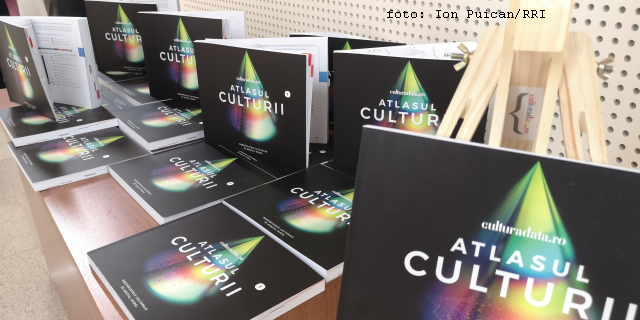
The Culture Atlas is the title of a volume that has been recently launched. The volume re-topicalizes a problem that needs to be solved as soon as possible. Specifically, it is about the reactivation of the cultural community centers in the rural regions across Romania, crucial elements of public infrastructure, education and culture. The volume seeks to assess the state of culture in the countrys rural area, looking into such aspects as the level of distribution of the infrastructure elements or the specificity of the cultural events, among many other issues. The National Institute for Cultural Research and Training affiliated to the Ministry of Culture is the initiator of the volume. The book was completed with the assistance of the National Statistics Institute. The Manager of the National Institute for Cultural Research and Training, Carmen Croitoru, was one of the guests in our program.
Carmen Croitoru:
“It is an initial endeavor, it is part of the program we started a couple of years back, actually we sought to count what happens in culture, and had it not been for the most precious help we got from the National Statistics Institute, we wouldnt even have dared to initiate such an undertaking, but we began to investigate and map those elements of cultural infrastructure, which are the first consumption barrier and also the first barrier of access to culture, in Romania.”
Carmen Croitoru went on to provide a couple of data on the making of the volume, on the prospective solutions to the problem, reminding everybody of the founder of Romanian sociology, Dimitrie Gusti (1880-1955).
“Allow me to give you a couple of technical pieces of info about the team of the Atlas: it is a research study with a two-year timeframe, when it was initiated and completed, those were years of data collection, of documentation, of statistics, they were field years, the field work that we did was just like in the time of Dimitrie Gusti, and we were very happy because of that, we could see for ourselves how that kind of sociological research could be reenacted. And yet, come to think of it, we were not necessarily brimming with joy, because all that was a giveaway for a rather worrying state of things. In Romania, we have several institutions based in the rural regions that ought to provide culture. As for what happens afterwards, youre about to see for yourselves in this book, since what the institutions are tasked with, that doesnt always come through. Basically, it is one of the widest-scope mapping initiatives were also trying to expand to other categories of institutions. Weve accomplished that also with a view to implementing a public policy proposal targeting the cultural community centers, because solutions still exist for that. There still are a great many NGOs that have already taken cultural intervention initiatives, all they need is a wee bit of support so that they can meet their task.”
The president of the National Statistics Institute, Tudorel Andrei, spoke about the perks of that kind of research, touching upon a couple of relevant statistical data:
“If you want the things you do to come along the proper way, you need to have a correct measurement, you need to have a reflection of reality, nay, you need to have a database that can be updated on a daily basis. Otherwise, were about to be going back to square one every time, we start building up and we dont know where we stand and were not going to know where we will eventually end either. And what can I say, as a statistician? What do we notice? That the population of Romania, beginning with the 1970s, in the rural areas, its proportion has decreased very little. The ratio we have is pretty much the same, accounting for 46 to 50%. Our neighbors ratio stands at less than 20%. So the proportion of our rural population is twofold. There is another truth revealed by the statistical figures, many children want to leave, but, sadly, the population we have in the rural regions is ageing. There are many counties, especially those around Bucharest, but also those around the big cities, where the population is over 48, maybe 50 years old, on average. So what is that particular cultural service the local community or the Romanian state must offer to an ageing population? Which is also a big problem: the cultural service must be tailored according to the age bracket of the people inhabiting a certain region. “
Another guest in our program, the manager of the National Romanian Peasant Museum, Virgil Nițulescu, shared his views on the issue.
“This kind of work, we should have had it for many years now. Tis a pity it is only now that we have such a data base at our fingertips, and such an analysis, cause thats what the National Institute for Cultural Research and Training does: it carries surveys and paves the way for the launch of various public policies. The Institute has offered an exhaustive survey, I daresay, or a very well-structured one, at any rate, a thoroughgoing analysis on the state of the cultural community centers in the rural regions. So this is the point we need to start from, in a bid to see what we next need to do, because the current situation is rampant on a national scale. It is only in a limited number of communities countrywide where the cultural centers are in a very good condition, having a remarkable activity, they are, I daresay, thriving, yet the overwhelming majority of Romanias rural settlements are deprived of a functional cultural infrastructure and we should not forget that some of our fellow citizens live there. And the Romanian state, and, apart from the Romanian state, the public local authorities, should offer equal opportunities to all Romanian citizens, irrespective of the place people live in.”
The Manager of the National Library of Romania, Adrian Cioroianu, highlighted the two main causes of the current situation. Dr Cioroianu revisited sociologist Dimitrie Gustis contribution, yet he presented it as a lesson for our times.
“There are two things I should like to remind you of: in history, as a rule, any given effect has more than one cause. What we have, as we speak, concerning this disastrous situation of the cultural involution in the rural areas, is the outcome of several causes. On one hand, the causes are political, or rather, what we have is the excessive politicization of certain things that should not be politicized, such as education, culture, healthcare or safety. Ageing is another cause of all that. This is a real cause scientists or statisticians speak about, yet not only do we not do anything about it, we do not even discuss what measures could be taken against it. We speak about Gusti and about that auspicious year 1921, when Romanias condition was critical in certain respects, yet it was thriving as regards the countrys birthrate. Honestly, Europe is ageing on a large scale, perhaps that is the main problem of the modern world. And yet, does not the very type of society we live in changes? The solution for that, from my point of view is not the return to Gusti. Gusti, for the 1920s, was a visionary, but we need to identify todays visionaries for tomorrows world.”
(EN)