Felix Aftene ‘Diary’ at Art Safari New Museum
The exhibition ‘Felix Aftene. Diary”’ is on view at the Contemporary Pavilion of the Art Safari New Museum, the new exhibition space in the heart of Bucharest
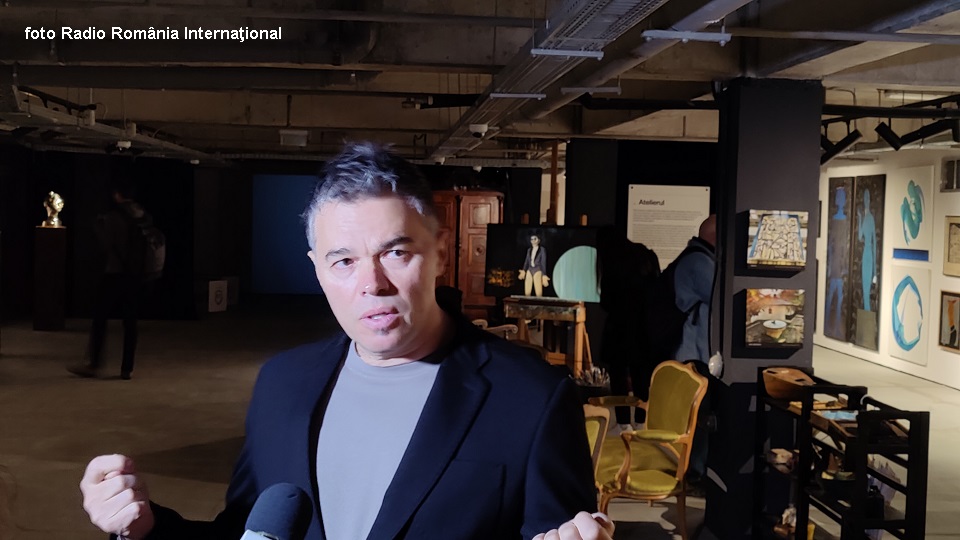
Eugen Cojocariu and Ion Puican, 27.06.2026, 14:00
The exhibition ‘Felix Aftene. Diary’ is on view at the Contemporary Pavilion of the Art Safari New Museum, the new exhibition space in the heart of the capital, located at 13 Amzei Square. The exhibition is open during the first season of 2026, through July 19. The artist Felix Aftene, born in 1972 in Vaslui (eastern Romania), settled in Iași, where he graduated in 1996 as valedictorian from the “George Enescu” Academy of Arts, Department of Mural Painting. In 2016, he earned his Ph.D. in visual arts from the same university. Felix Aftene works across a wide range of media, painting, monumental painting, sculpture, and new media, exploring themes of the human condition, memory, and identity, often through symbolic reinterpretations of the self-portrait. Throughout his career, he has exhibited in Romania and in numerous countries across Europe, North America, and Israel, and has been honored, among other distinctions, with the National Prize for Painting from the Romanian Artists’ Union (UAP) in 2016. The exhibition ‘Diary’ brings together thirty years of artistic creation, from the artist’s earliest works, created at the age of 16 and during his student years, to his current visions. Curated by Maria Bilașevschi, the works are arranged in an evolutionary order, exploring memory, family, society, and the transformations taking place within it.
RRI’s Eugen Cojocariu spoke with the exhibition’s curator, Maria Bilașevschi: “Felix Aftene ‘Diary’, an exhibition that might seem like a retrospective, but which is much more than that. It is a confession spanning a 30-year career, a confession that also includes those objects you keep at home, in your studio, in your private space, objects you rarely want to put on display. It’s an exhibition that, like an X-ray, reveals everything that goes on inside the creative laboratory and within Felix Aftene’s personality.”
How is the exhibition organized? Maria Bilașevschi tells us everything about what visitors can see at the Contemporary Pavilion at Art Safari New Museum: “The exhibition is divided into three sections. When we talk about divisions, we think of clear boundaries. This time, the boundaries are temporal, so to speak. Because we’re entering a gallery where sculptures and paintings are displayed behind a grille, designed to make you curious to explore, to delve into the mysteries of his painting as it is captured there. And then the memories begin, memories of childhood, memories of places, of loved ones, of all those objects he received or acquired during his study trips, alongside pages from his diary. It’s not actually a diary, as we might imagine it, in sheets of paper or manuscripts, but rather a journal in colors. Over 100 worn-down pencils, kept in a small box. A large vase full of paintbrushes. Every object he has touched or that has meant something to him is documented and becomes part of the everyday inventory of Felix Aftene’s artistic life. And on the other hand, we have a conclusion, I believe, of memories, through two video projections, two films made by Felix Aftene: one at his grandparents’ house, in the Vaslui area, so that we can see the objects on display. We’ll wonder what a dining table is doing there, what a pair of scissors is doing there, or what his grandfather’s boots are doing there. They all come from that household, which is, in a way, the axis mundi of the beginning of his artistic career. His first drawings, the first portraits he made for his family at the age of 16. Diplomas that show his promising career even before the Revolution. And, above all, I believe we must pause to carefully consider these series of works which, over the past ten years, have revealed a different way of viewing Felix Aftene in relation to the monumental public art created in the city of Iași.”
Eugen Cojocariu also spoke with artist Felix Aftene about this ‘Diary’ right at the Art Safari exhibition: “Welcome to my studio! … It’s a project in which I set out to create a very honest self-portrait, in which I essentially lay my studio bare, like an open book with all its pages spread out. I show why the artist is drawn to objects, to fragments of everyday life, essentially. There are many objects that I analyze; I gather them wherever I go and later try to find solutions in my compositions, which I create on canvas. I’m presenting an artistic journey in this studio. This studio of mine, which isn’t necessarily a workspace, is a living organism that invites you to maybe discover your own story, that of the viewer.”
The artist presents the exhibition ‘diary’ from his perspective: “The exhibition, which is, in fact, a large-scale installation, has three chapters. Conceptually speaking, the first chapter is dedicated to sculpture. I’m exhibiting bronze works, patinated and polished, on oxidized metal supports. The second chapter is dedicated to memories; it’s a space where I’ve gathered objects from my childhood, and there I’m also presenting a video I made at my grandparents’ house. It’s called “Memory of Space II.” And then there’s the studio, which is a recreation of my own studio, my creative space in Iași. The central focal point is the easel, and surrounding it are works from every period of my career, from my graduation projects to the present day. …”
Finally, the exhibition’s curator, Maria Bilașevschi, gives us more details about her collaboration with the artist Felix Aftene: “I believe my collaboration with Felix Aftene will soon mark over 20 years. The fact that we live in the same city, hold similar positions, and meet very often at public events means I know him very well indeed. I think the friendship that binds us is why this exhibition came together so naturally, featuring everything we both felt would be useful to visitors seeking a different perspective on contemporary art.” (LS)