The New Year that Never Came
The New Year that Never Came, written and directed by Bogdan Mureșanu
Corina Sabău, 16.11.2024, 13:20
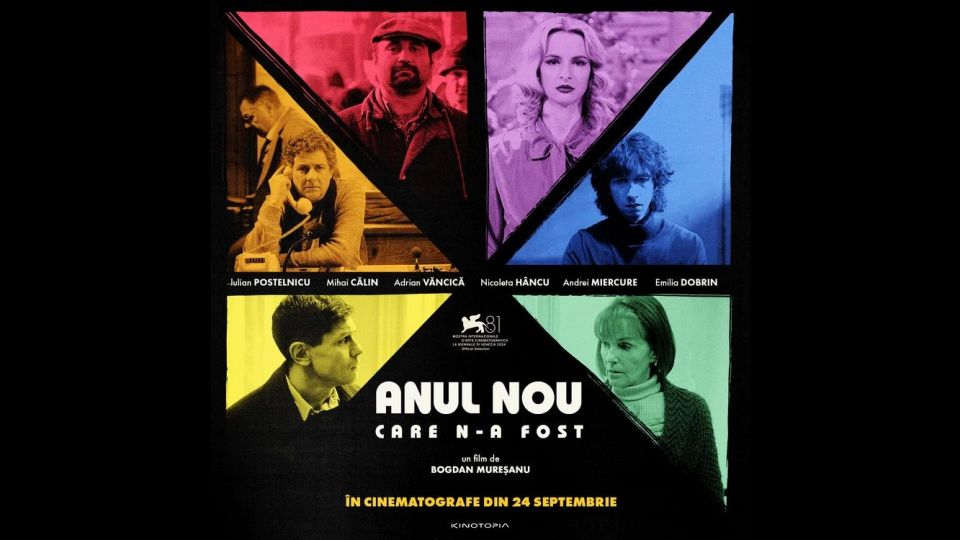
The New Year that Never Came, written and directed by Bogdan Mureșanu, was proposed on the list of films that will be considered for nomination at the European Film Academy awards, an event that celebrates the most important achievements of European cinema. The New Year that Never Came became the first Romanian debut feature film to win four awards at the Venice International Film Festival (including the Best Film in the Orizzonti section, the FIPRESCI Award for Best Film, offered by the jury of the International Federation of Film Critics, Bisato d’Oro 2024 Award for Best Screenplay), and took first place at the box office a few weeks after its release in Romania, overtaking major titles.
After the world premiere at the Venice International Film Festival, the film was shown in Italy and at other events. Recently, the North American premiere of the film took place, after which The New Year that Never Came found itself in the selection of the Zurich International Film Festival, and was also screened in Germany. The fiction feature The New Year that Never Came completes the story of the short film The Christmas Present, one of the most appreciated Romanian titles, with 200 international selections and 72 awards. Winner of the Best European Short Film Award (at the European Film Academy Awards gala, 2019), the Gopo Award for Best Short Film (2019), and the Best Short Film Trophies at Berlin, Clermont-Ferrand, Cottbus, and TIFF , the short film directed and written by Bogdan Mureșanu stars Adrian Văncică, Ioana Flora and Luca Toma. The action of the film takes place on the evening of December 20, 1989, shortly before the fall of the Ceausescu dictatorship, when Marius, a 9-year-old child, reveals to his parents the contents of the letter sent to Grandfather Frost, and they realize that it includes a message very dangerous for everyone’s safety. Bogdan Mureșanu tells us why he chose to continue The Christmas Present, integrating it into the multistory narrative of The New Year that Never Came.
“I always had the impression that that short film was just a fragment of a more complex story. Ever since I filmed with Adrian Văncică, that means six years ago, it seemed to both of us that the story could be part of a longer narrative, and I, anyway, had a lot of stories in mind. And this project, the The New Year that Never Came, did not start with the The Christmas Present, but with the story of the demolition of the Uranus District. I was planning a feature film about this demolition initiated by Nicolae Ceaușescu in the ’80s, but I kept postponing this project. I postponed it because I didn’t know how to film it, because, obviously, Bucharest has changed a lot since then, and it was very hard to find suitable locations. In relation to The Christmas Present, I filmed that short story more as a test, and I was surprised by the success of the short, because in my mind it was always just a fragment. After I also wrote the film The Christmas Present, it took me some time to reach this type of multistory narrative, in which the characters meet, but without the meeting between them having consequences. The characters, as one critic who wrote about the film said, are like islands that would form an archipelago. I also thought about the fact that, if I keep debuting so late in the feature film, I should do it with something that is more complicated, and the two years of the pandemic gave me the necessary time to complicate things even more. For almost a year it was a construction site in my mind, I wrote two completely different versions of the script, there were actually two films, and in the end I opted for this one, which is maybe written in a slightly American way, but which, anyway, seems to me quite a contemporary way of telling stories, considering the success with the public and the critics.”
One of the main roles in The New Year that Never Came, that of Margareta Dincă, is played by the actress Emilia Dobrin, performer of over 30 roles in Romanian films and series, winner of the UNITER award for the best actress. Margareta Dincă’s house, located in the Uranus district of Bucharest, is to be demolished in order to build a new block of flats. It is actually one of the last remaining houses not demolished, and Margareta has the misfortune of having to leave her home very shortly before the Revolution. Emilia Dobrin spoke to RRI about the collaboration with the director Bogdan Mureșanu and about her role in The New Year that Never Came.
“The meeting with the director Bogdan Mureșan was extraordinary, in an instant what was supposed to be was connected between us, something very beautiful, and that’s how I ended up playing this emotional character in the film. For me, that period that the film discusses was and remains painful, very painful. I can say that both my brother and I were very marked by the injustices we experienced during communism. We came from Vălenii de Munte, we were not from Bucharest, and because of our unhealthy origins, – as they said at the time – our scholarships were suspended and our places in the dormitory were taken away. And our parents had no way to support us, those were very hard times. My brother and I were also very marked by the injustice that was done to us, and so we remained. I don’t want to make a boast out of this, but I didn’t want to be an ‘utecist’, that is, to join the Communist Youth Union, nor to be part of that yes-man system, as we called those in the party at that time.”
Adrian Văncică, Iulian Postelnicu, Mihai Călin, Nicoleta Hâncu, Andrei Miercure, Manuela Hărăbor, Ioana Flora and Ada Galeș complete the cast of the film The New Year that Never Came.